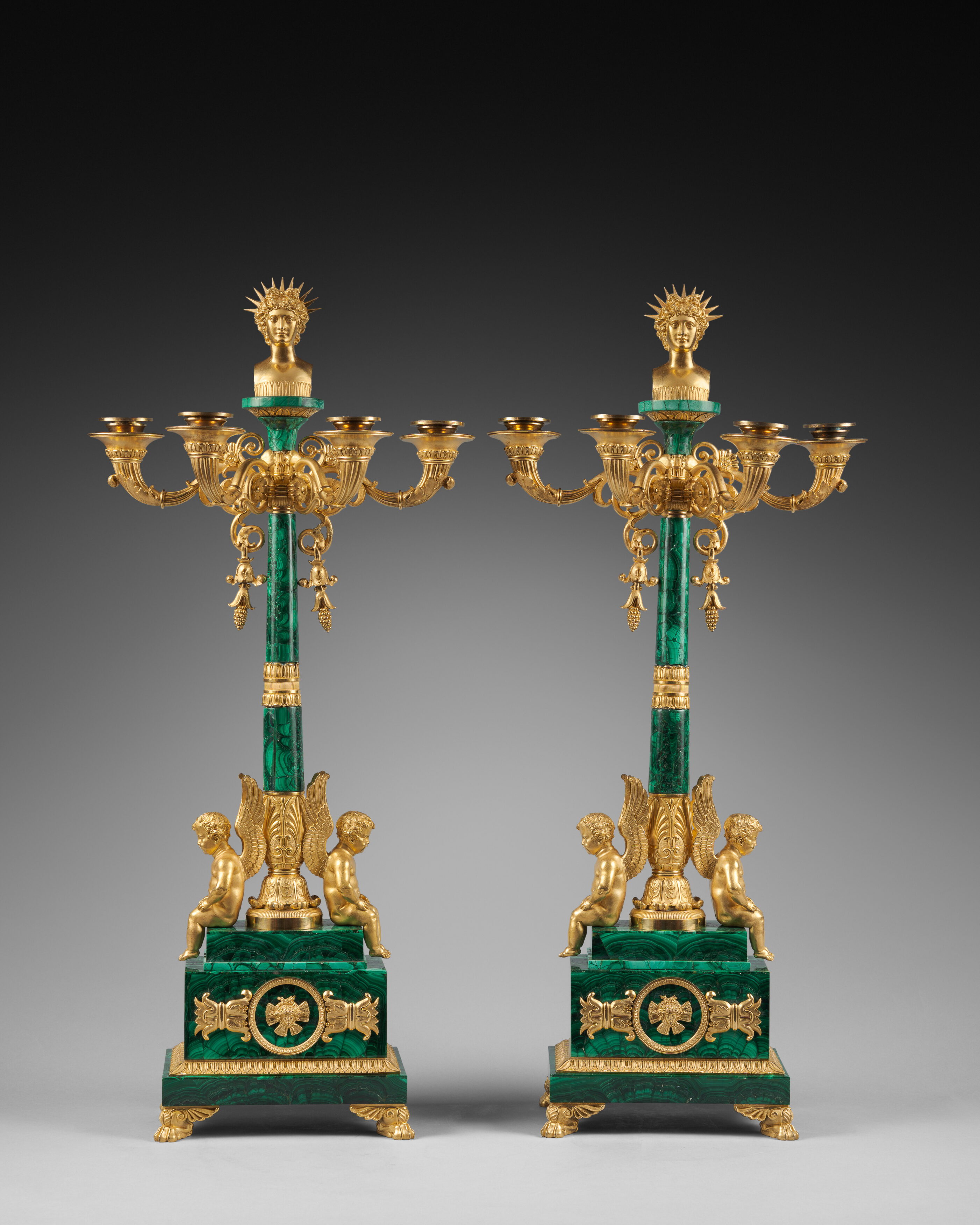
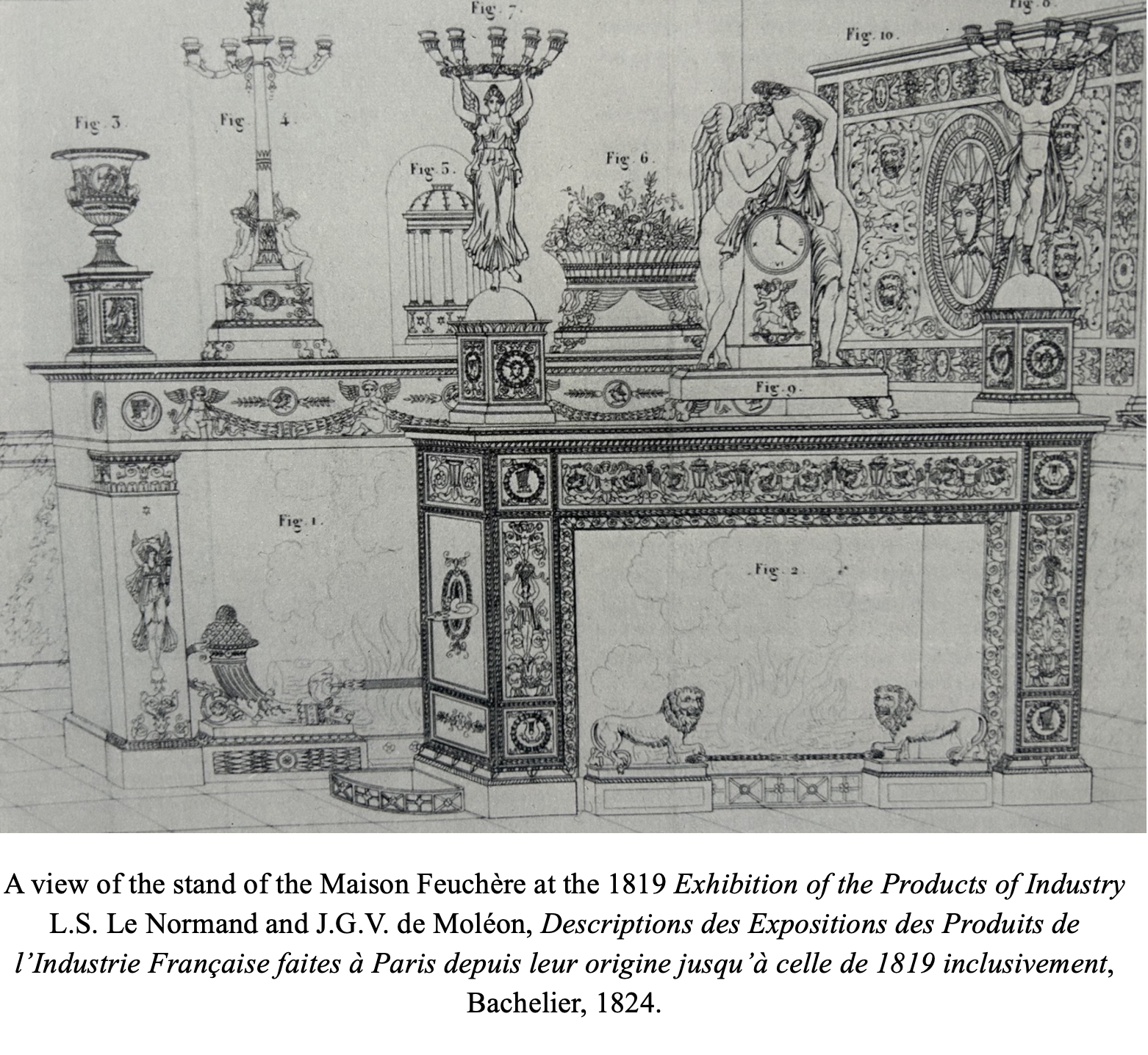
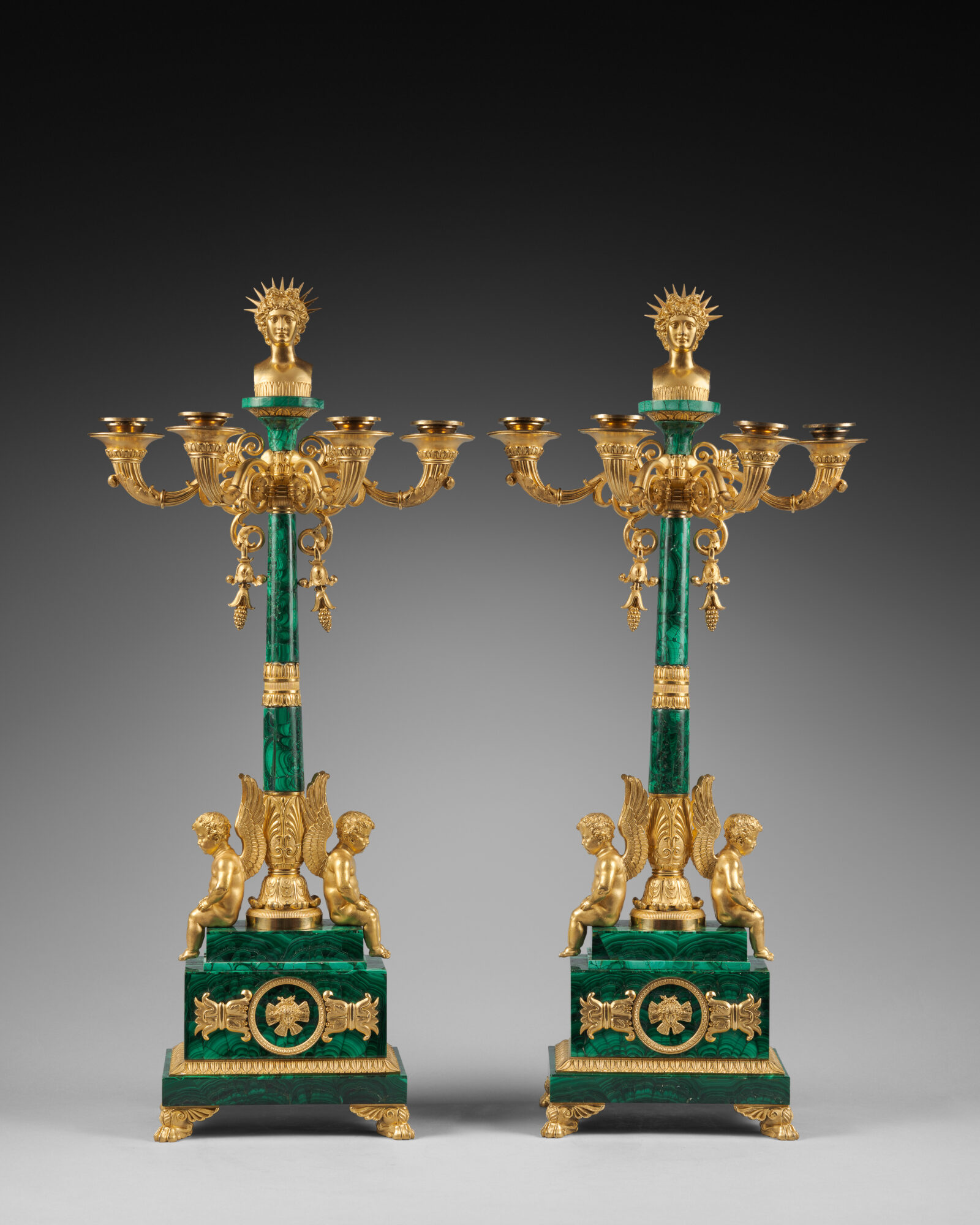
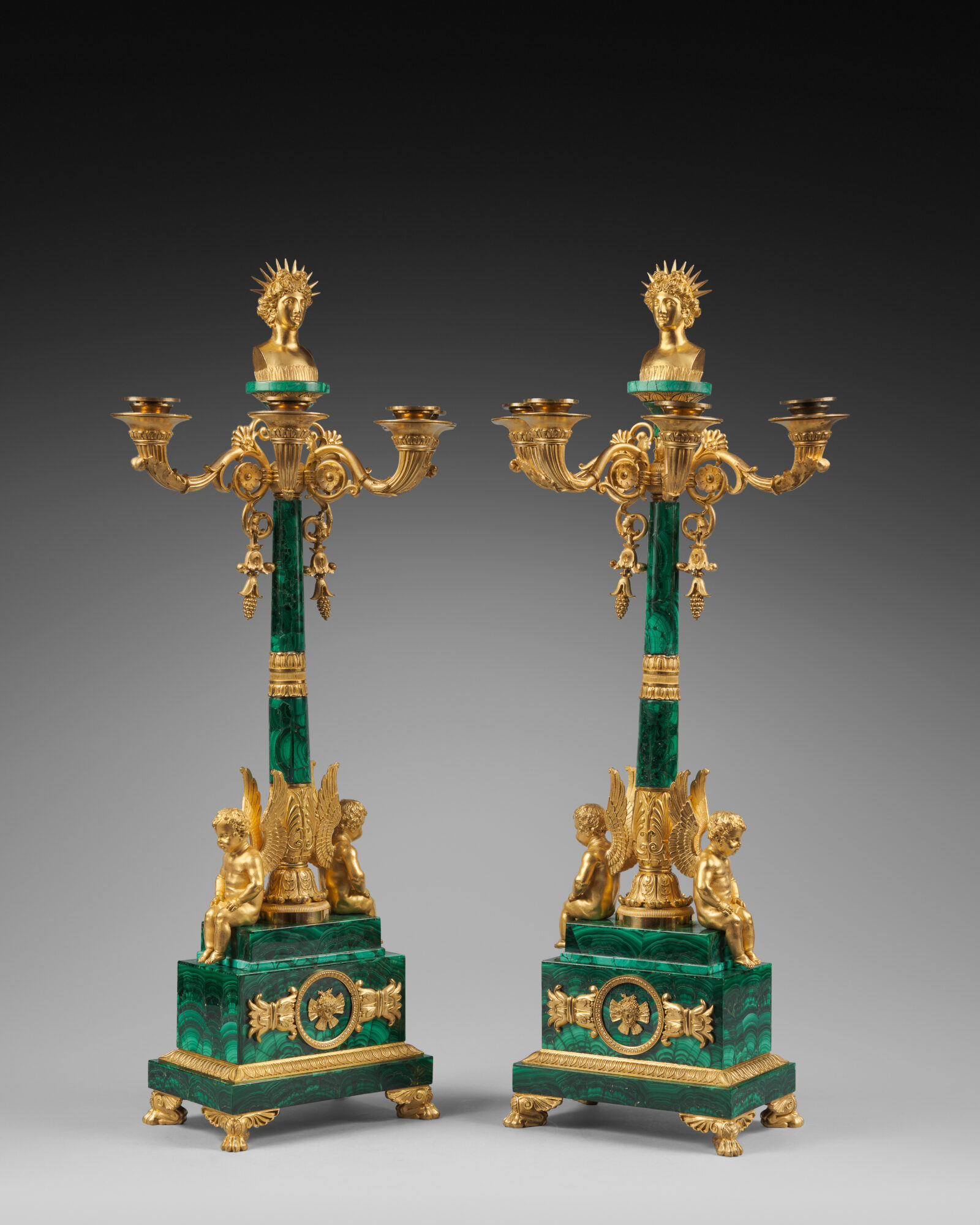
– Probably exhibited in 1819 at the Exposition des Produits de l’Industrie Française.
– Sold Sotheby’s, Monaco, March 4, 1989, lot 235.
Bibliography :
– S. Le Normand and J.G.V. de Moléon, Descriptions des Expositions des Produits de l’Industrie Française faites à Paris depuis leur origine jusqu’à celle de 1819 inclusivement, Bachelier, 1824.
– Exhibition Catalogue, “Dessins Les Feuchère, Dynastie de fondeurs 1785-1840“, Galerie André Lemaire, Paris, June 1998.
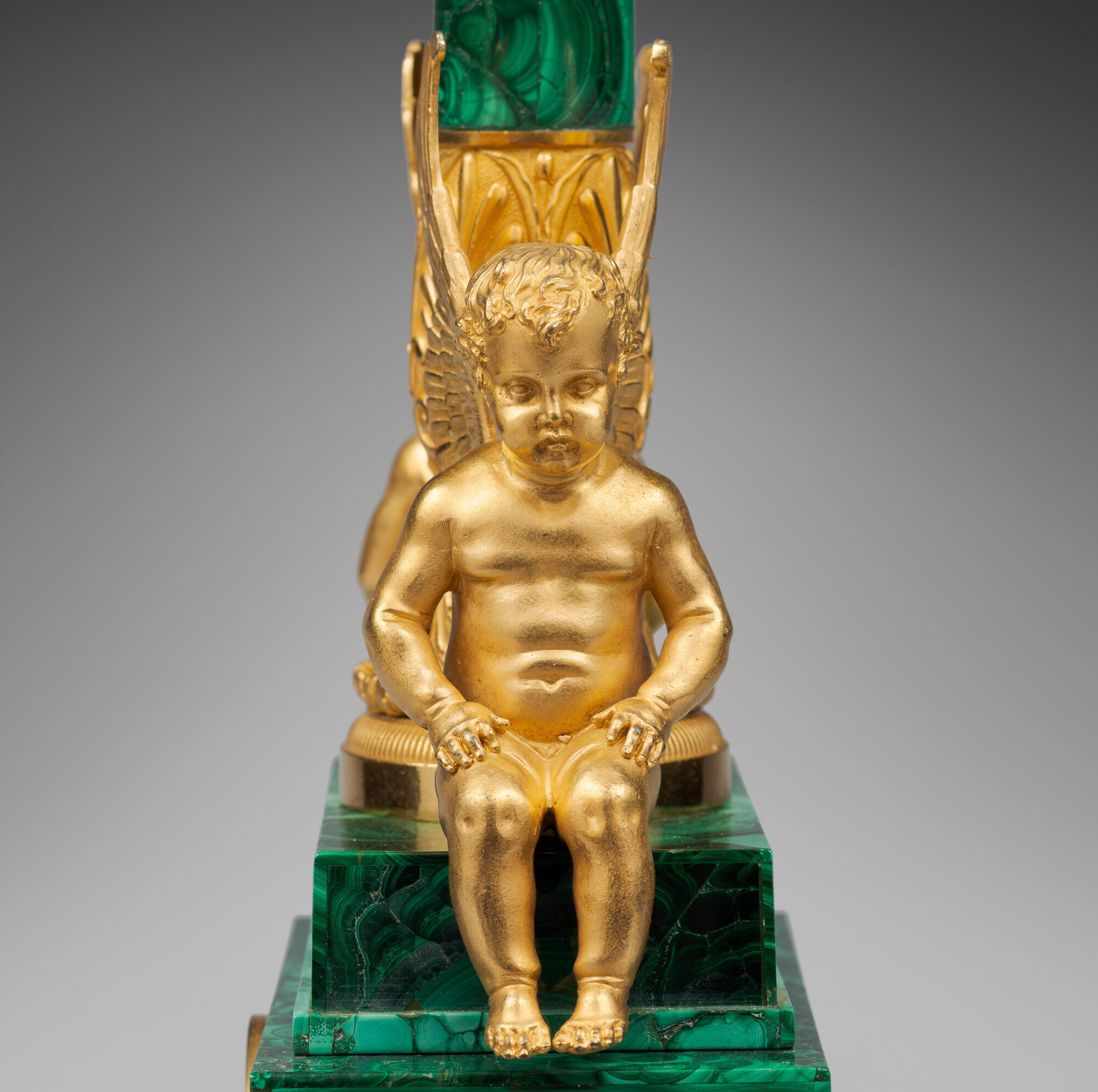
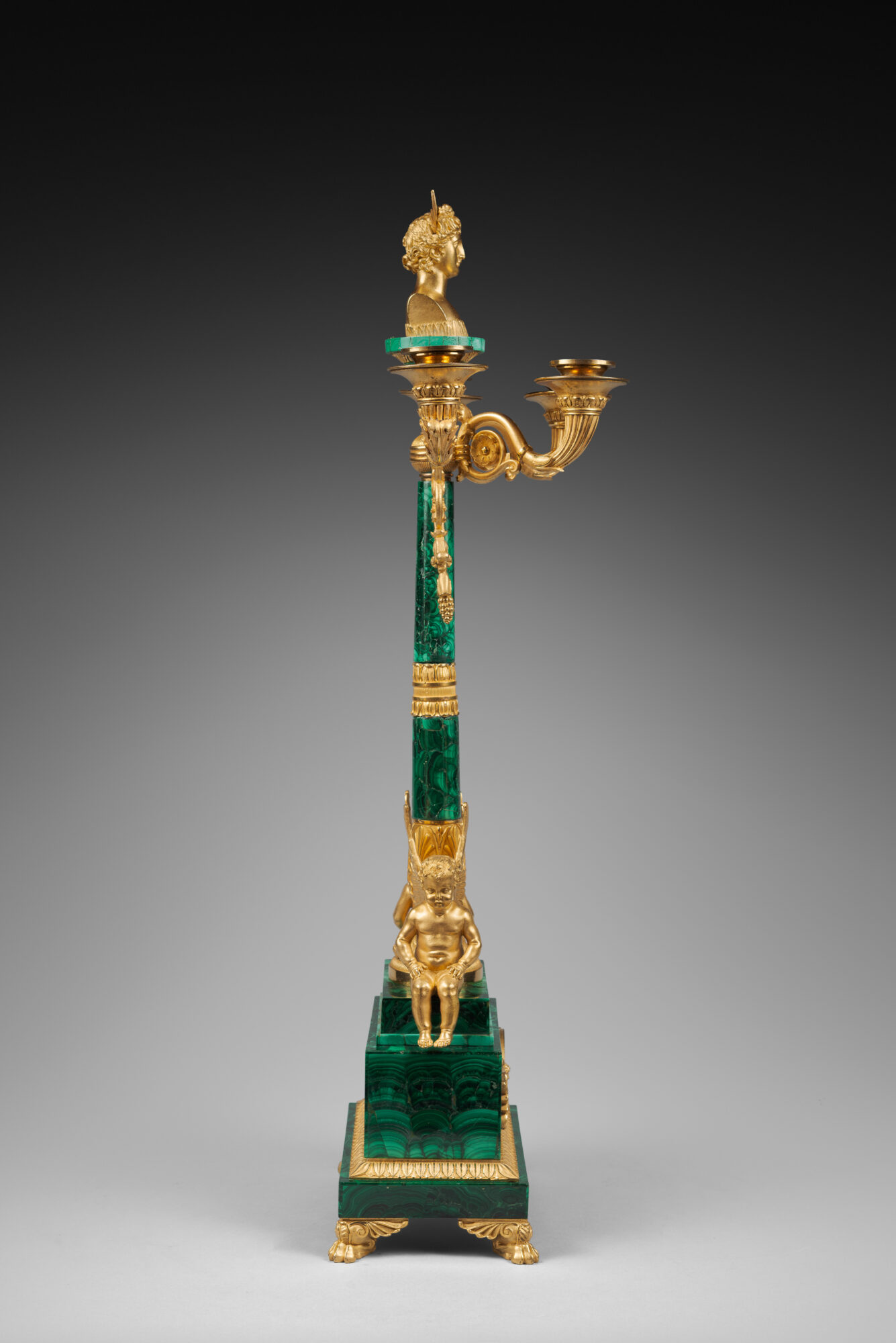
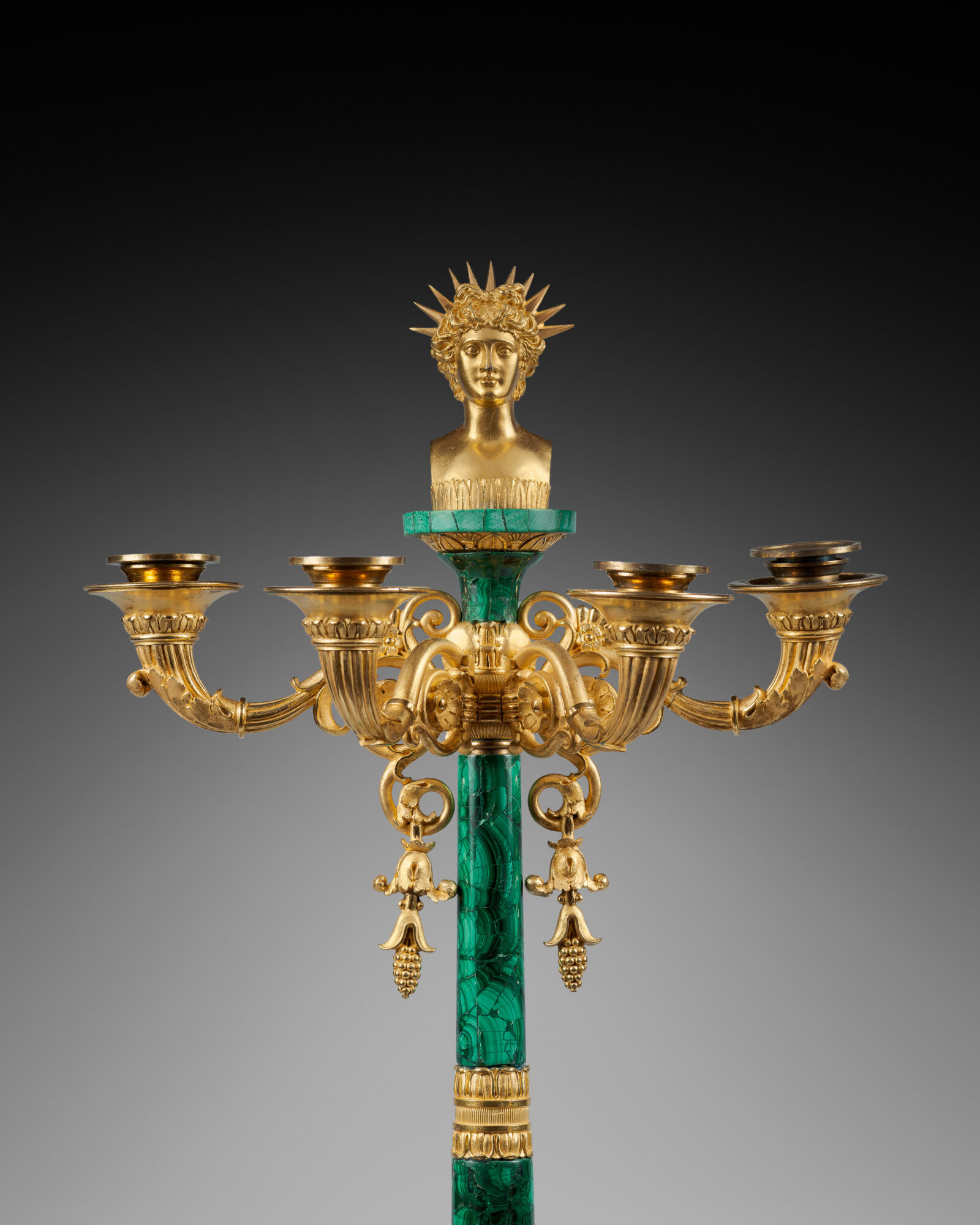
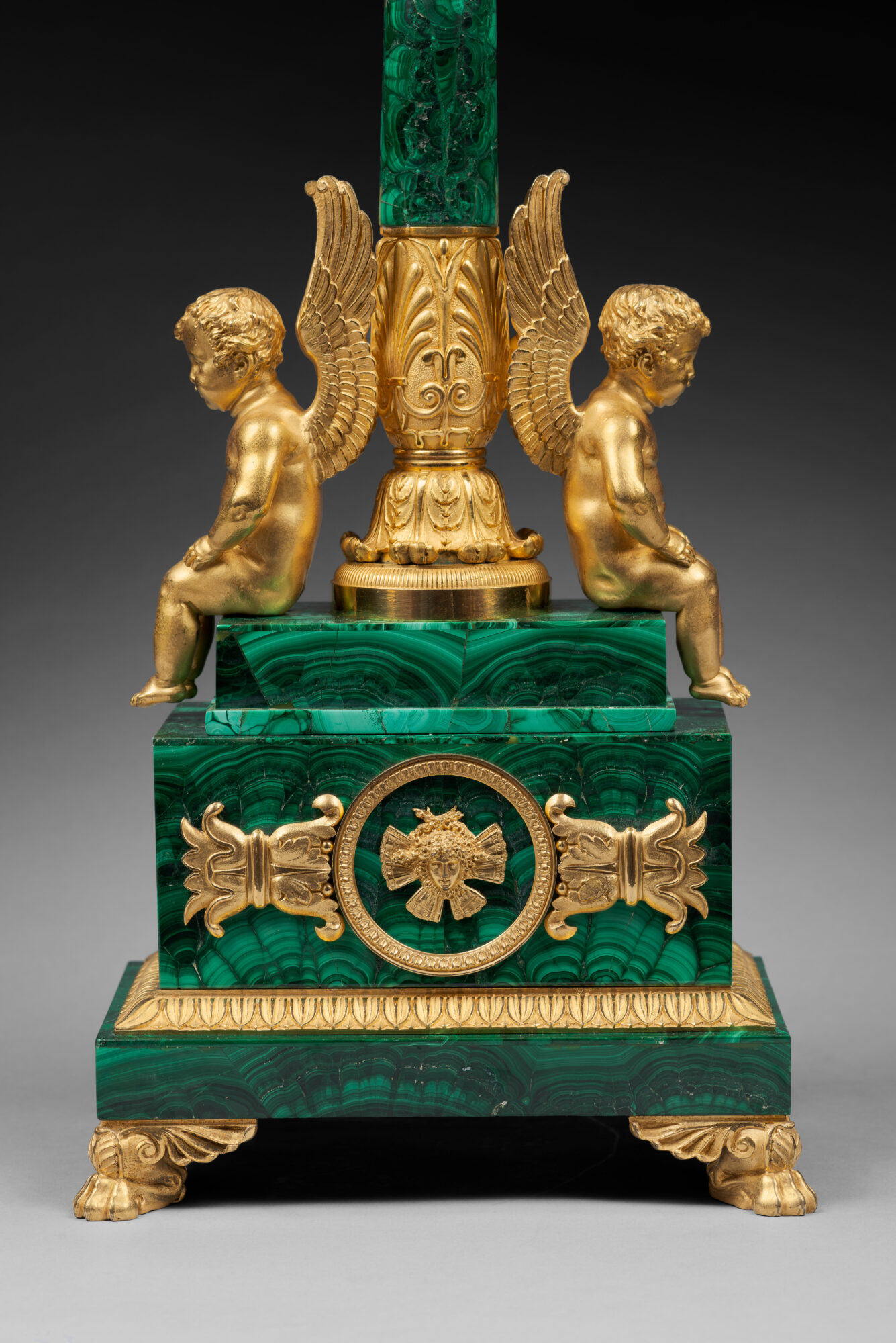
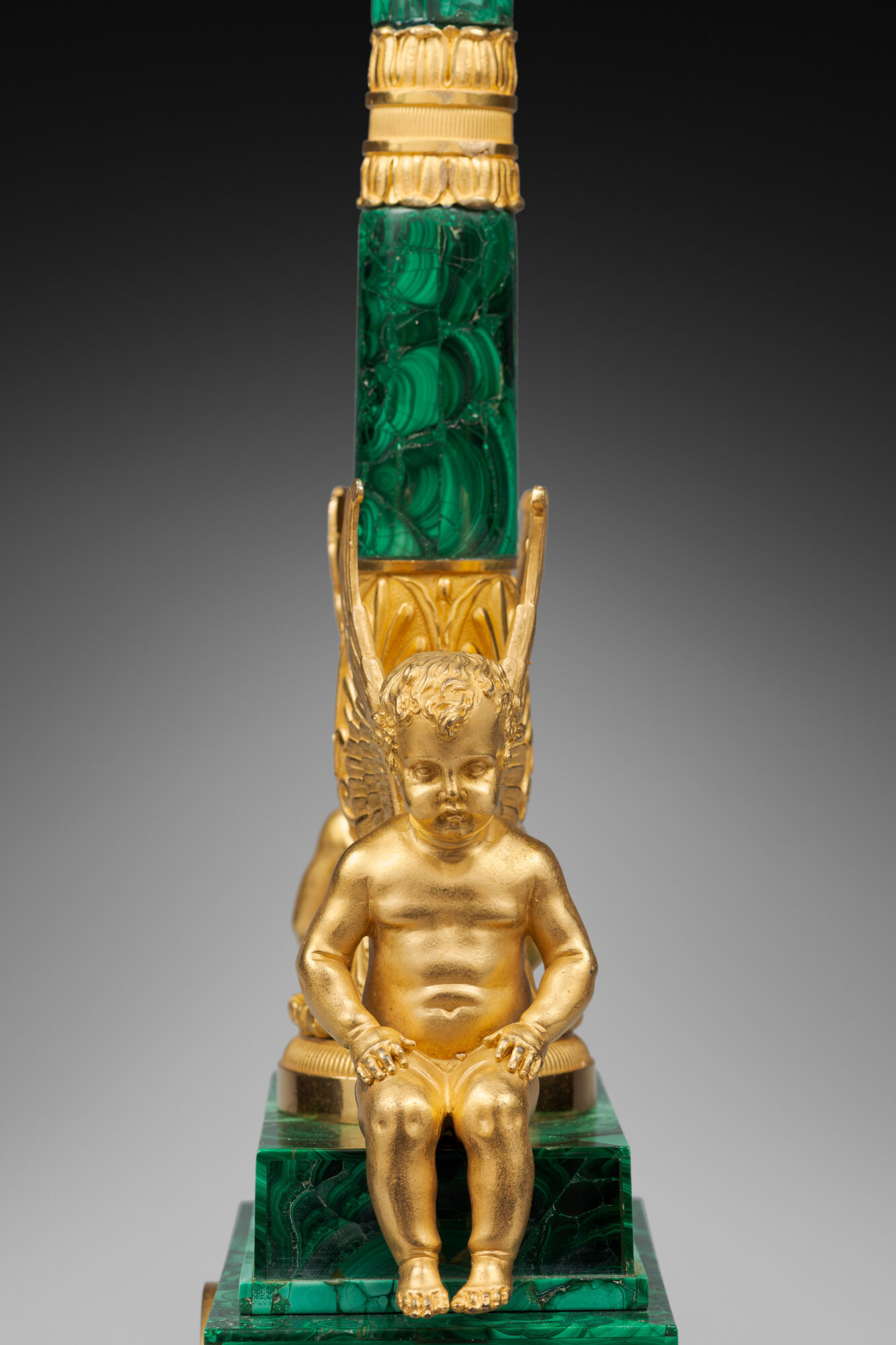
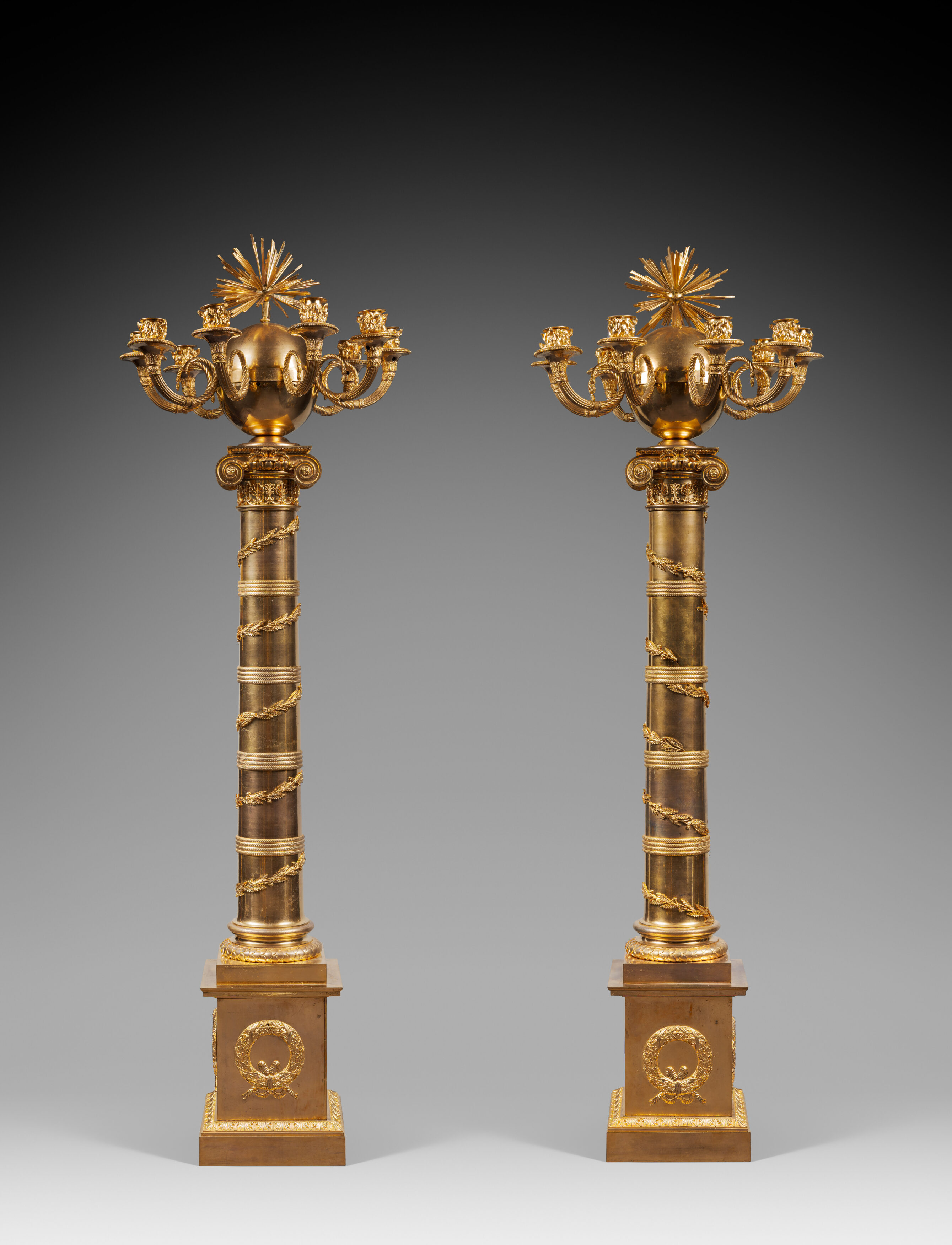
Made of finely chased matte and burnished gilt bronze and malachite veneering, the candelabra feature a column-form stem adorned with a band decorated with deeply incised leaves, resting on a base with large palm leaves alternating with flower blossoms that emerge from an acanthus leaf bouquet, to which is fixed the bouquet of four curved light arms in the form of reeds adorned with acanthus leaves and further embellished with falling garlands of flowers that terminate in seed finials. The projecting summit of the stem is adorned with a classical bust representing a man with a radiating crown, probably representing the god Apollo. The column is supported by a rectangular entablature on which are seated two winged children, which itself is supported on a quadrangular base with molding decorated with water and applied motifs comprising a medallion flanked by flower blossoms and centered by a male mask. The candelabra are raised on four lions’ paw feet flanked by palm leaves.
During the Restoration, after the fall of the Empire and Napoleon’s exile, the new government desired to promote French art, in part by holding exhibitions that were meant to highlight the skills of the kingdom’s artists, artisans, and manufacturers. Thus, in 1819, the Exhibition of the Products of French Industry (Exposition des Produits de l’Industrie française) was inaugurated in the Louvre. In the specific field of the decorative arts, one material was particularly prized: this was malachite, a semi-precious stone that came from Russian quarries that were exclusively exploited by the powerful Demidoff family. Malachite thus became a highly prized material for important Parisian bronze casters, who used it to produce luxurious and often unique bronze furnishings. At the 1819 Exhibition Pierre-François and Lucien-François Feuchère chose to showcase this stone, to impress viewers. They were clearly successful, for they were awarded a silver medal in the category of “bronze ornaments“.
Their stand was succinctly described in the Jury’s Report as offering “fourmantle garnitures of great opulence and in the best taste, candelabra, chandeliers, and ornaments for consoles and mantle decorations” (see M.L. Costaz, Rapport du Jury Central sur les produits de l’Industrie Française, Paris, Imprimerie Royale, 1819, p. 215). Five years later, in 1824, Le Normand and Moléon published a selection of pieces from the 1819 Exhibition, giving a detailed description of the pieces exhibited by the Feuchères. These descriptions were accompanied by an invaluable engraving in which the present candelabra appears as figure 4, described as “Candelabra with a tall stem, at the base of which are winged children” (see L.S. Le Normand and J.G.V. de Moléon, Descriptions des Expositions des Produits de l’Industrie Française faites à Paris depuis leur origine jusqu’à celle de 1819 inclusivement, Bachelier, 1824, p. 227, plate 228, fig.4). The engraving is also reproduced in H. Ottomeyer and P. Pröschel, Vergoldete Bronzen, Die Bronzearbeiten des Spätbarock und Klassizismus, Band II, Munich, 1986, p. 669, fig.4). Ons should note that there are slight differences between the design of the candelabra in the engraving and the present pair; thus we cannot affirm that they were shown at the 1819 exhibition. Nevertheless, to our knowledge no other candelabra of this type are known to exist.
The Feuchère workshop, founded by the chaser-gilder Pierre-François Feuchère (1737-1824) was active as early as the reign of Louis XVI. During the first two decades of the 19th century it became the principle rival of the Parisian bronziers Pierre-Philippe Thomire, Claude Galle and André-Antoine Ravrio. Lucien-François, the son of Pierre-François (active 1780-1828), a master chaser, assisted his father and helped develop the workshop during the Empire period, creating remarkable pieces for a wealthy clientele in France and abroad, including influential German and Austrian aristocrats.