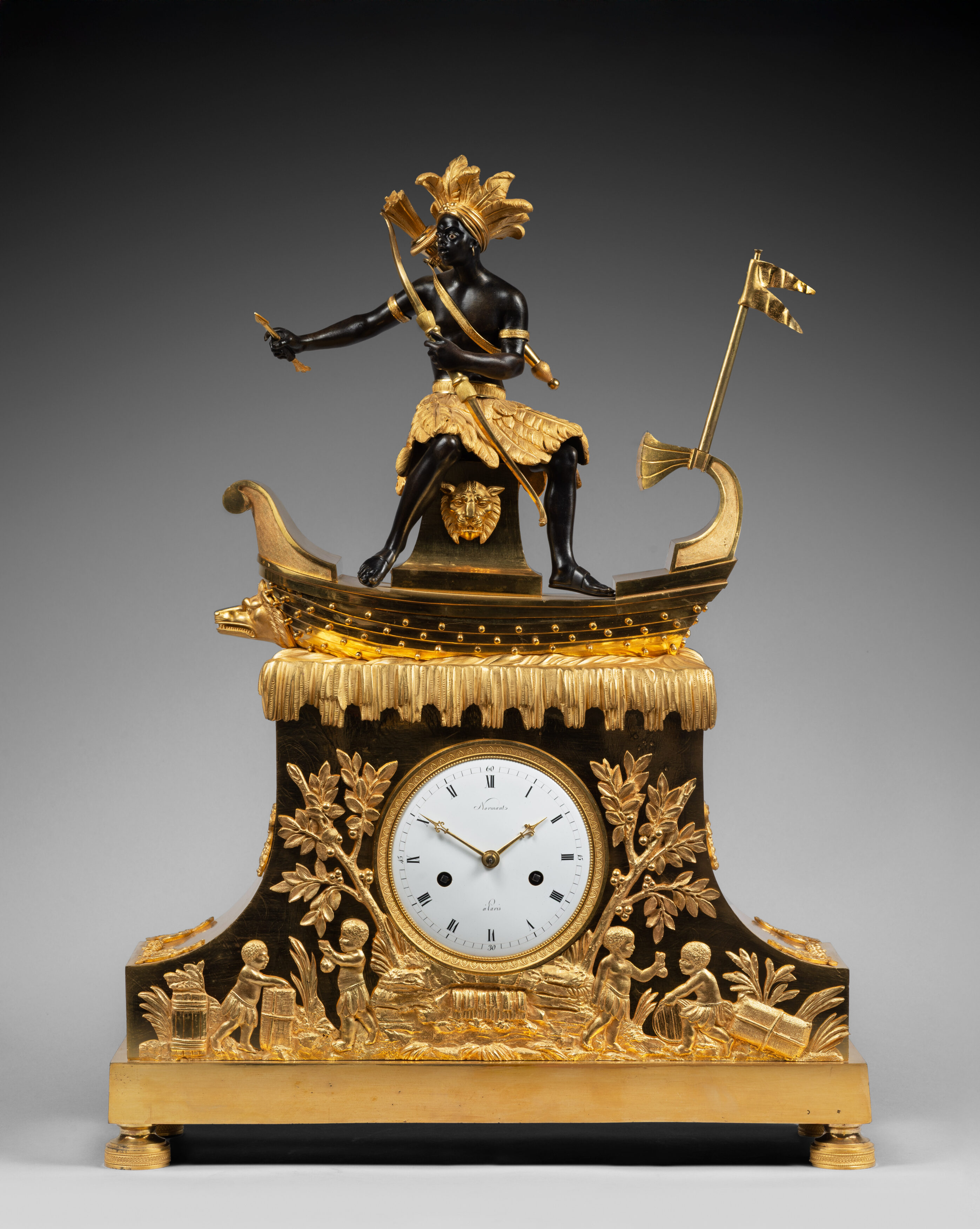
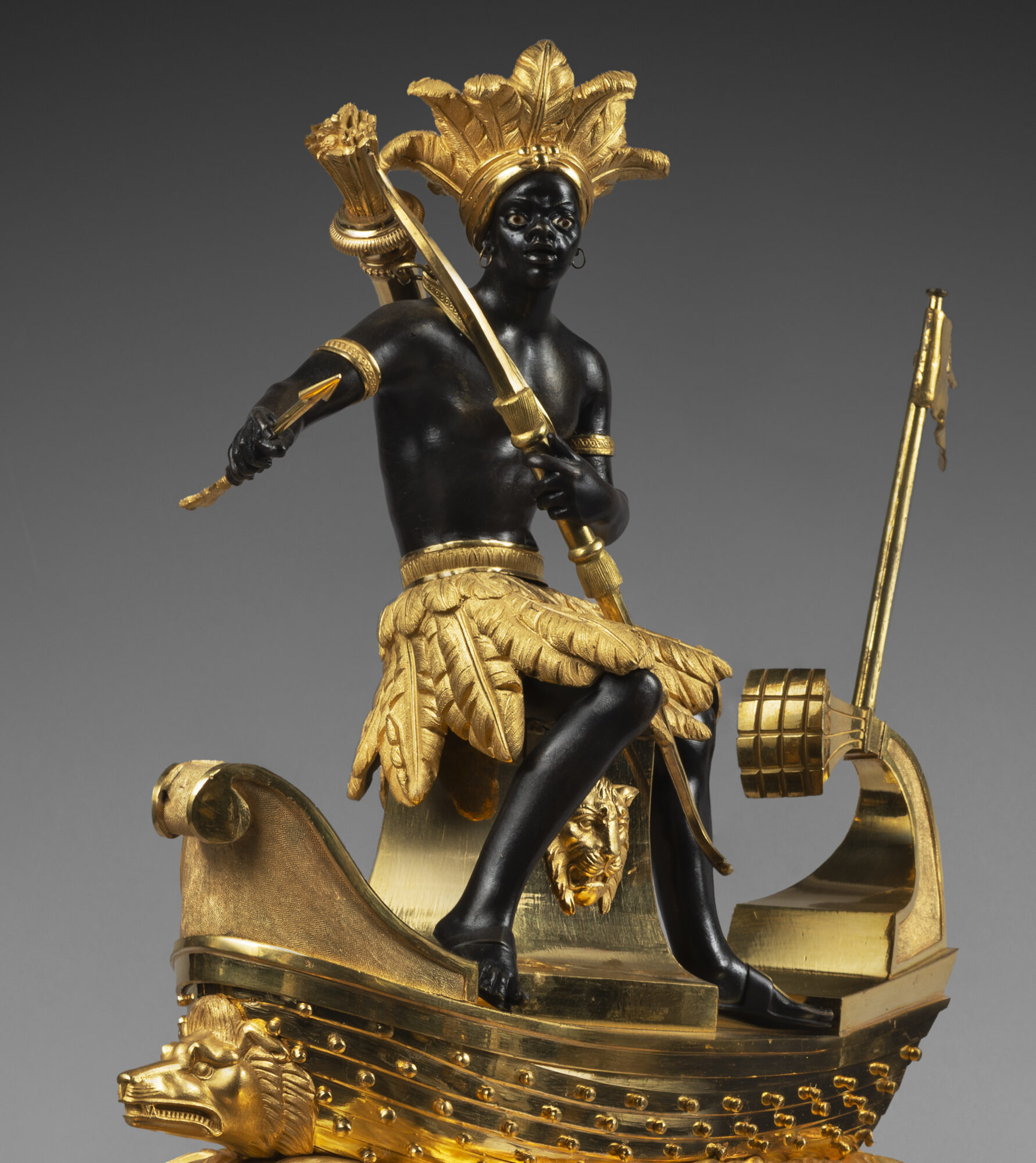
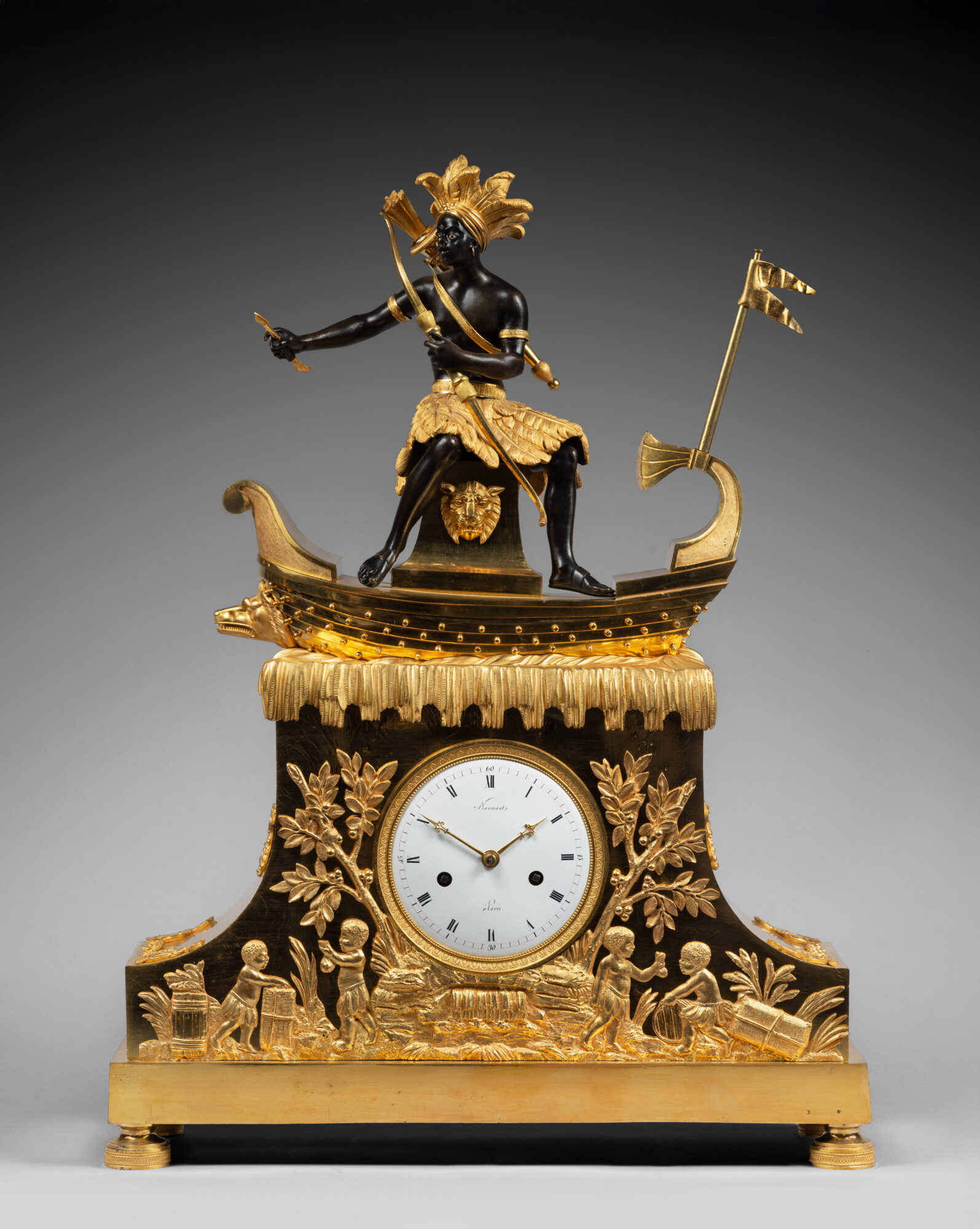
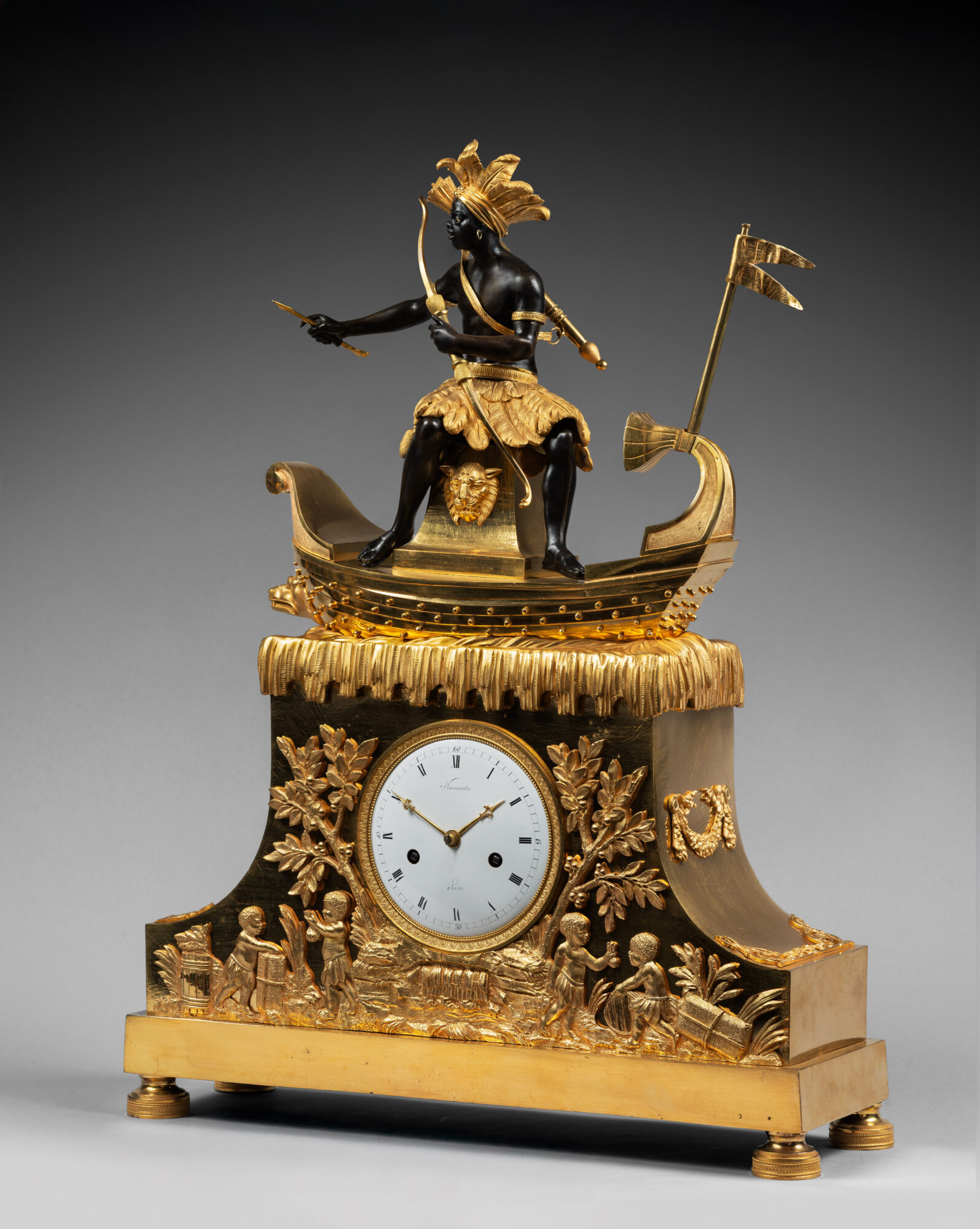
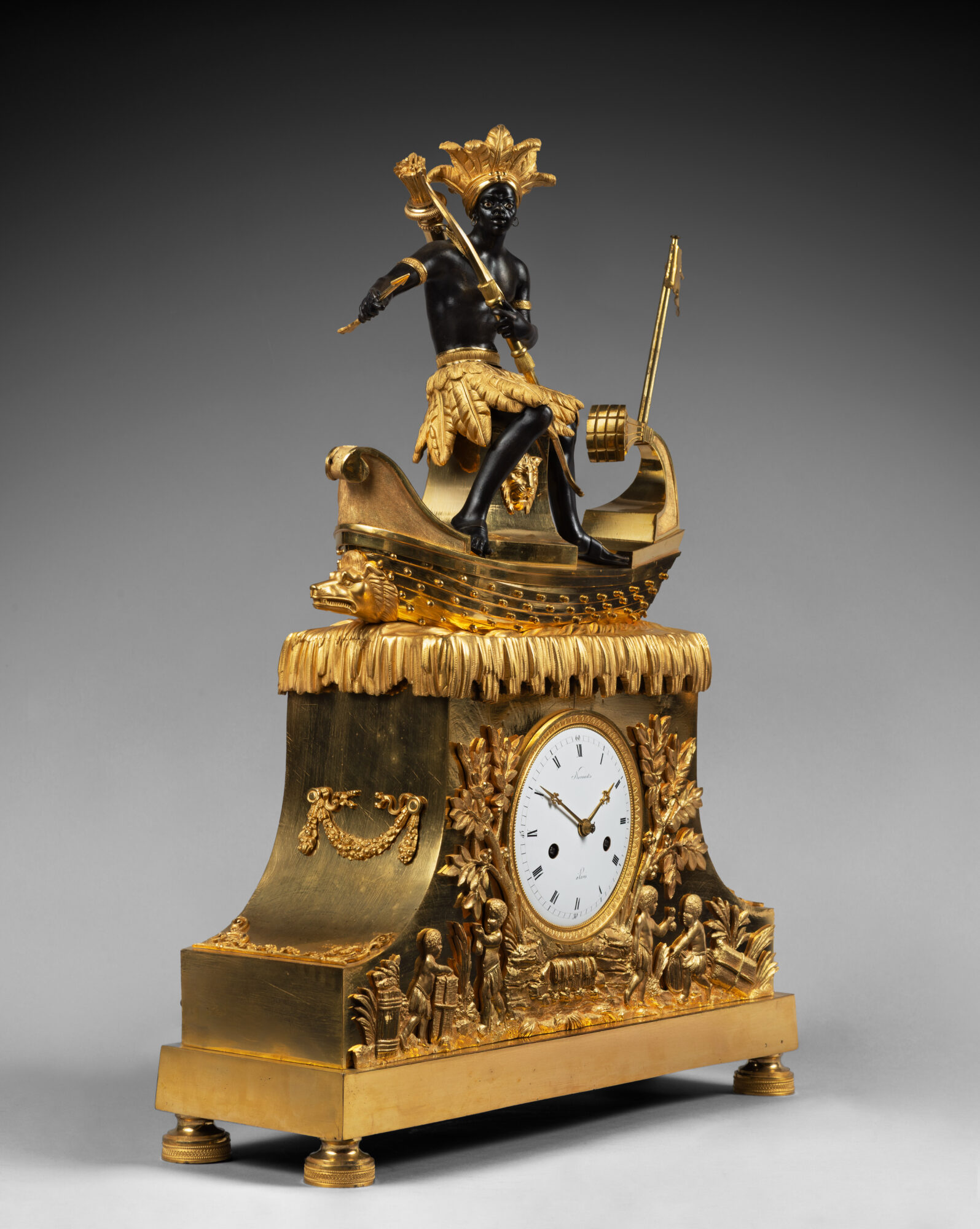
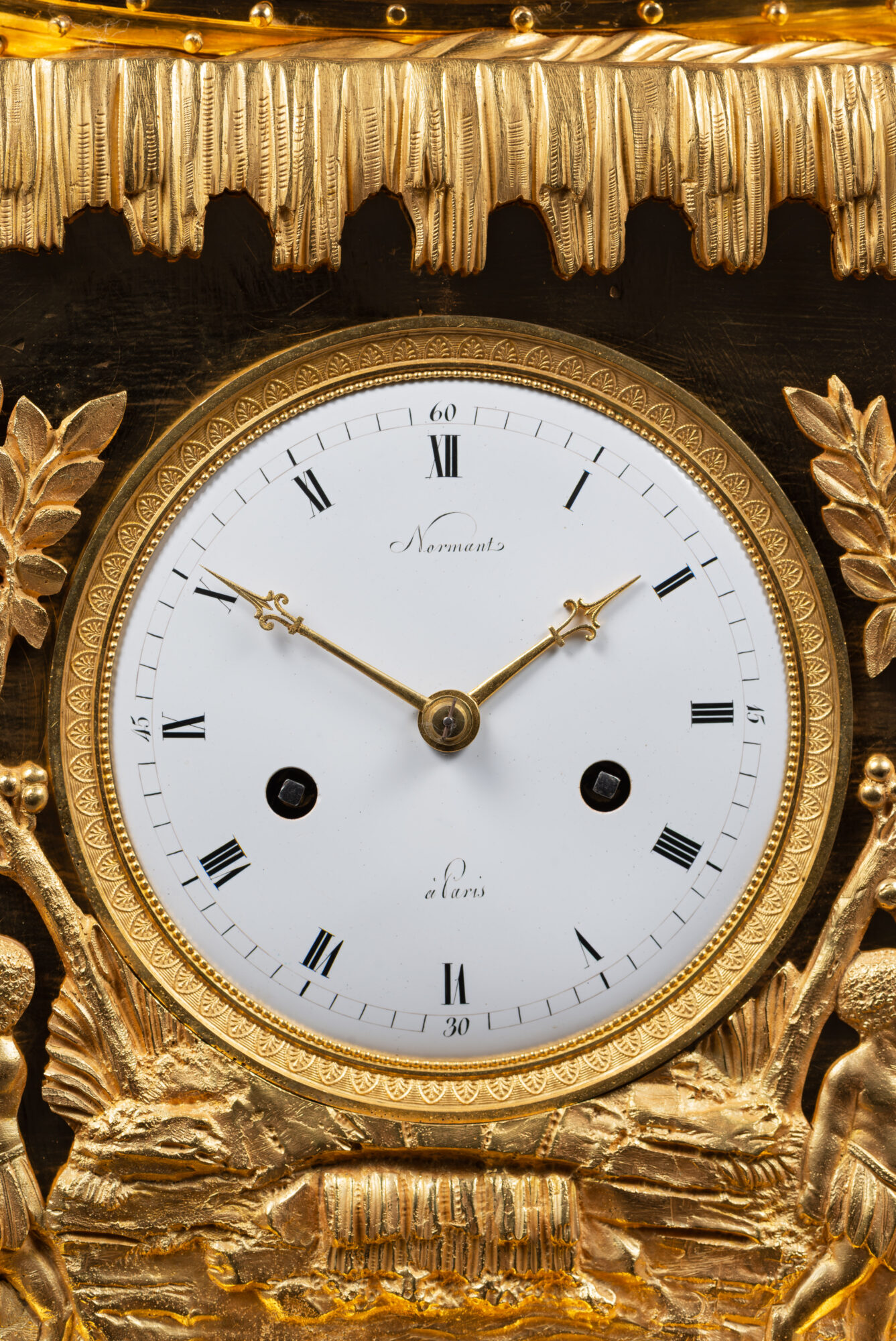
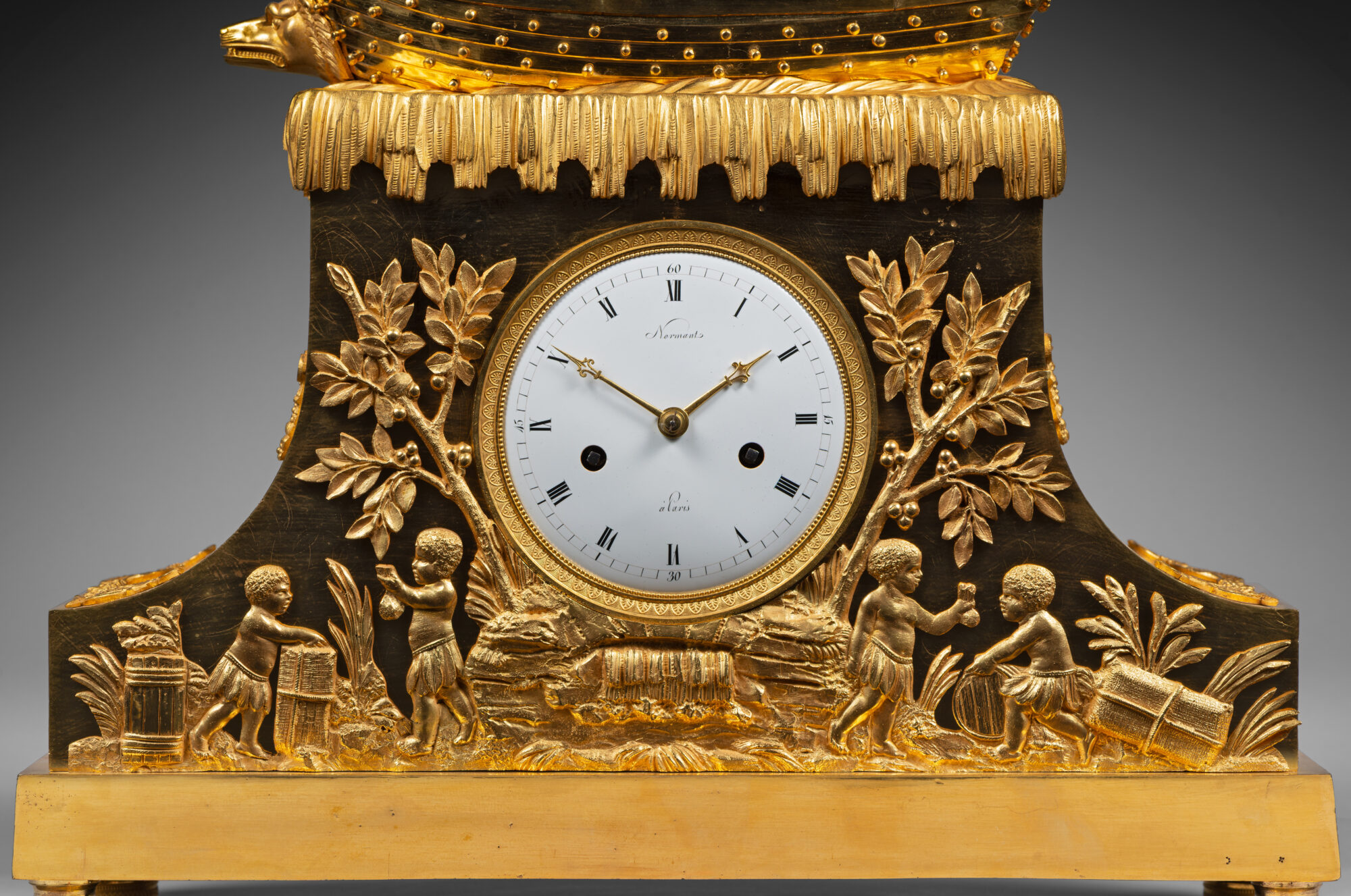
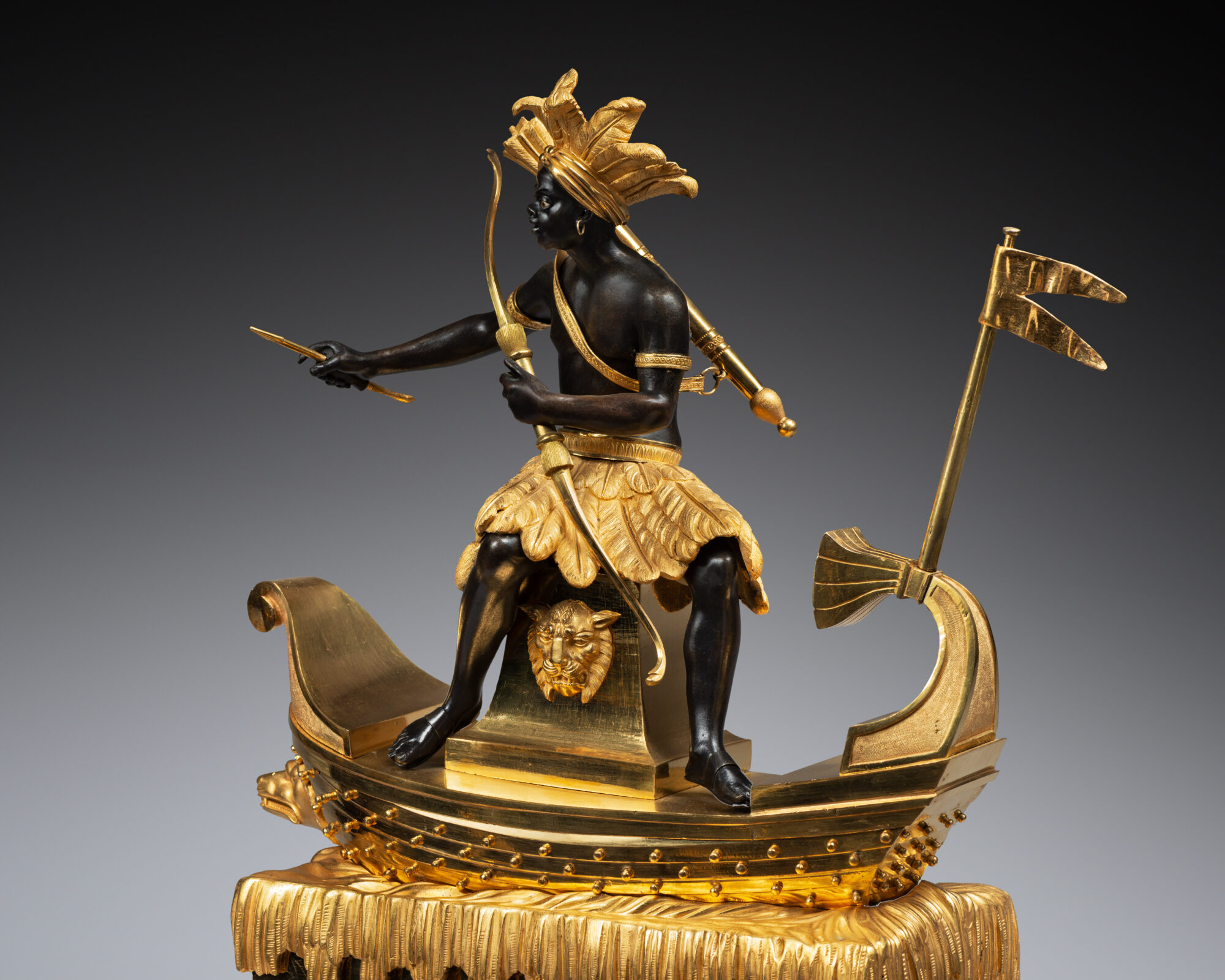
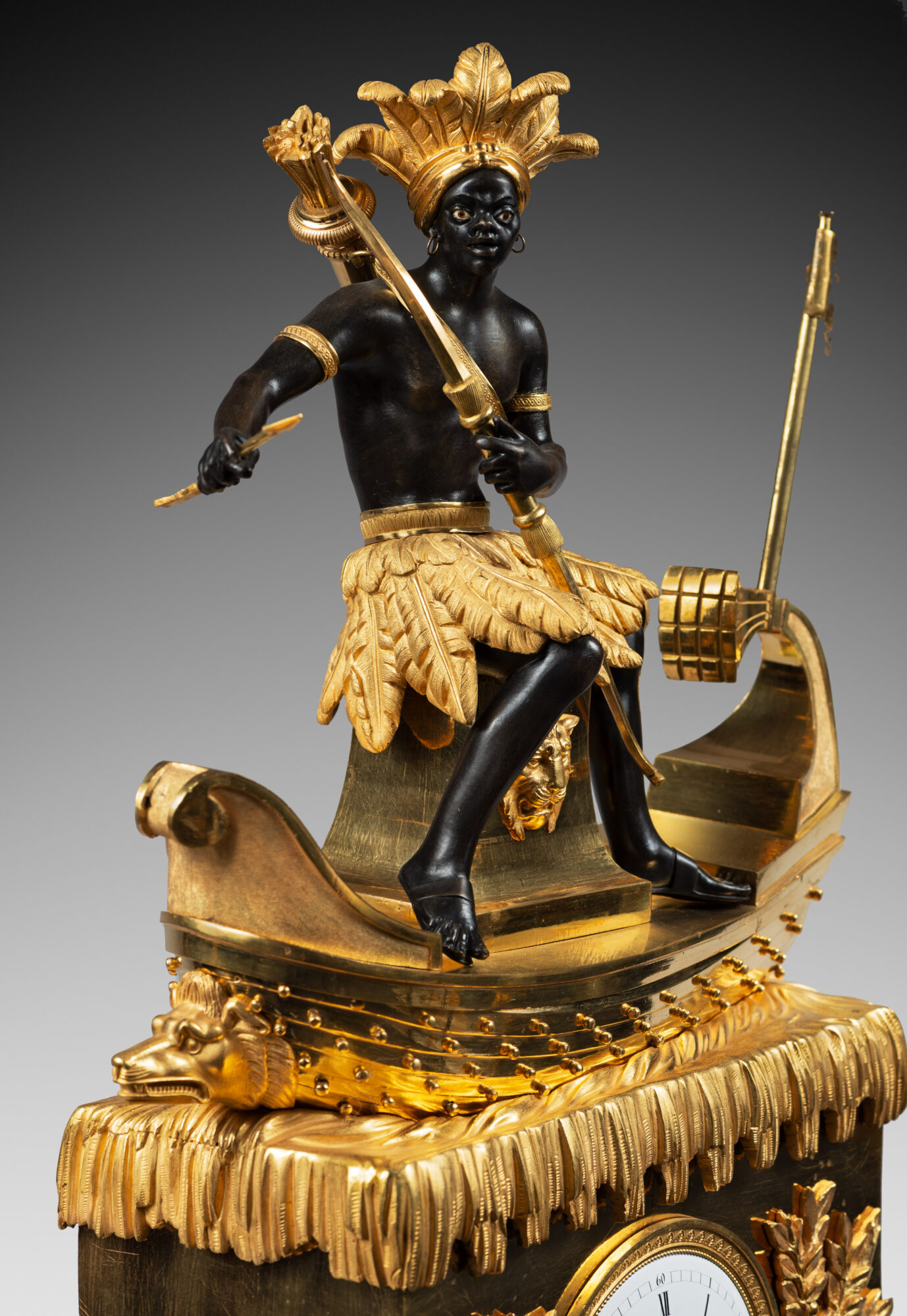
The round enamel dial, signed “Normant à Paris”, indicates the Roman numeral hours and the Arabic fifteen-minute intervals by means of two bronze hands. It is housed in a finely chased and gilt bronze case with matte and burnished finishing. The clock is surmounted by the figure of a black hunter wearing a feather headdress and a feather loincloth who is holding a bow in his left hand and an arrow in his right hand, with a quiver of arrows slung across his chest. He is sitting on a sloping rectangular form decorated with a lion’s head, which is placed in a ship with a wolf’s head figurehead. It stands on a terrace adorned with naturalistic waves. The quadrangular base with concave sides is decorated with applied motifs including palmettes, scrolls, and torches; its façade is embellished with an elaborate high-relief scene depicting rocks, a hut, and palm trees, among which four little boys dressed in loincloths are hunting, fishing, and resting with their dog. The oblong plinth rests on four flattened feet that are adorned with bead friezes and double zigzags framed by engine turning centered by cabochons.
Exoticism became fashionable during the late 18th century, inspired by the philosophical writings of Jean-Jacques Rousseau, who called for a return to Nature and exalted the virtues of the “noble savage”; it was conveyed by contemporary literature as well. Among the great literary successes of the time were “Paul et Virginie” written by Bernardin de Saint-Pierre in 1788; it echoed the well-known “Robinson Crusoe” by Daniel Defoe; the novel “Les Incas” by Marmontel, which was published during the American War of Independence; and “Atala” by Chateaubriand, which was published in 1801. These works profoundly changed Europeans’ attitudes toward other civilizations, plunging the Old World into a deep romantic nostalgia that was linked to the quest for a pagan Garden of Eden, regenerated and redeemed by Christianity.
As was often the case in the French decorative arts, this current influenced artistic trends, and particularly horological creations. The model of the present clock was created within that particular context. Very likely an allegorical representation of the discovery of the New World, two versions of it were offered.
The first type featured a figure seated on a chariot. Only a few examples are known to exist, notably a clock kept at the Museum of the New World in La Rochelle and another at the Paul Dupuy Museum in Toulouse, as well as a third reproduced in G. and A. Wannenes, Les plus belles pendules françaises, De Louis XIV à l’Empire, Florence, 2013, p.315; and a final one with a dial signed “Ouasse à Paris” which is in the Parnassia collection in the Netherlands (Inv. 2.084).
The second type corresponds to the one we are offering, with the figure on a canoe, of which a few other examples are known. Of particular note are the two clocks of this model belonging to the collections of the François Duesberg Museum in Mons (illustrated in Musée François Duesberg, Arts décoratifs 1775-1825, Brussels, 2004, p.59); as well as an example with a dial signed “Gaston Jolly à Paris” in the Parnassia collection in the Netherlands (Inv. 2.056).