BIBLIOGRAPHY : Pierre Kjellberg, Encyclopédie de la pendule française du Moyen Age au XXe siècle, Les éditions de l’Amateur, Paris, 1997, p. 289, fig. B.
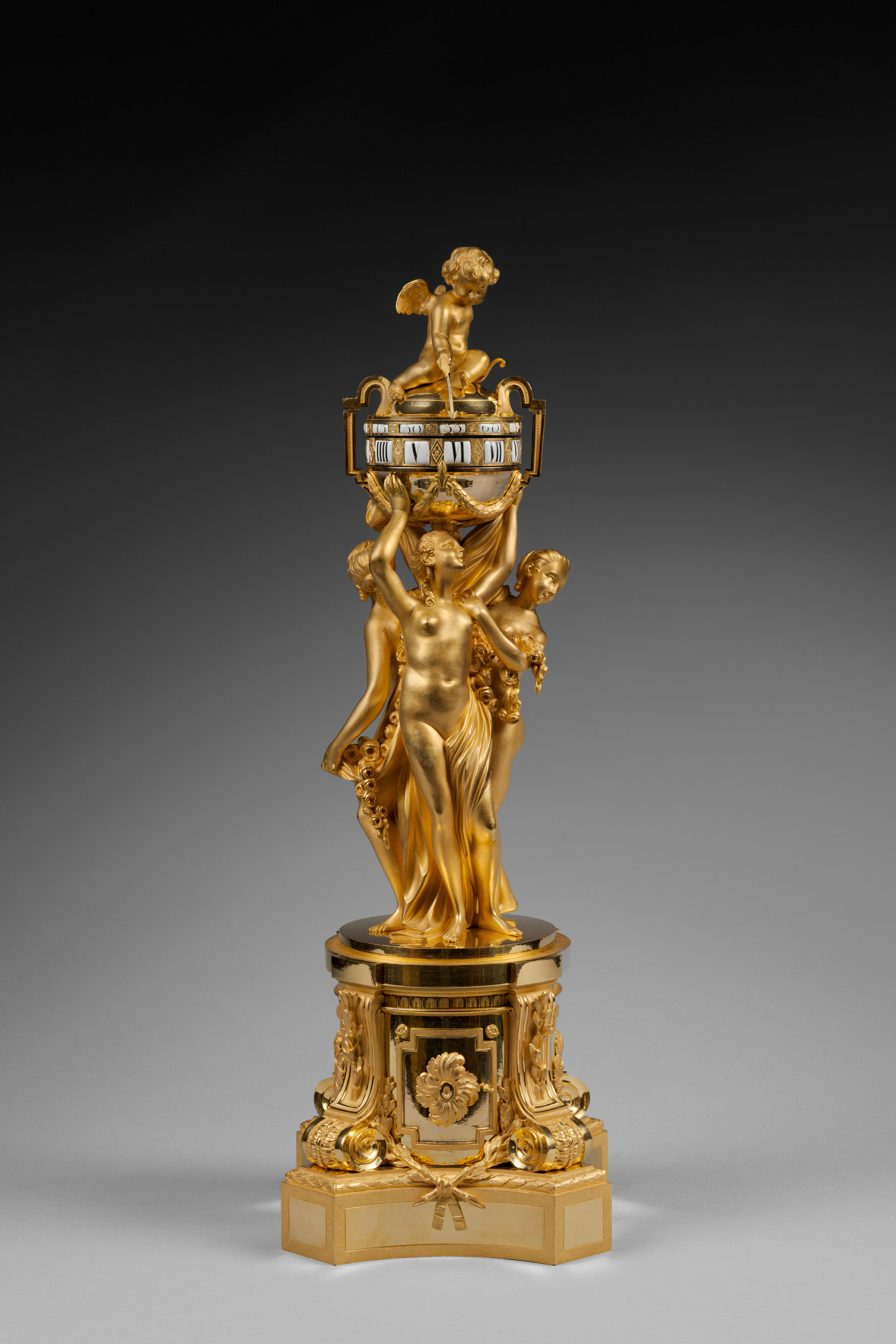
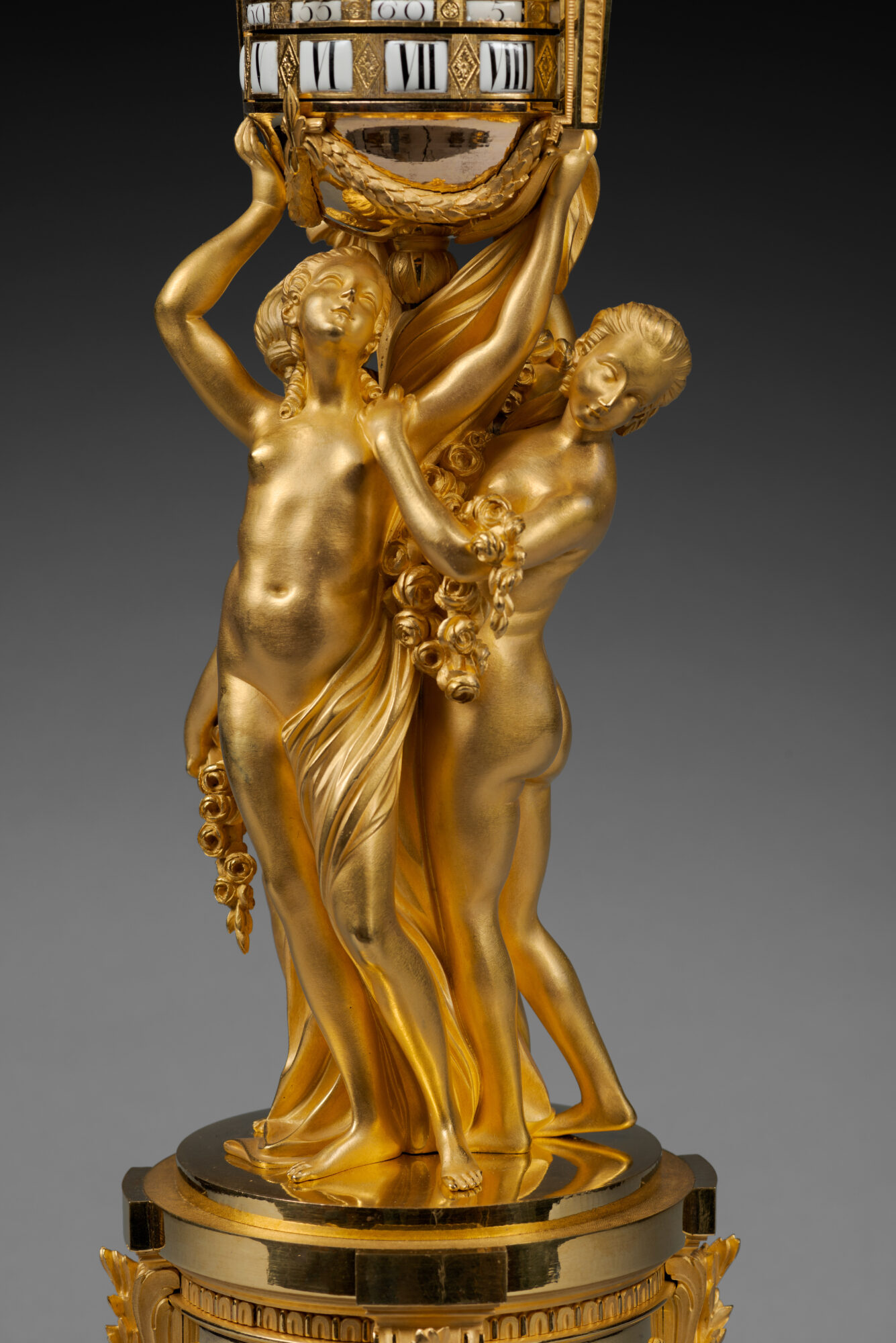
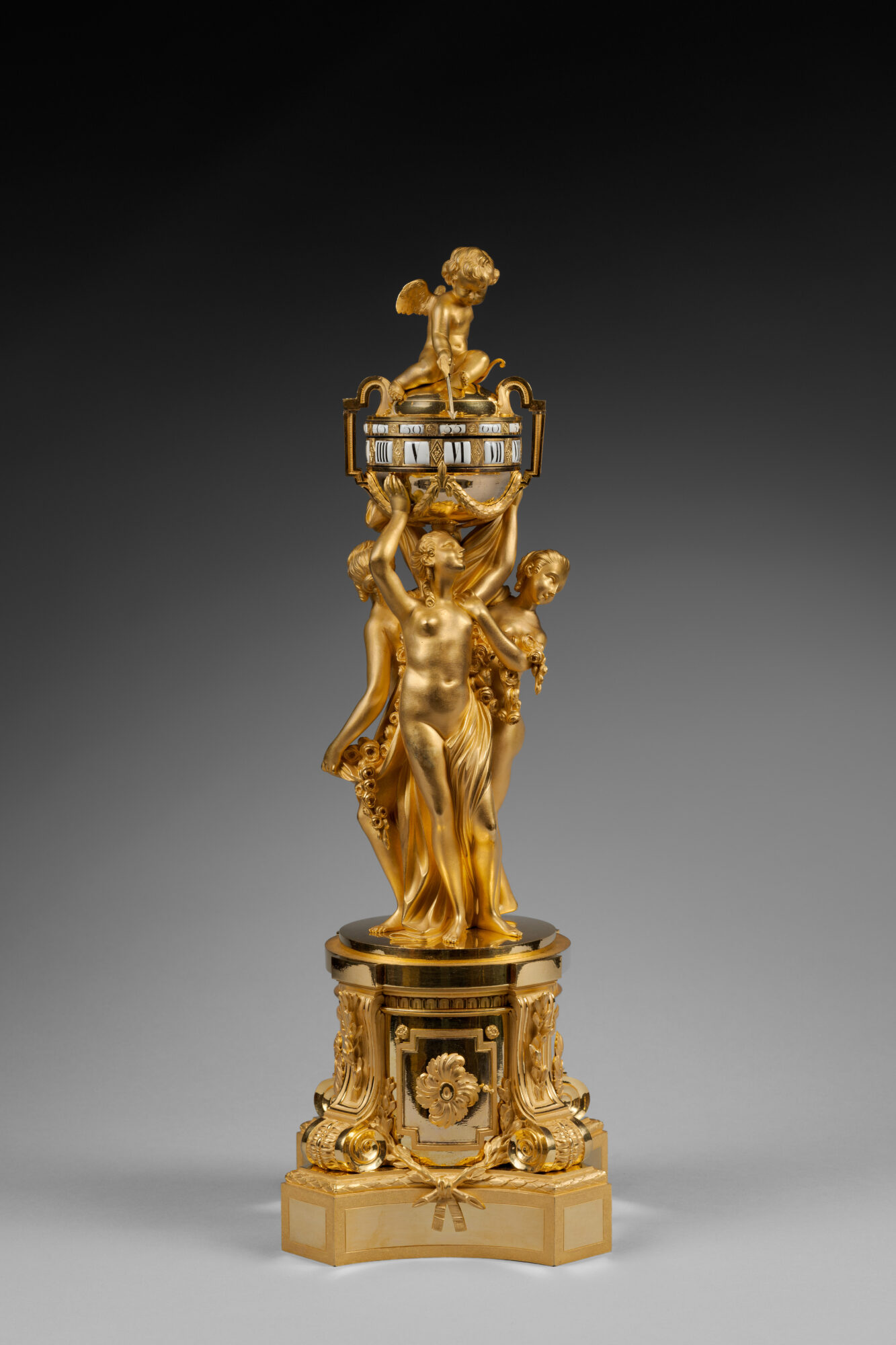
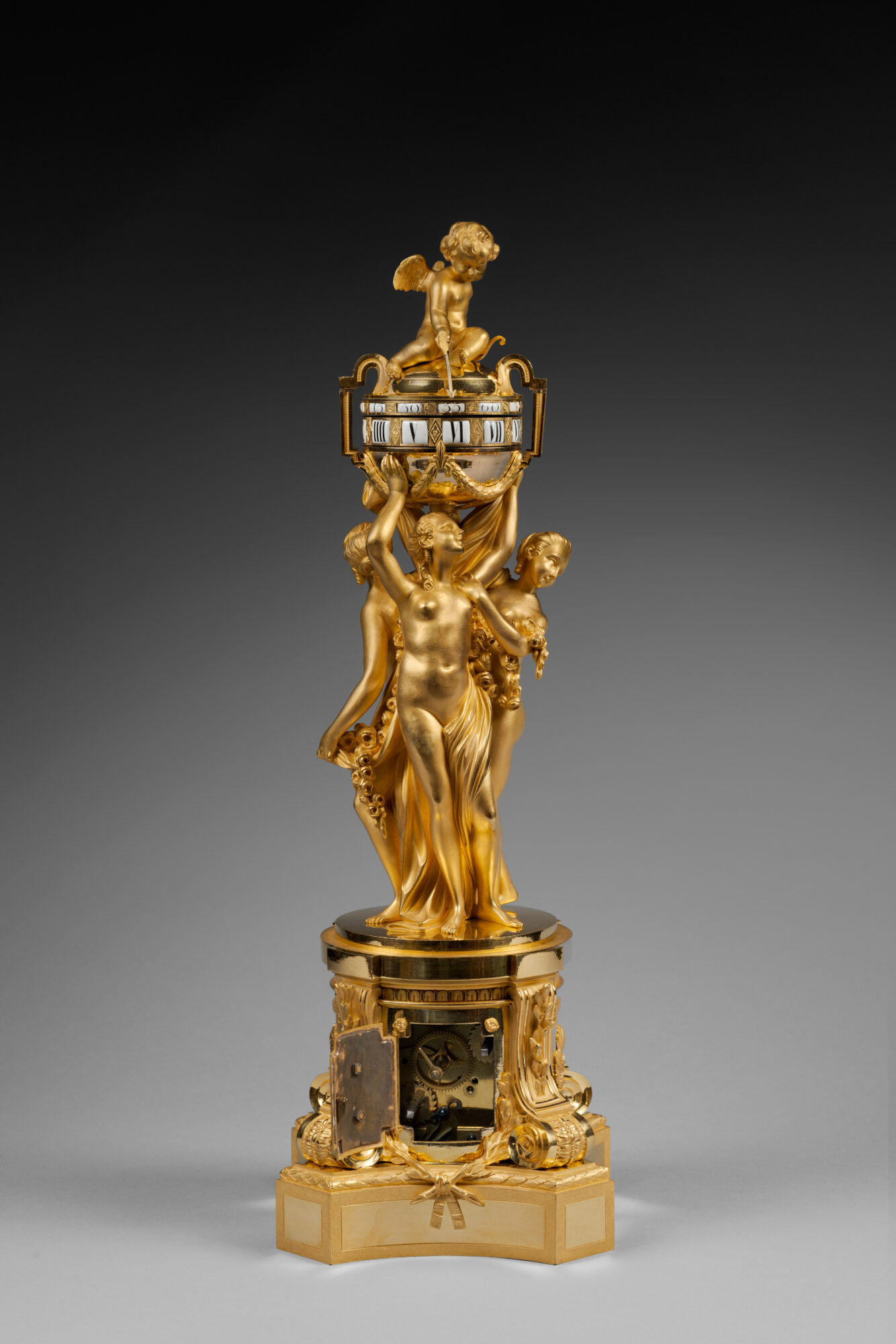
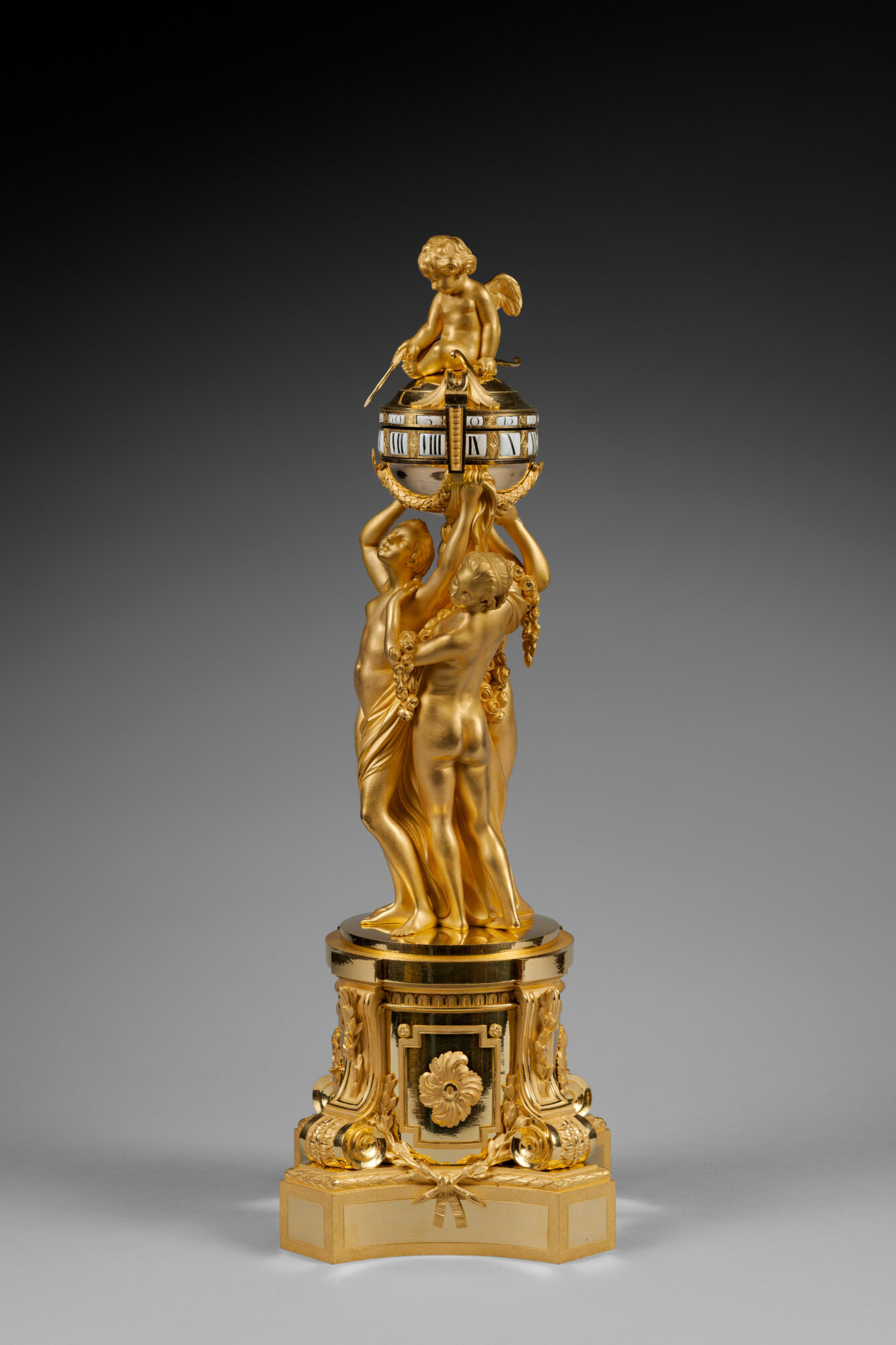
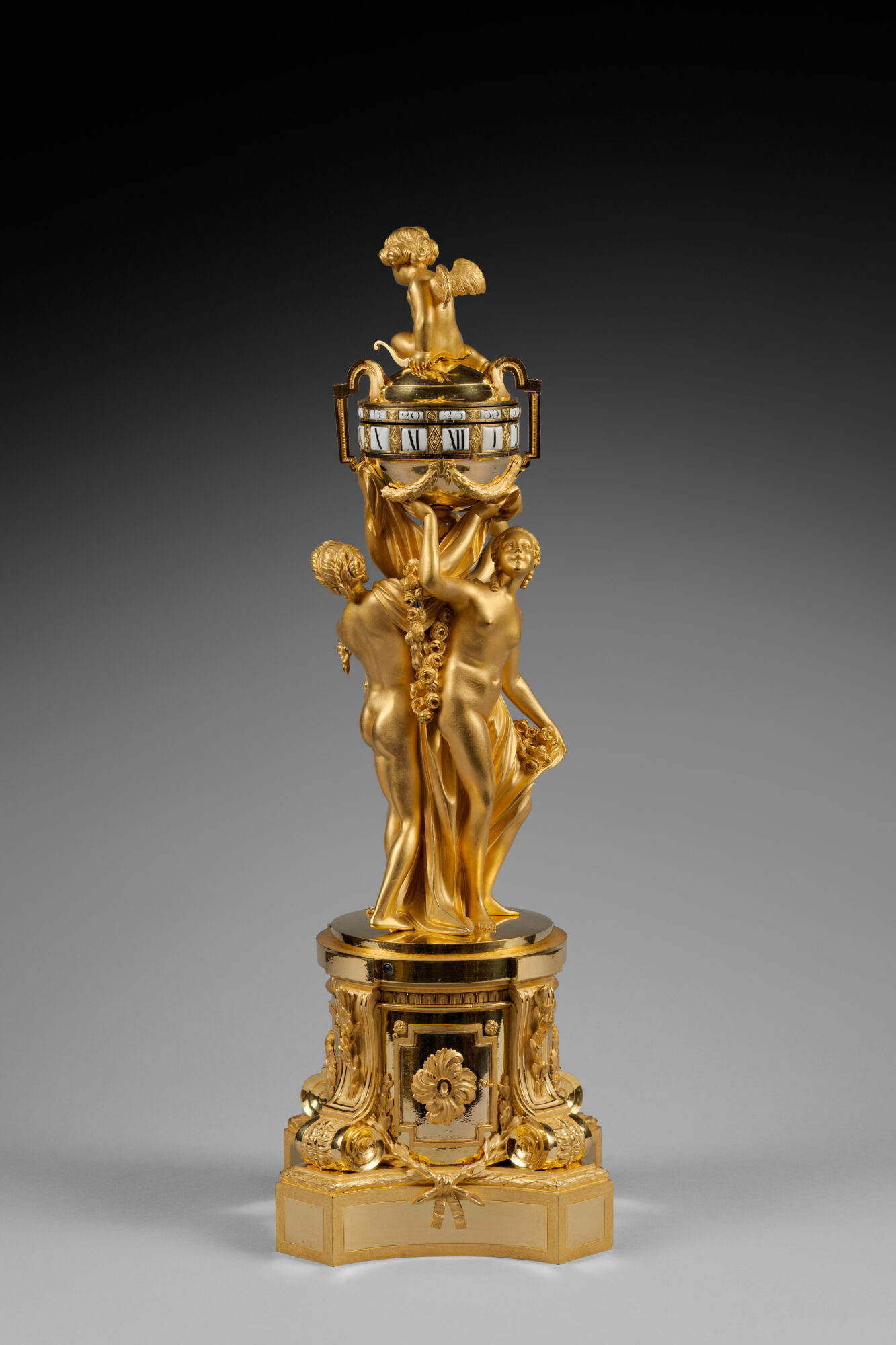
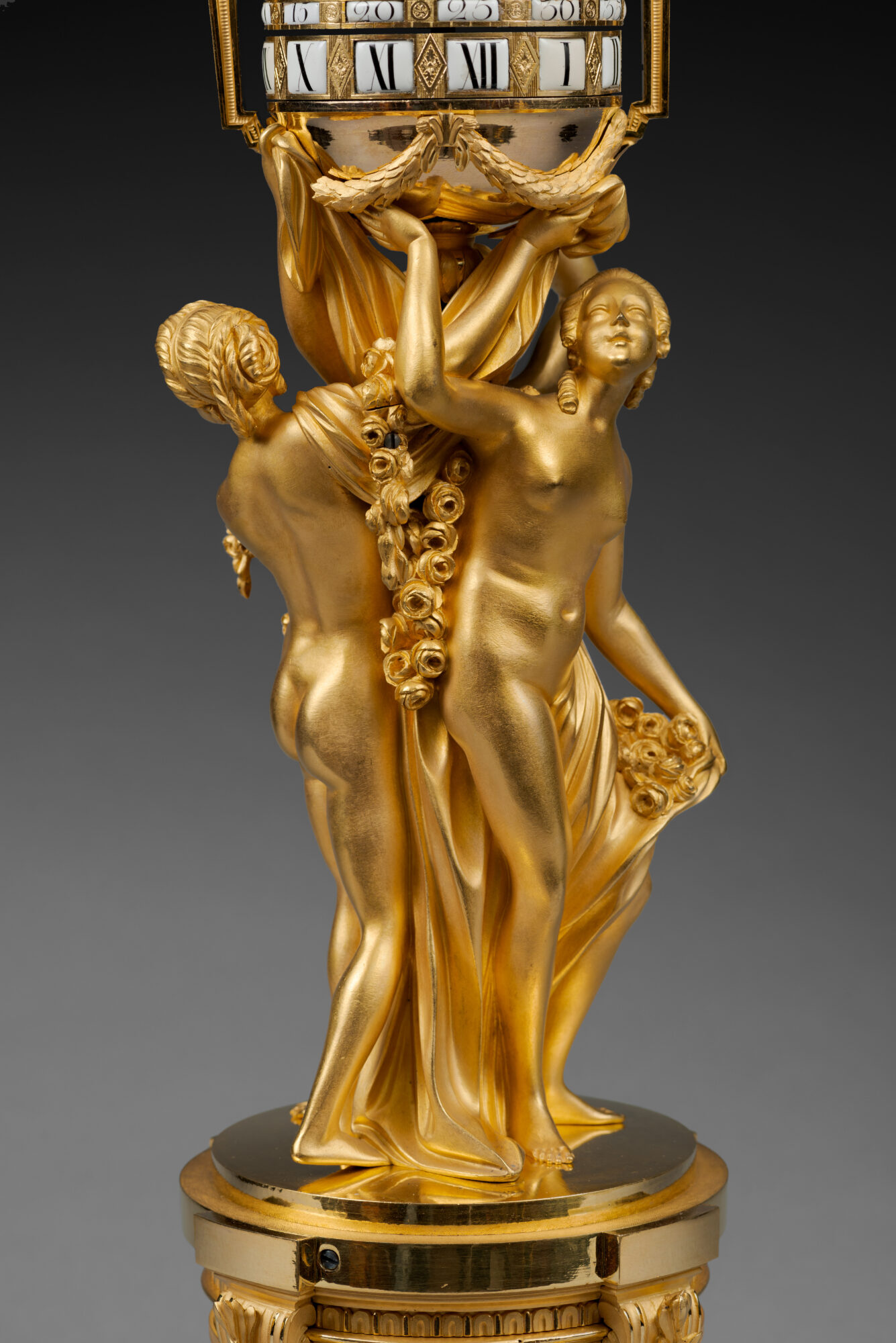
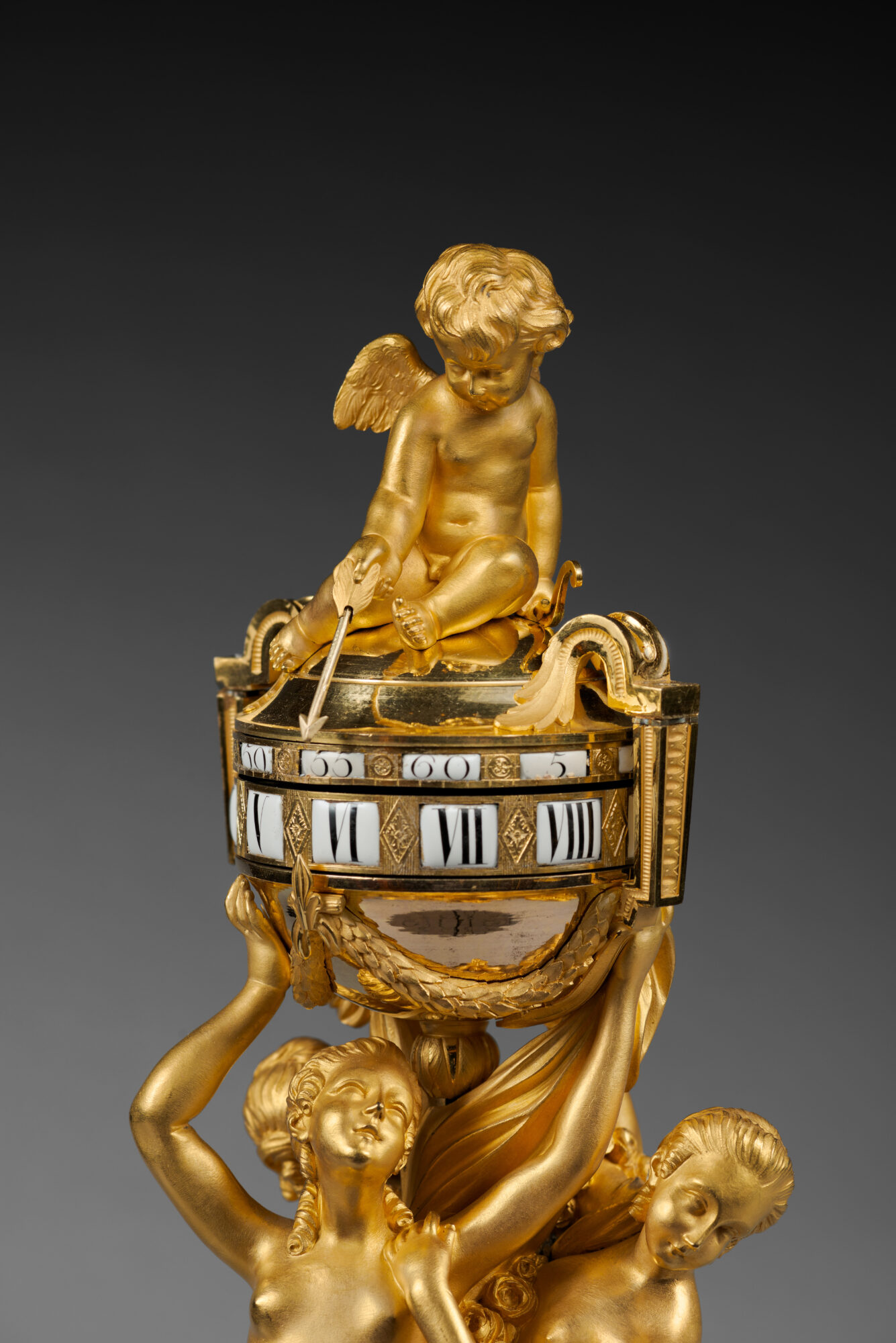
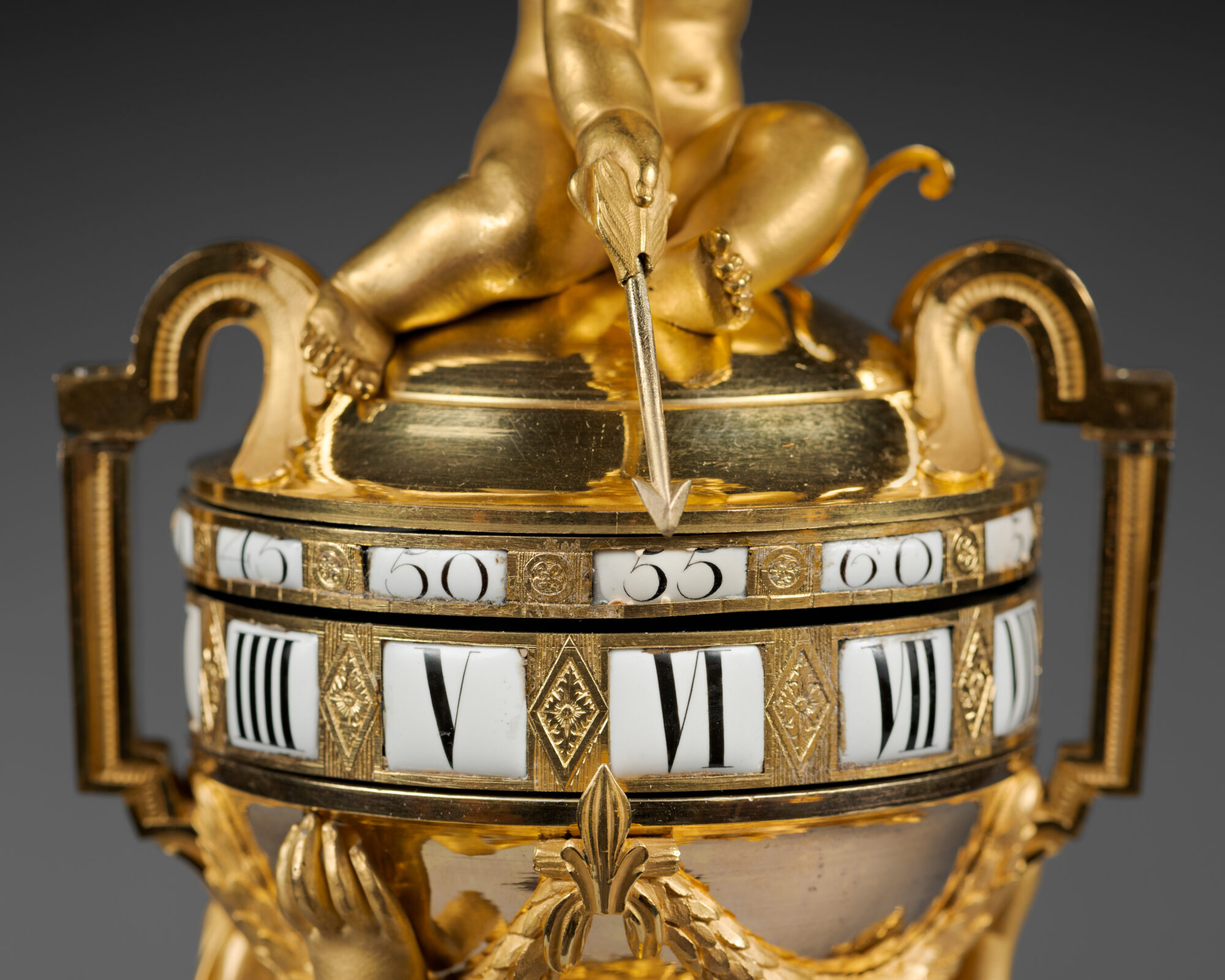
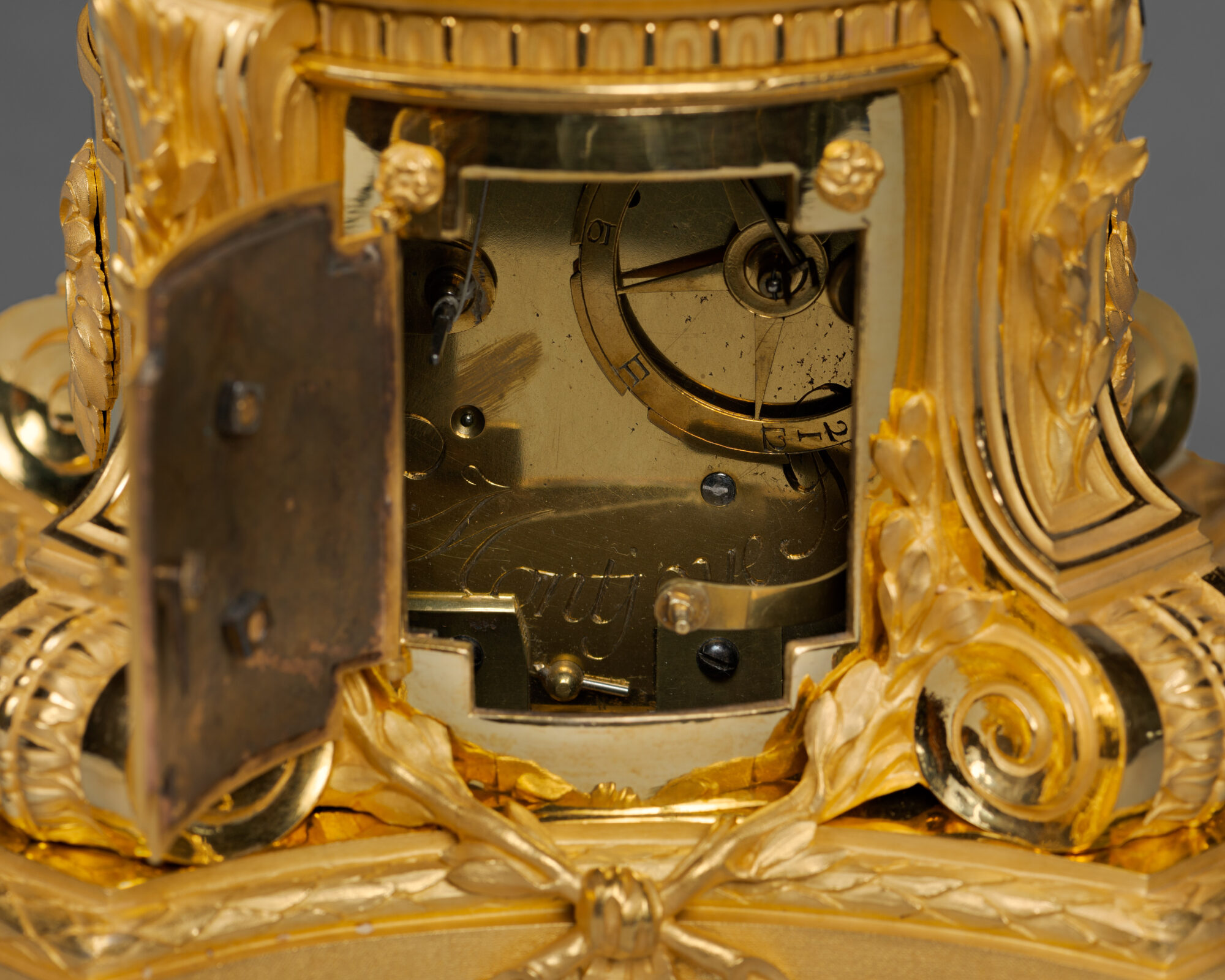
The “cercles tournants” dials, composed of two superimposed rings decorated with stylized motifs in oval medallions and diamonds centered by leaf clovers, alternate with rectangular and square enamel cartouches that are marked with the Roman numeral hours and Arabic numeral minutes. This type of clock is called Cercles Tournants or Turning Circles because the two superimposed rings will rotate as time passes. A part of the movement is housed in a lidded urn with squared fretted handles, which is decorated with delicate leaf garlands and is surmounted by a winged Cupid. The seated Cupid holds a bow in his left hand and an arrow in his right hand, which he uses to indicate the minutes. The hours are shown by a petal of fleur-de-lys, a royal symbol. The vase is supported by three magnificent female figures with upswept hair, holding rose garlands, who are wrapped in antique draperies that are suspended from the vase. The women symbolize the Three Graces, daughters of Zeus in Greek mythology. They are associated with beauty, grace and nature. They stand on a shaped architectural plinth supported by four consoles, which are decorated with branches and volutes, and feature olive branches and rectangles with sloping tops that are separated by rosettes and are centered by rotating rosettes. The similarly shaped base is decorated with a laurel torus. The main part of the movement can be revealed by two small doors. Behind one, you can find the winding holes. Behind the other, the bell hides the back plate of the movement that is engraved « L. Montjoye à Paris ».
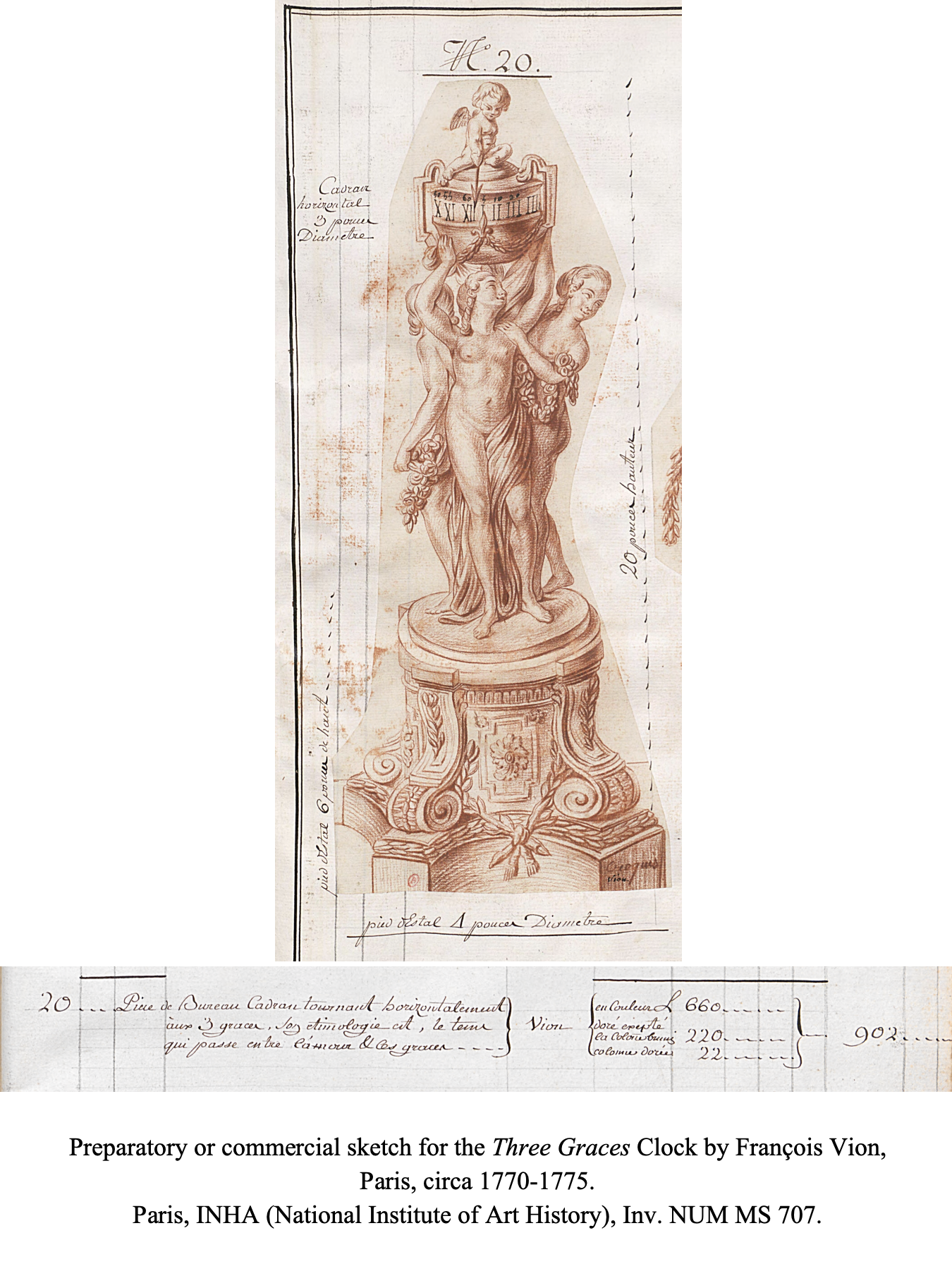
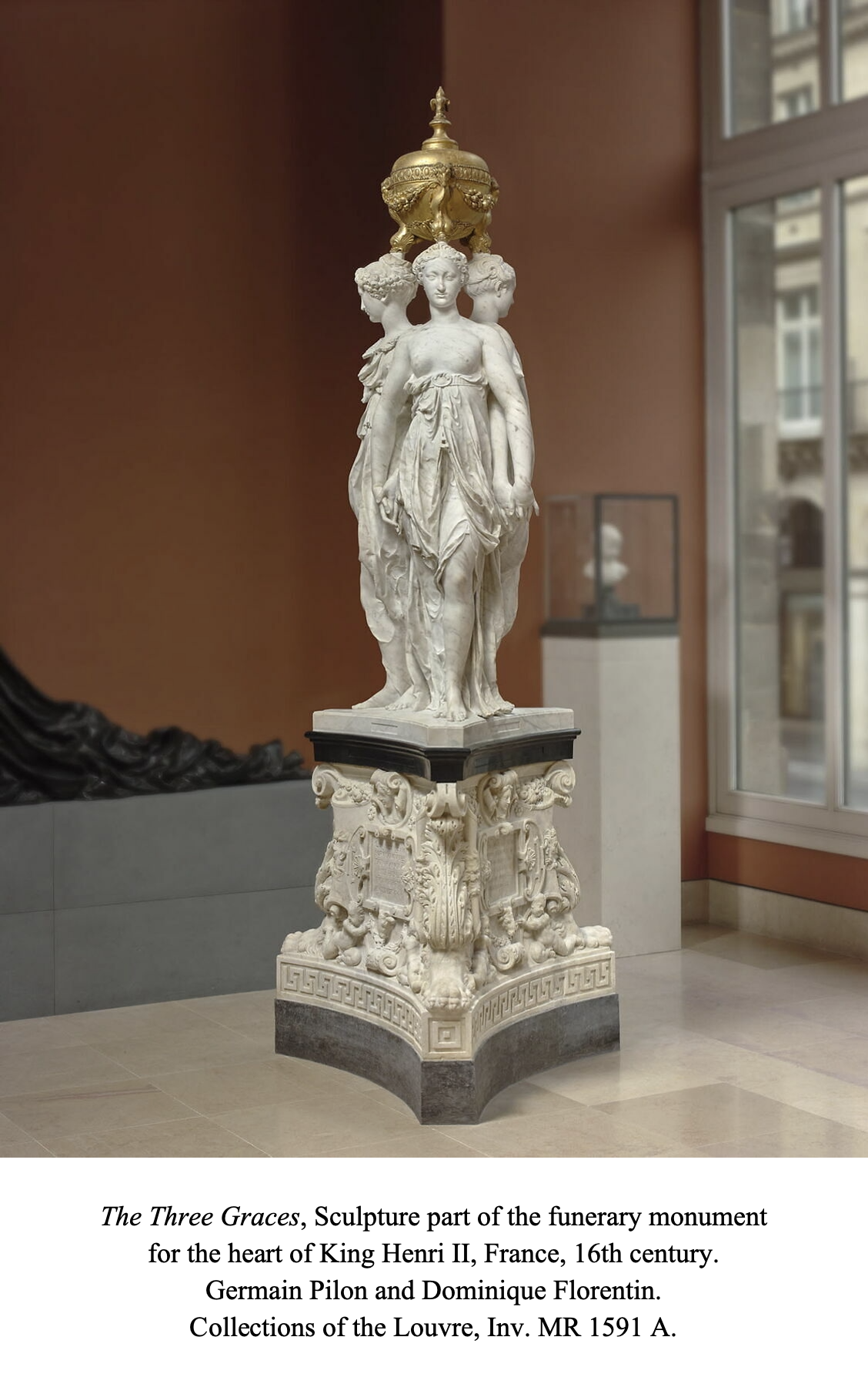
The design of the “Three Graces” model of clock was created by master bronze-caster François Vion. His preparatory or commercial drawing was inspired by a monument made in the French Renaissance by Germain Pilon, meant to hold the heart of King Henry II in the urn held by the Three Graces. The sketch appears in an album of horological pieces that is in the Paris Institut National d’Histoire de l’Art (Inv. NUM MS 707 in INHA, formerly the Bibliothèque Jacques Doucet. Illustrated in H. Ottomeyer and P. Pröschel, Vergoldete Bronzen, Die Bronzearbeiten des Spätbarock und Klassizismus, Band I, Munich, 1986, p. 179, fig. 3.7.4).
Called a “Pièce de bureau” (desk piece), the model is almost identical to an example that the marchand-mercier Simon-Philippe Poirier delivered to Countess Du Barry in the Château de Versailles, on October 4, 1769. The gilding of that piece had been done by François-Thomas Germain (1726-1791). Approximately twenty years later, in April 1787, a second example was included in the posthumous sale of the belongings of Nicolas Beaujon, formerly Court Banker and State Counselor: “415: A clock, movement by Lepaute in Paris, with an antique-colored bronze globe, indicating the hours, which are shown by a Cupid holding an arrow, and is supported by the Three Graces. The whole on a pedestal with scroll consoles and base with gilt bronze rosettes. Height 19 pouces”.
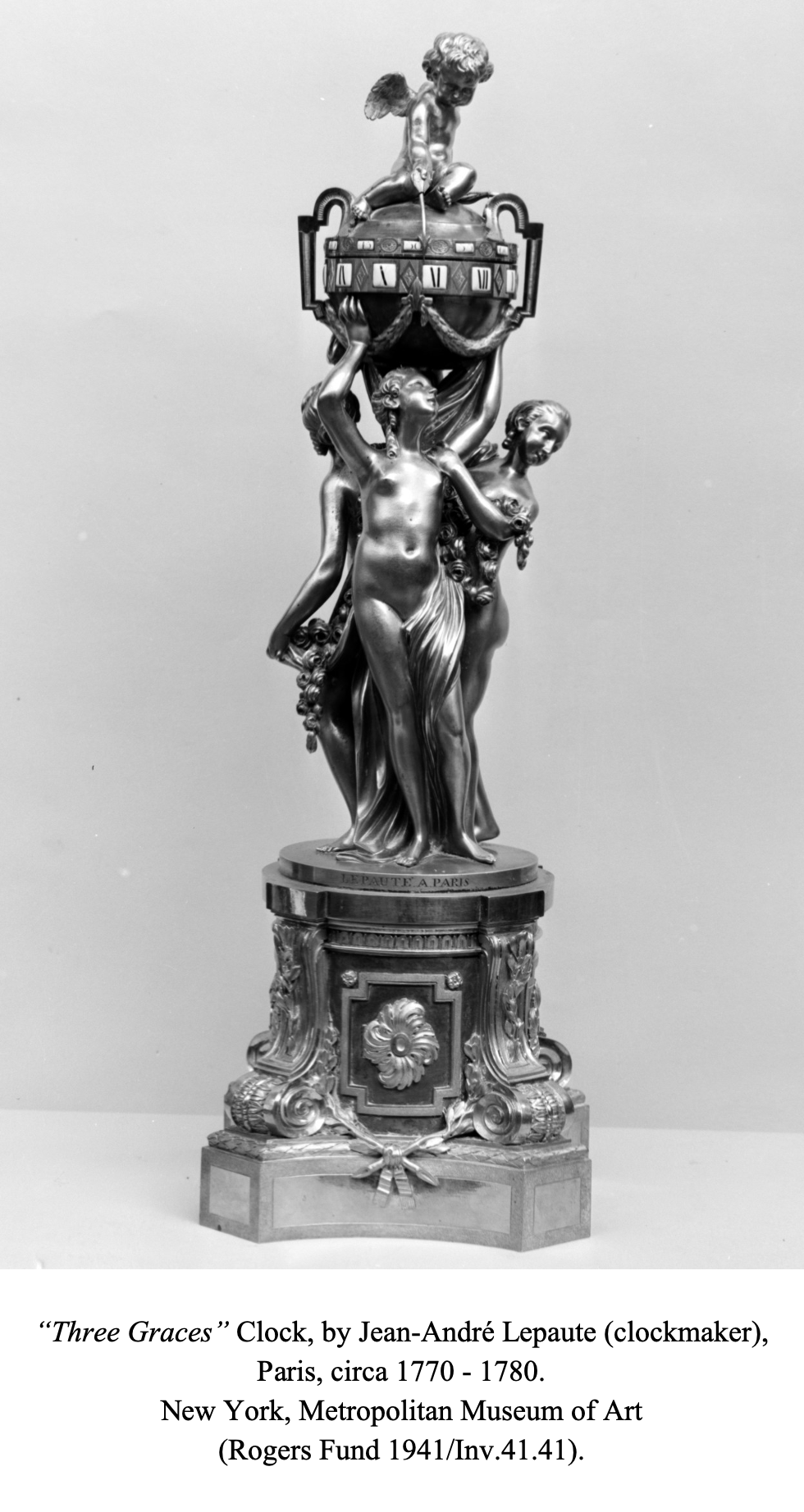
For many years it was thought that the clock in Fontainebleau Castle was the “Du Barry” example. However, several decades ago, it was suggested that the clock ordered by Countess Du Barry in 1769 may be one of the rare identical models known. One such example, signed “Lepaute à Paris”, was first in the collections of the Countess de Crisenoy de Lyonne, and then in that of Monsieur and Madame Djahanguir Riahi (sold Christie’s, New York, November 2, 2000, lot 2). It is important to note that the few known identical clocks are nearly all in international public collections. One such piece, having belonged to General Moreau, who lived in the rue d’Anjou, is in the Musée national du Château de Fontainebleau (illustrated in the exhibition catalogue Dans les rêves de Napoléon, La première chambre de l’Empereur à Fontainebleau, Château de Fontainebleau, October 15, 2016 – January 23, 2017, p. 71, catalogue n° 16). A second example is in the Royal Ontario Museum in Toronto (illustrated in French Clocks in North American Collections, The Frick Collection, 1982-1983, p. 80-81). A third is in the Huntington Collection in San Marino, California (illustrated in French Art of the Eighteenth Century at The Huntington, 2008, p. 144, catalogue n° 43). A fourth clock is in the Metropolitan Museum of Art in New York (Rogers Fund 1941/Inv.41.41).
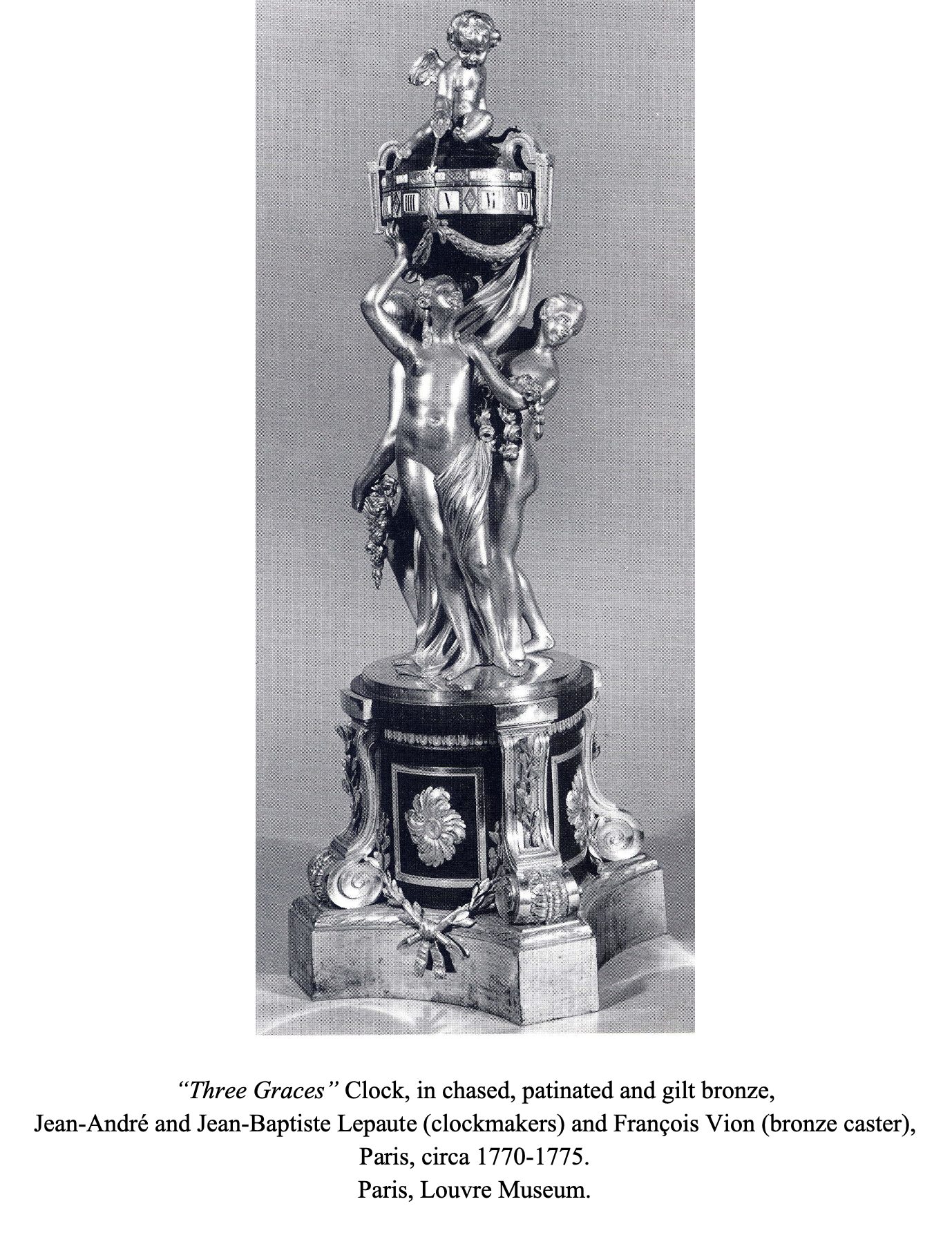
A fifth example, signed Lepaute et Vion, is in the Louvre Museum in Paris (see Christian Baulez’ article in the exhibition catalogue Pierre Gouthière, ciseleur-doreur du roi, The Frick Collection, New York, 2016, p. 33, fig. 5).
One further clock in polychrome porcelain, produced by the Royal Sèvres Manufactory, is in the Geneva Musée d’Art et d’Histoire (see Tardy, La pendule française, 2ème Partie: Du Louis XVI à nos jours, Paris, 1975, p. 291, fig. 1).
One of the most important Parisian bronze casters of the second half of the 18th century. Having become a master bronze caster in 1764, he was a rival of the Osmonds and Jean-Joseph de Saint-Germain. He specialized in creating clock cases, several of which bear his signature, particularly those known as “Venus and Love” and “Love and the Three Graces”.
This is the signature of Louis Montjoye, one of the foremost Parisian clockmakers of the second half of the 18th century. After becoming a maître in August 1748, he opened a workshop in the rue Dauphine, gaining immediate recognition among Parisian connoisseurs of fine horology. He worked for many of the most important merchants of the time, including Dominique Daguerre, and collaborated with remarkable artisans such as Charles Cressent, Jean-Joseph de Saint-Germain, François Rémond and the Osmond family of bronze-casters, for his clock cases. During the 18th century, his pieces were in the collections of the Duchess of Mazarin, the Duke of Richelieu and the Count of Vaudreuil; during the Revolutionary period one of his clocks was recorded as being in the Château de Montreuil in Versailles, which was the home of Louis XVI’s sister Madame Elisabeth.