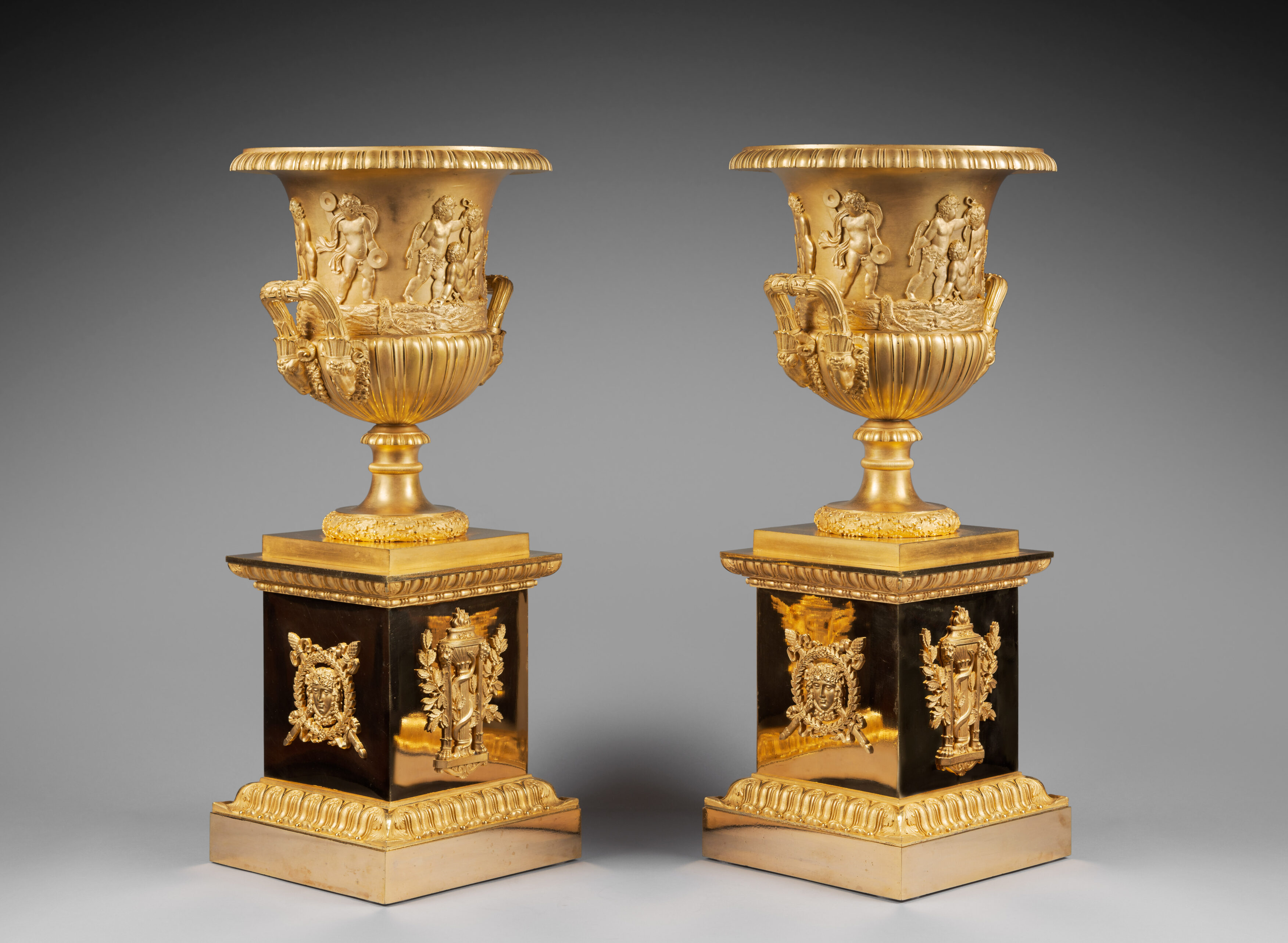
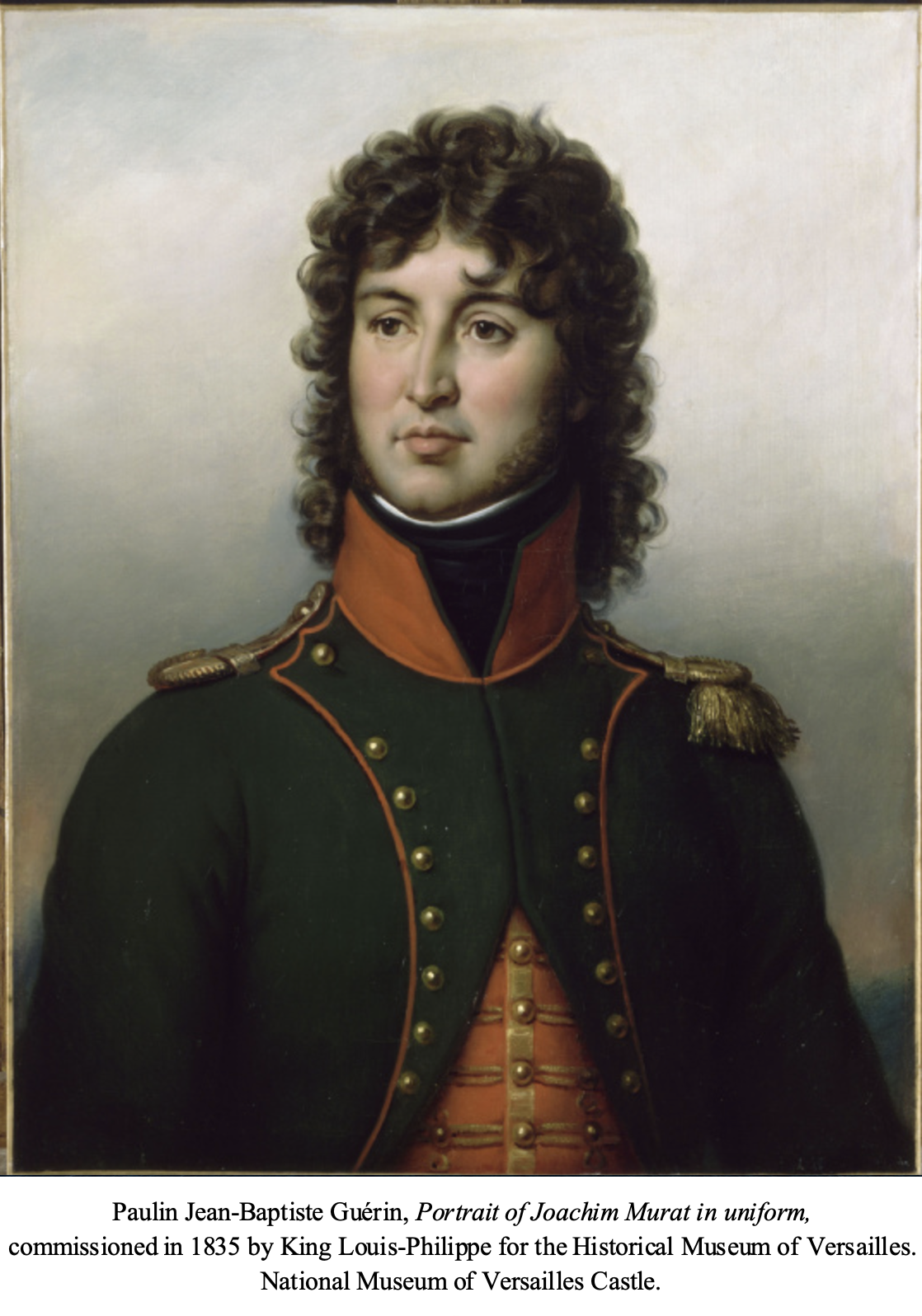
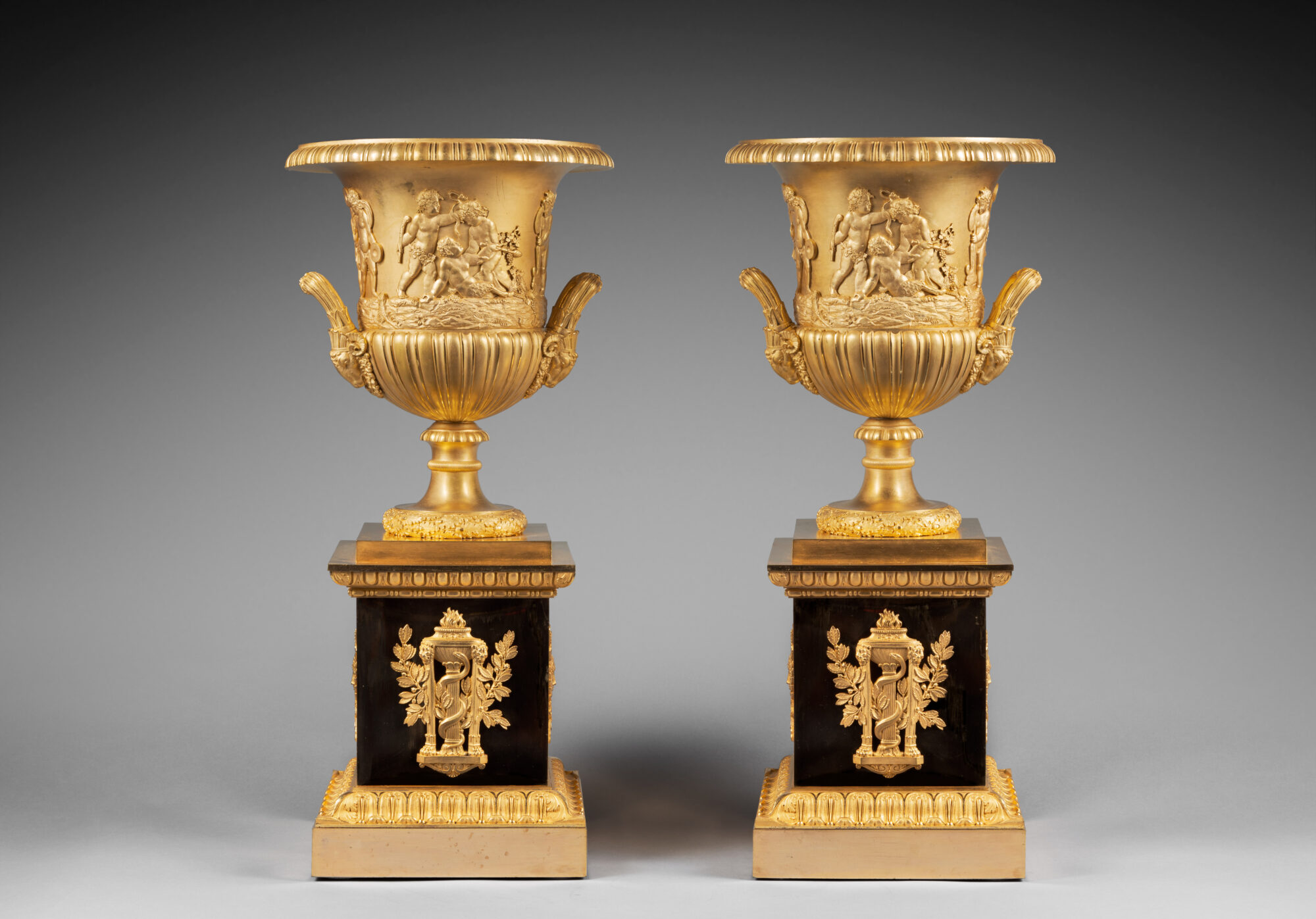
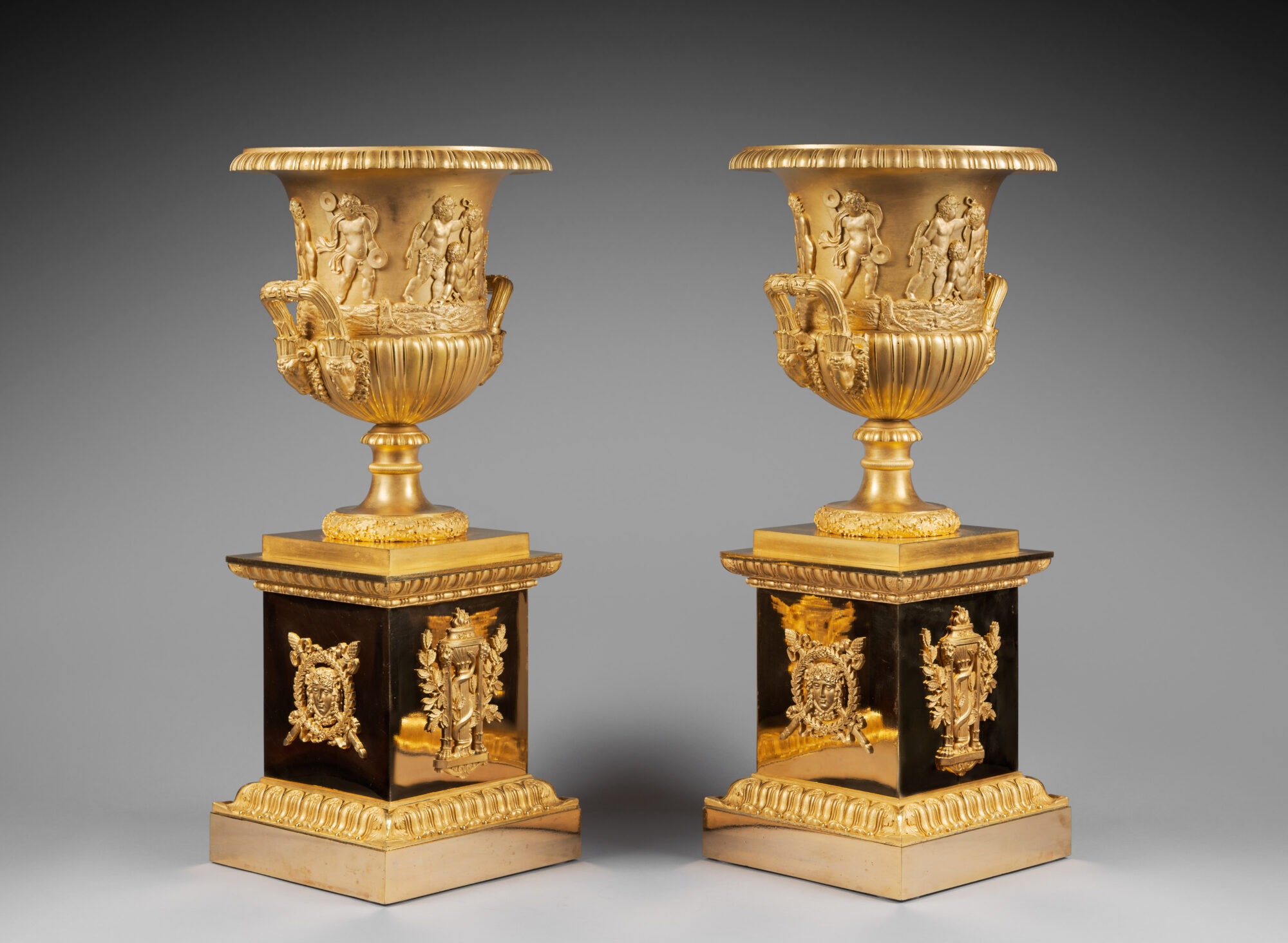
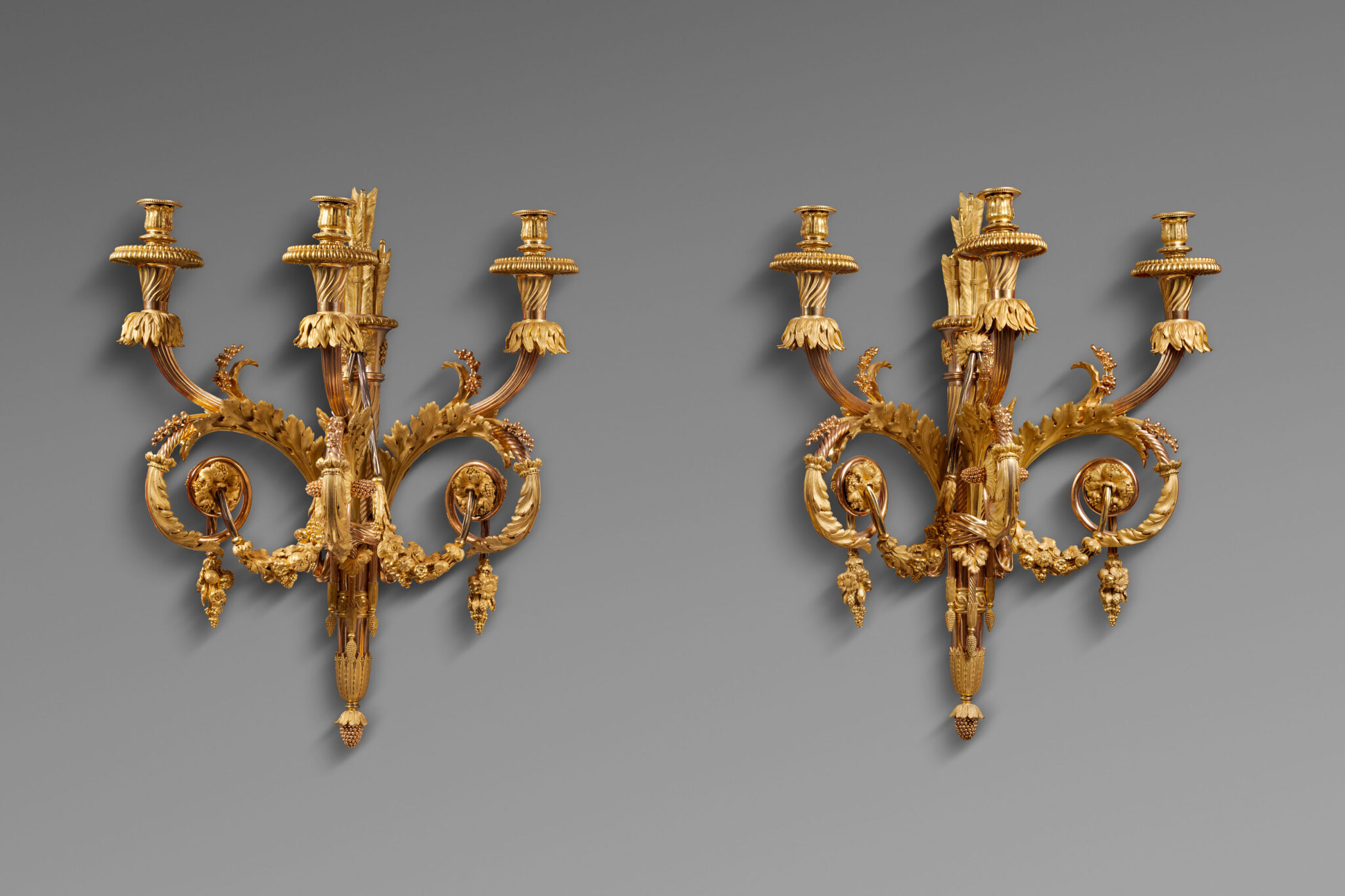
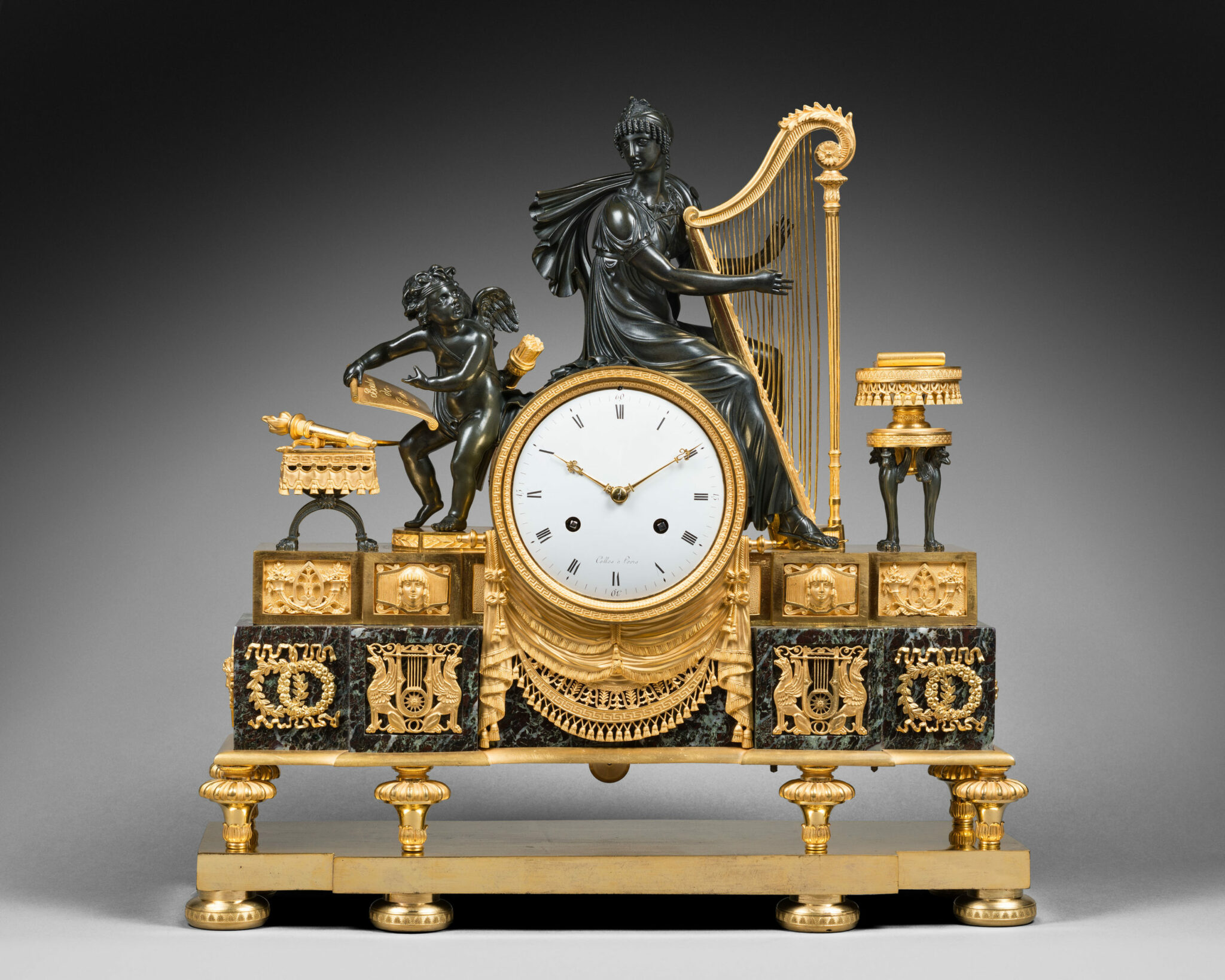
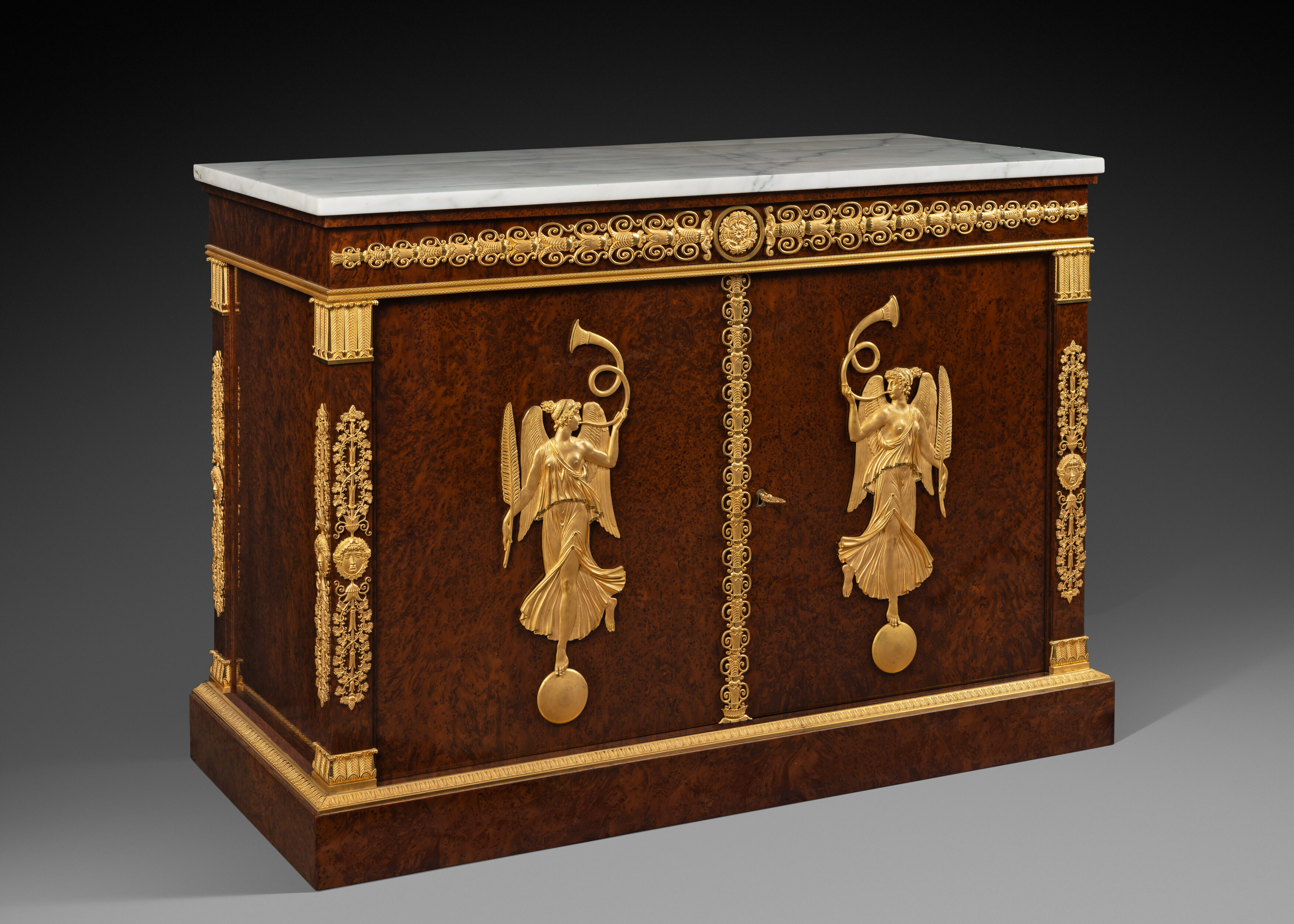
– Commissioned circa 1805-1810 by Joachim Murat, Marshal of the Empire, King of Naples (1767-1815) for the Royal Palace of Naples.
– Sold at auction after his death in 1815 ; acquired by Marquis Emilio Tortora Brayda di Belvedere (1784-1854) for his residence in Molfetta.
– Thence by descent; then sold at Sotheby’s, New York, April 25, 1998, lot 225.
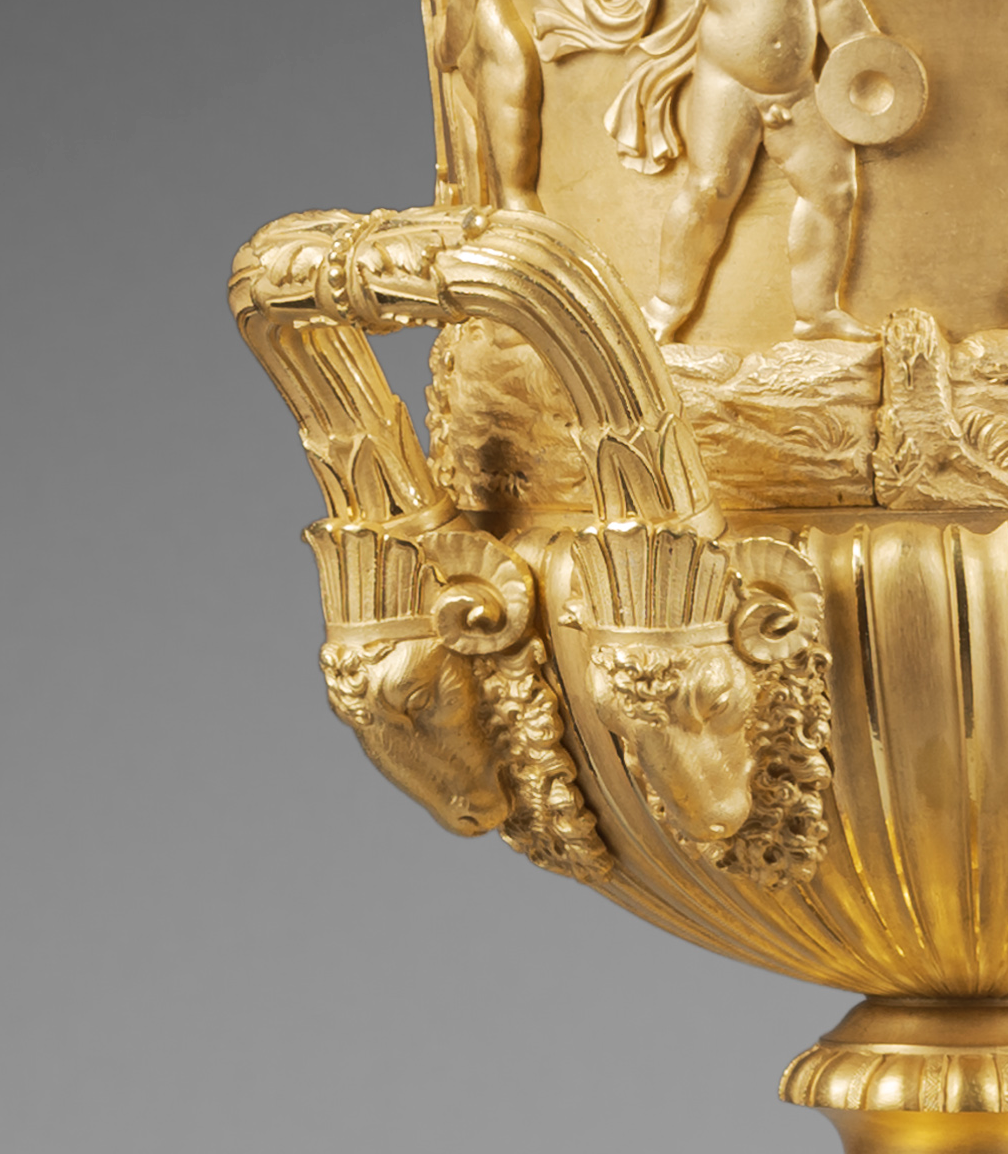
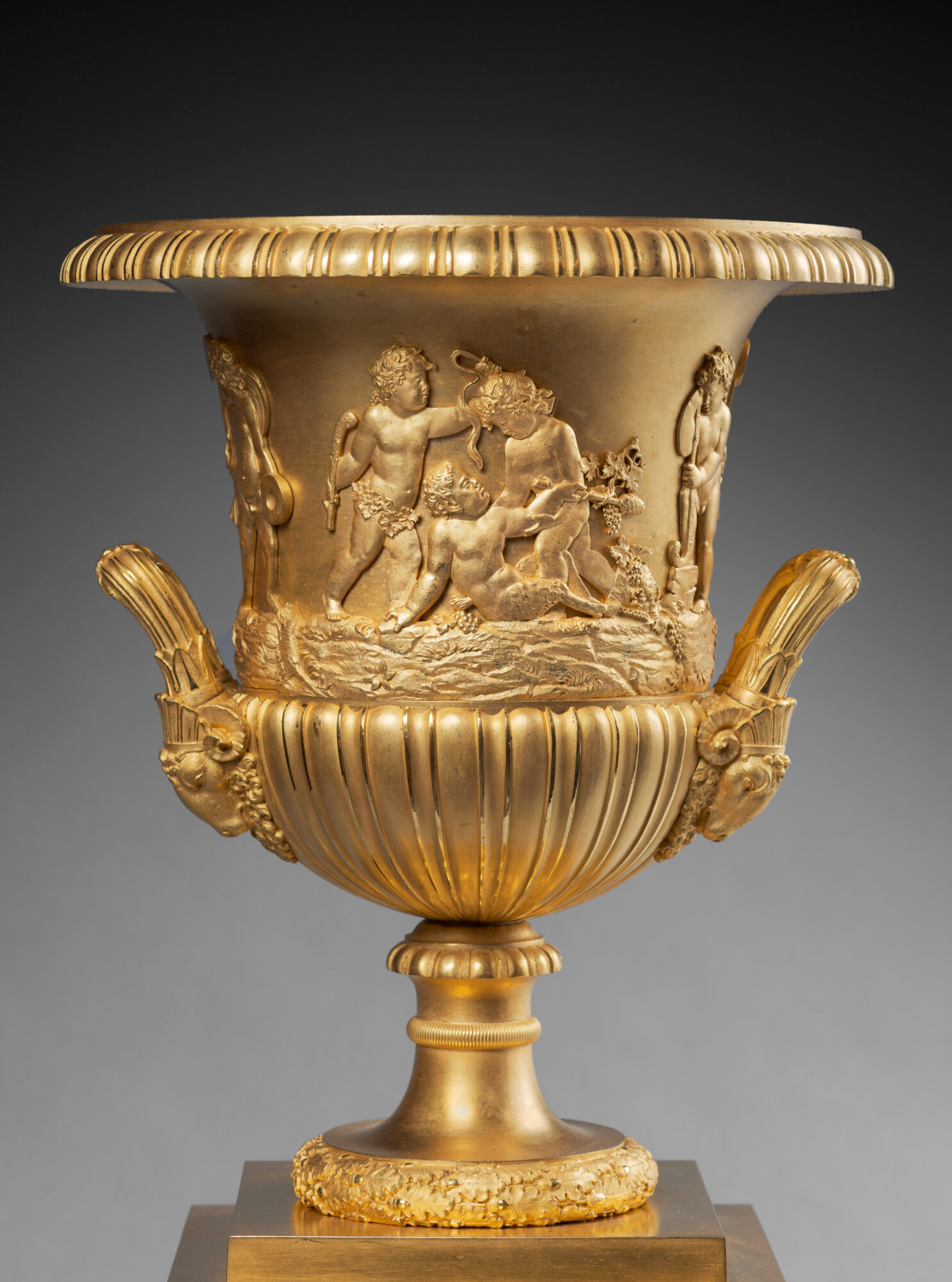
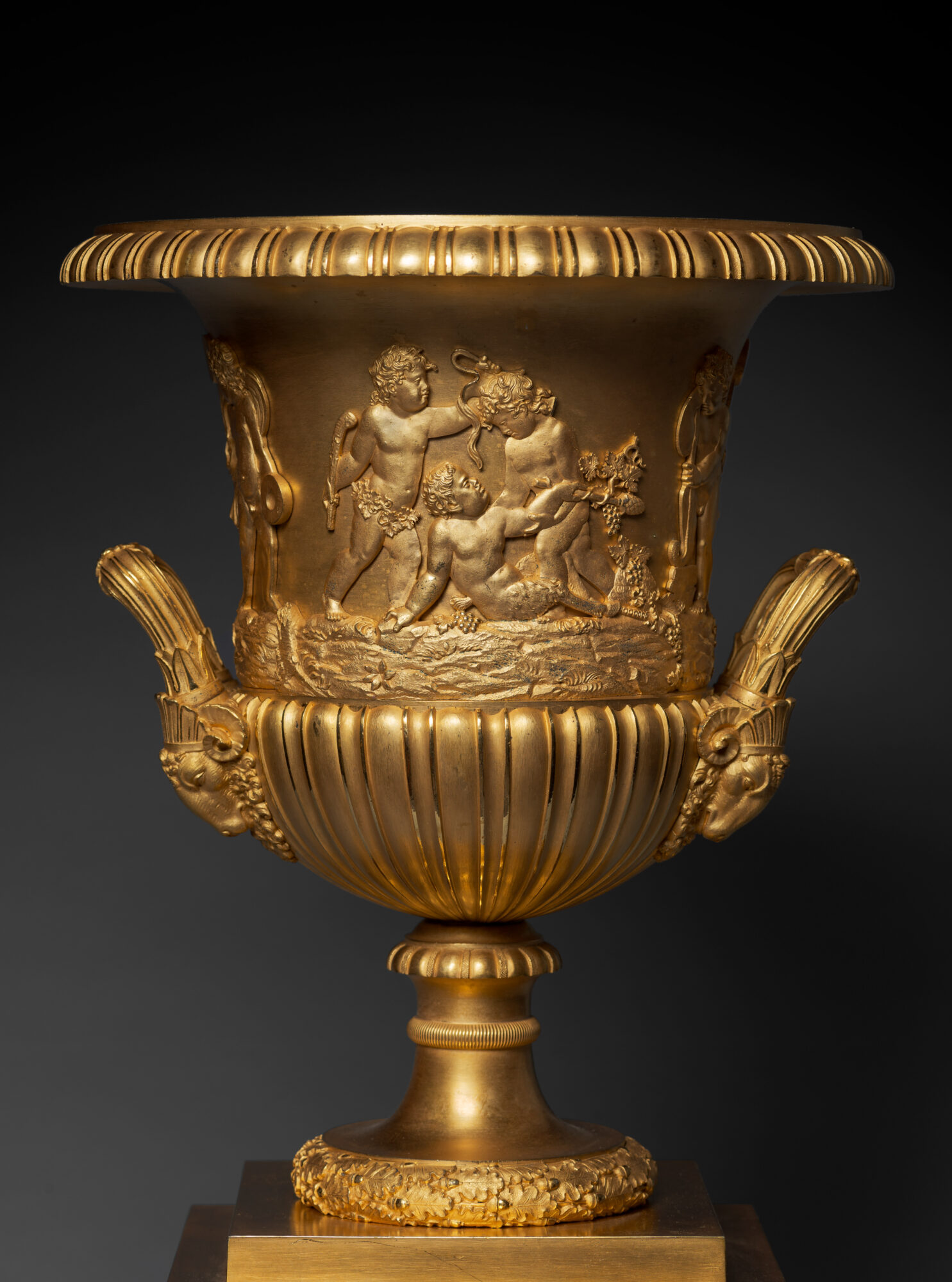
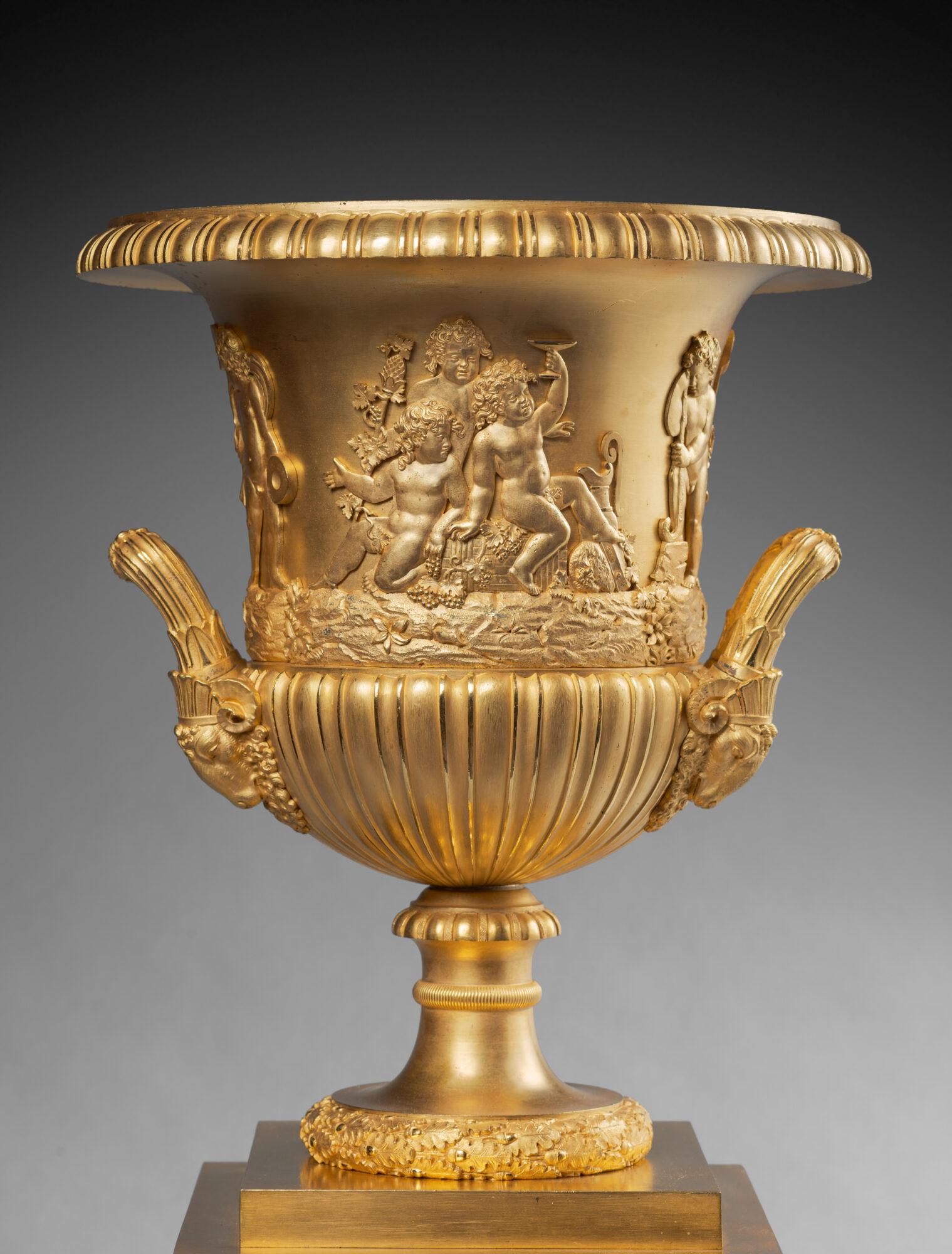
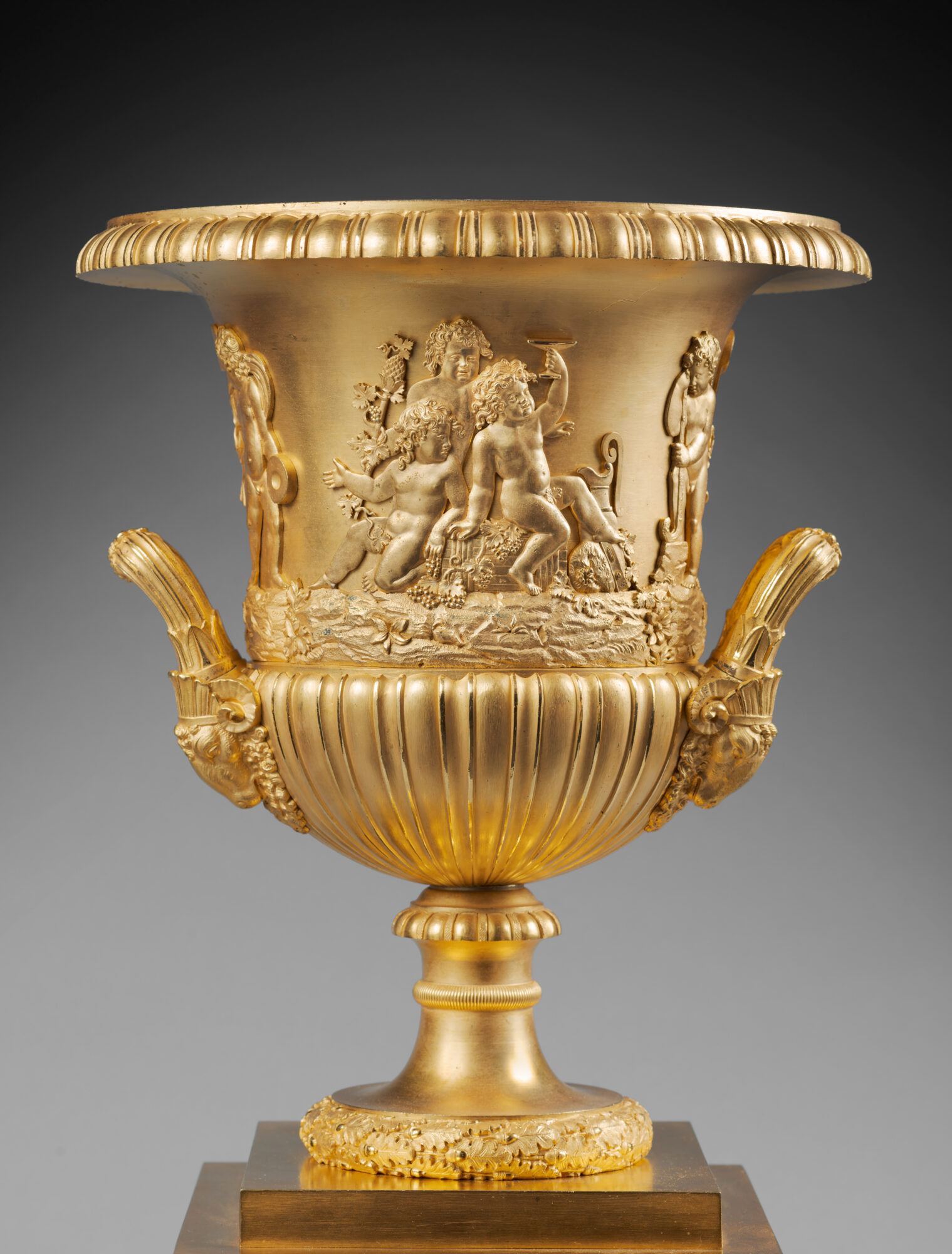
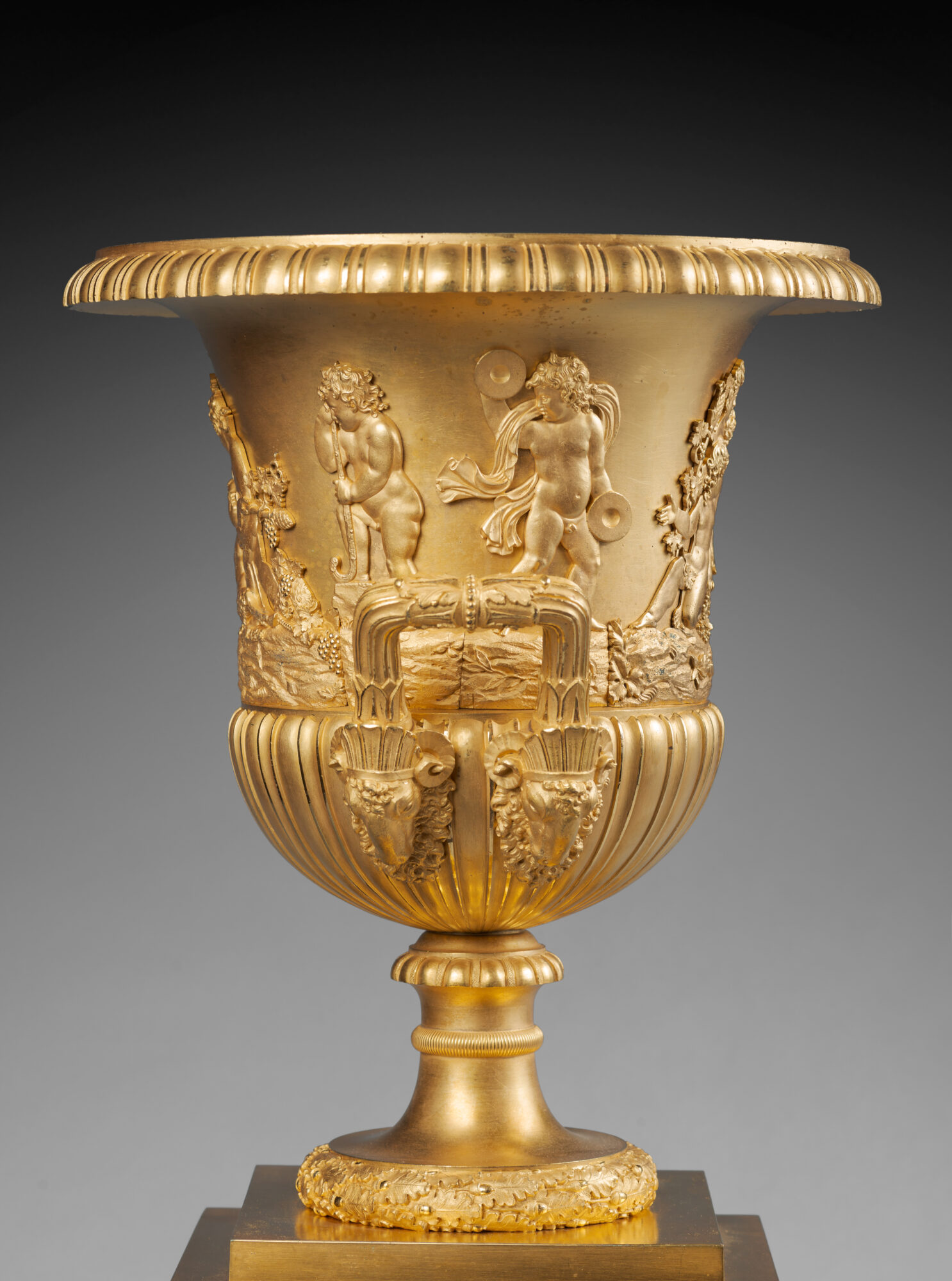
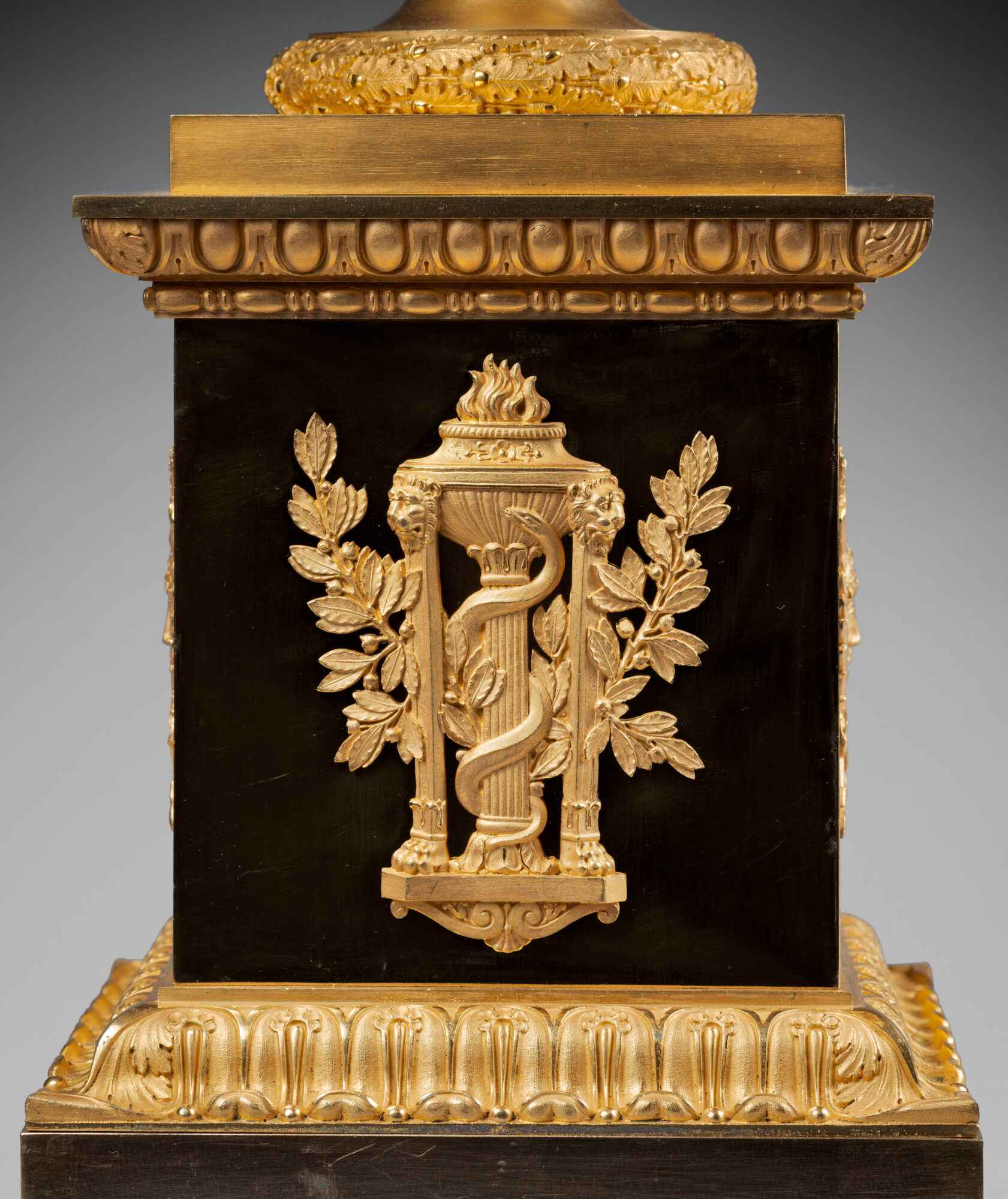
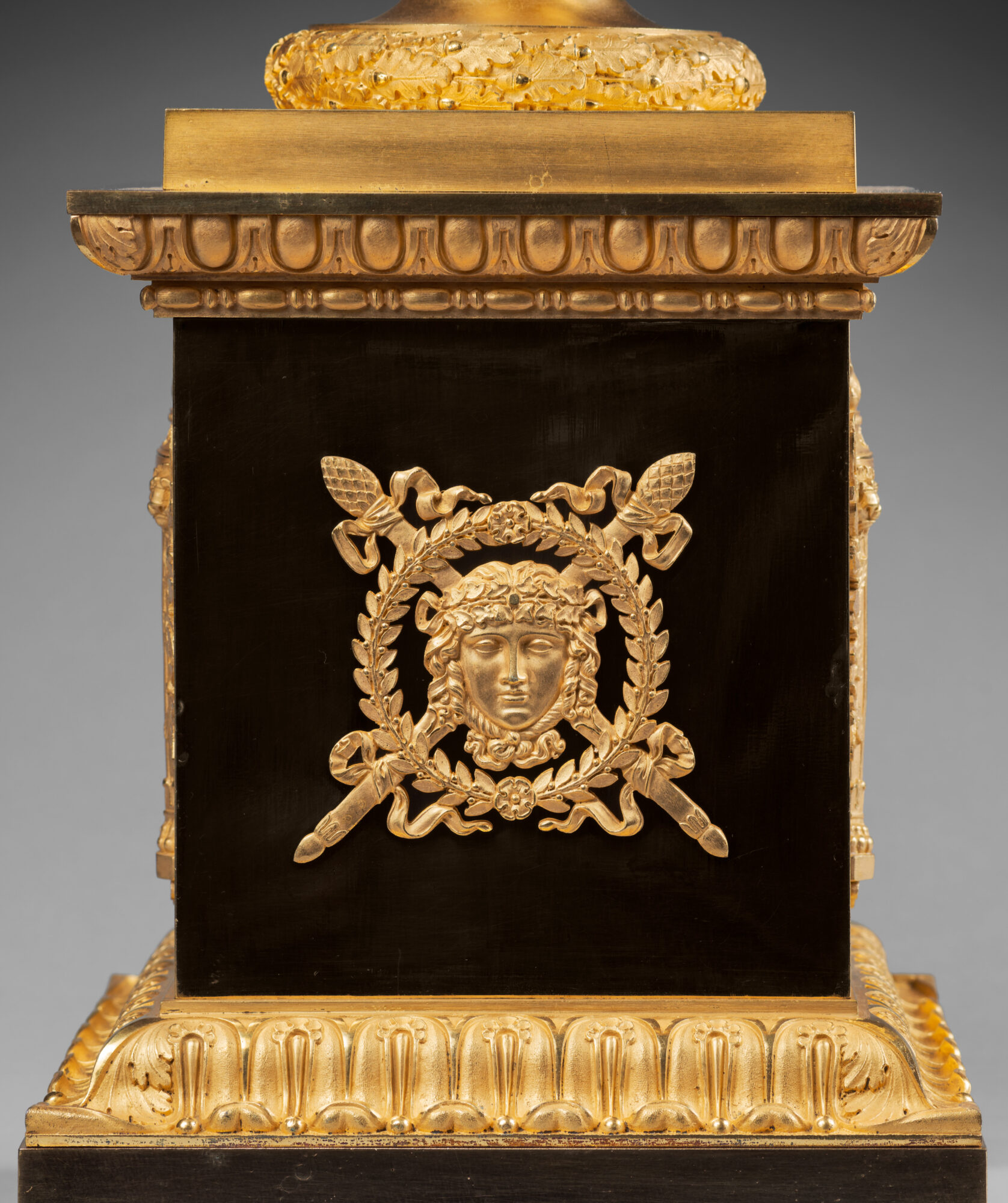
Made of finely chased gilt bronze with matte and burnished finishing, the vases are in the form of antique Campana vases, i.e. they are shaped like an upside-down bell. The sloping lips are decorated with a frieze of gadroons alternating with double bars. The bellies are decorated with bacchanalian scenes of putti and young satyrs against a plain ground and standing on naturalistic terraces. The lower portions of the vases, adorned with gadrooning and bands, feature applied handles with double rams’ heads linked by reeds emerging from bouquets of finely detailed leaves. The knopped pedestals are adorned with toruses of oak leaves and acorns; they are set on a quadrangular plinth that itself stands on an entablature with protruding cornice that is decorated with egg-and-dart friezes and beadwork, alternating with oval beads. The tall base is decorated with applied motifs of atheniennes that are decorated with lions’ heads and pillars adorned with laurel branches around which snakes are entwining themselves, or wreaths centered by masks of Bacchus and crossed thyrsi. Plinths with molding adorned with leaf friezes featuring acanthus leaves in their corners, support the composition.
The history of the present rare pair of vases is closely linked to that of Joachim Murat, one of the most important personalities of the first quarter of the 19th century, and one of Napoleon Bonaparte’s close friends.
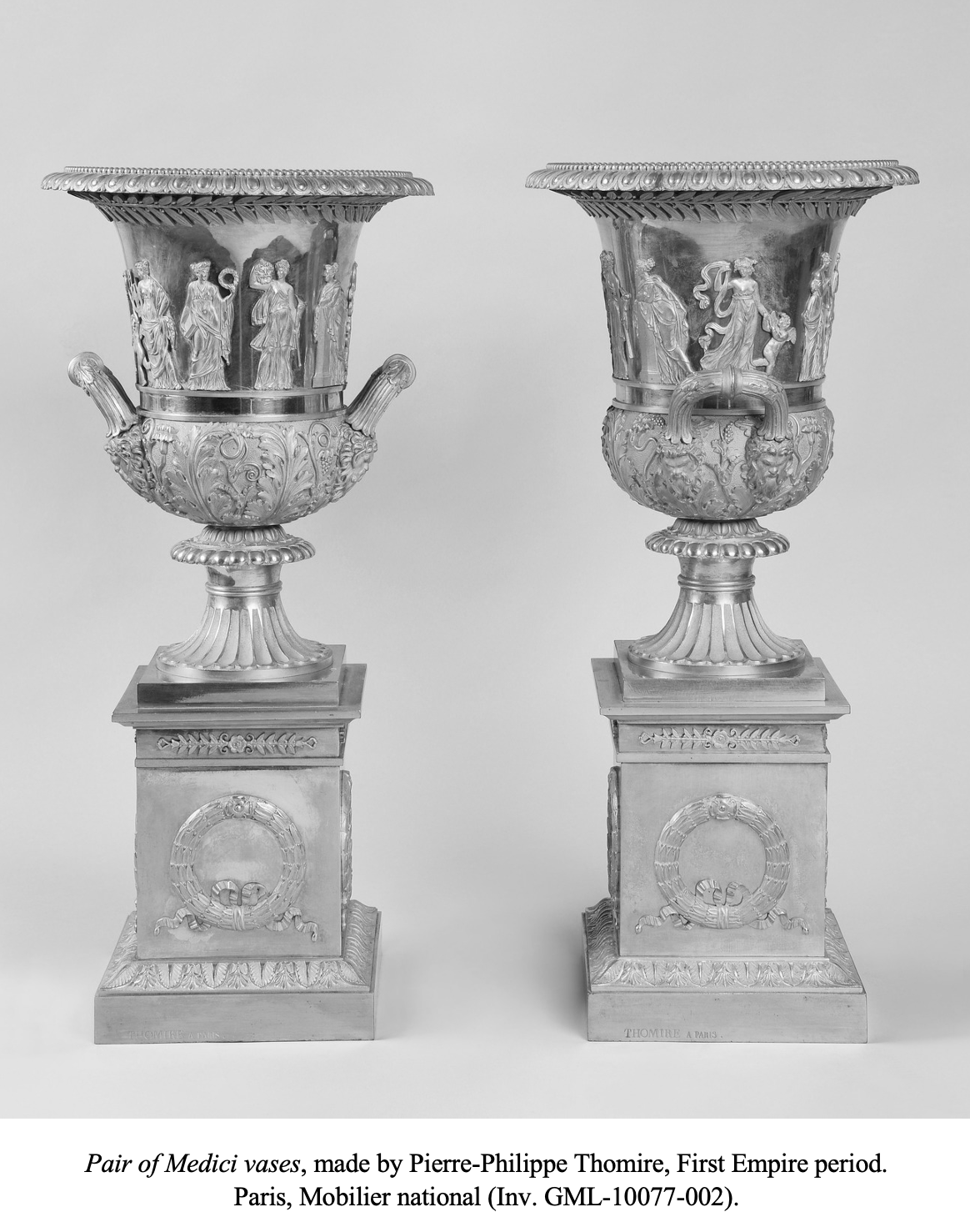
The exceptional quality of their chasing and gilding and their remarkable decoration allow them to be attributed to Pierre-Philippe Thomire, the most important Parisian bronze caster of the time. In creating them, Thomire was inspired by the shape of the famous “Borghese” vase, today in the Louvre Museum in Paris. Thomire took some liberties with the composition and added various ornaments when creating a limited number of similar vases, including one pair that is today in the Mobilier national in Paris (Inventory number GML-10077-002). A second pair is on display in the Royal Palace of Naples; it is illustrated in G. Zampino and F. Sardella, Soprintendenza per i Beni Ambientali e Architettonici di Napoli e Provincia, Il Palazzo Reale di Napoli, Editions Electa, Naples, 1995, p. 62.
Pierre-Philippe Thomire was the most important Parisian bronzier of the last quarter of the 18th century and the first decades of the following century. Early on in his career he worked for Pierre Gouthière, ciseleur-fondeur du roi, and toward the mid-1770’s began working with Louis Prieur. He later became one of the bronziers attached to the Manufacture Royale de Sèvres, creating the bronze mounts for most of the important creations of the day. After the Revolution, he purchased the stock of Martin-Eloi Lignereux, thus becoming the most important suppliers of furniture bronzes for châteaux and Imperial Palaces. In addition, he worked for a wealthy private clientele, both French and foreign, including several of Napoleon’s Marshals. Thomire retired in 1823.
Joachim Murat was one of Napoleon Bonaparte’s most important Marshals. He married the Emperor’s younger sister Caroline. Murat and his wife were important and influential collectors, who resided at first in the Hôtel de Thélusson, a magnificent neoclassical mansion built in the 1780s by the architect Ledoux. In 1805 they acquired the Élysée Palace, today the residence of the President of the French Republic, carrying out extensive renovations and furnishing it with great care. The palace was finished in late 1806. Architects Vignon and Thibault were in charge of the renovation, while the furnishings and carpentry were entrusted to the Jacob-Desmalter workshop. The bronze pieces were furnished by Ravrio, and the textiles tapestries by Boulard. All were selected for the exceptional quality of their creations and for their reputation. However, the Murats did not long enjoy their luxurious mansion, for after the Emperor’s brother Joseph was crowned king of Spain, Murat replaced him on the throne of Naples, from 1808 to 1815. Yet again, the Murats became known for the renovation and the decoration of their residences in Naples; they gathered together an important collection of Italian paintings, objets d’art, and bronze furnishings which they ordered in Paris. In 1815, Murat was driven out of Naples by the Austrians and the British. He fled to Corsica, where he was captured and executed. After his death, the majority of his collection was sold at auction. It was acquired by Marquis Emilio Tortora Brayda di Belvedere for his homes in Molfetta and Manfredonia.