search icon
Galle  -  Minet
Claude Galle (1759-1815)

Important Mantel Clock in Green-Sea Marble and Gilt Bronze

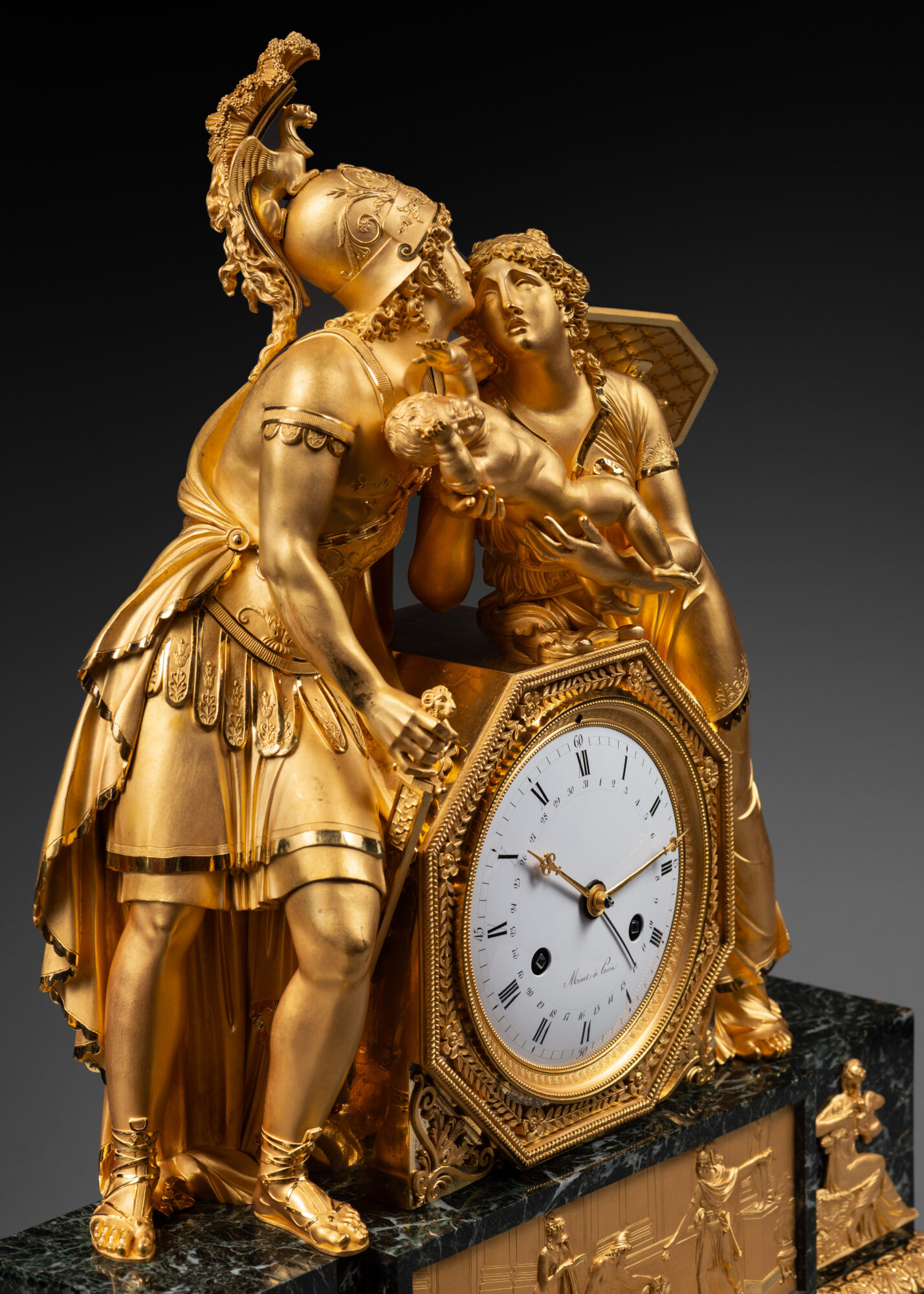
The Farewell Between Hector and Andromache

Pendule_542-05_HD_WEB

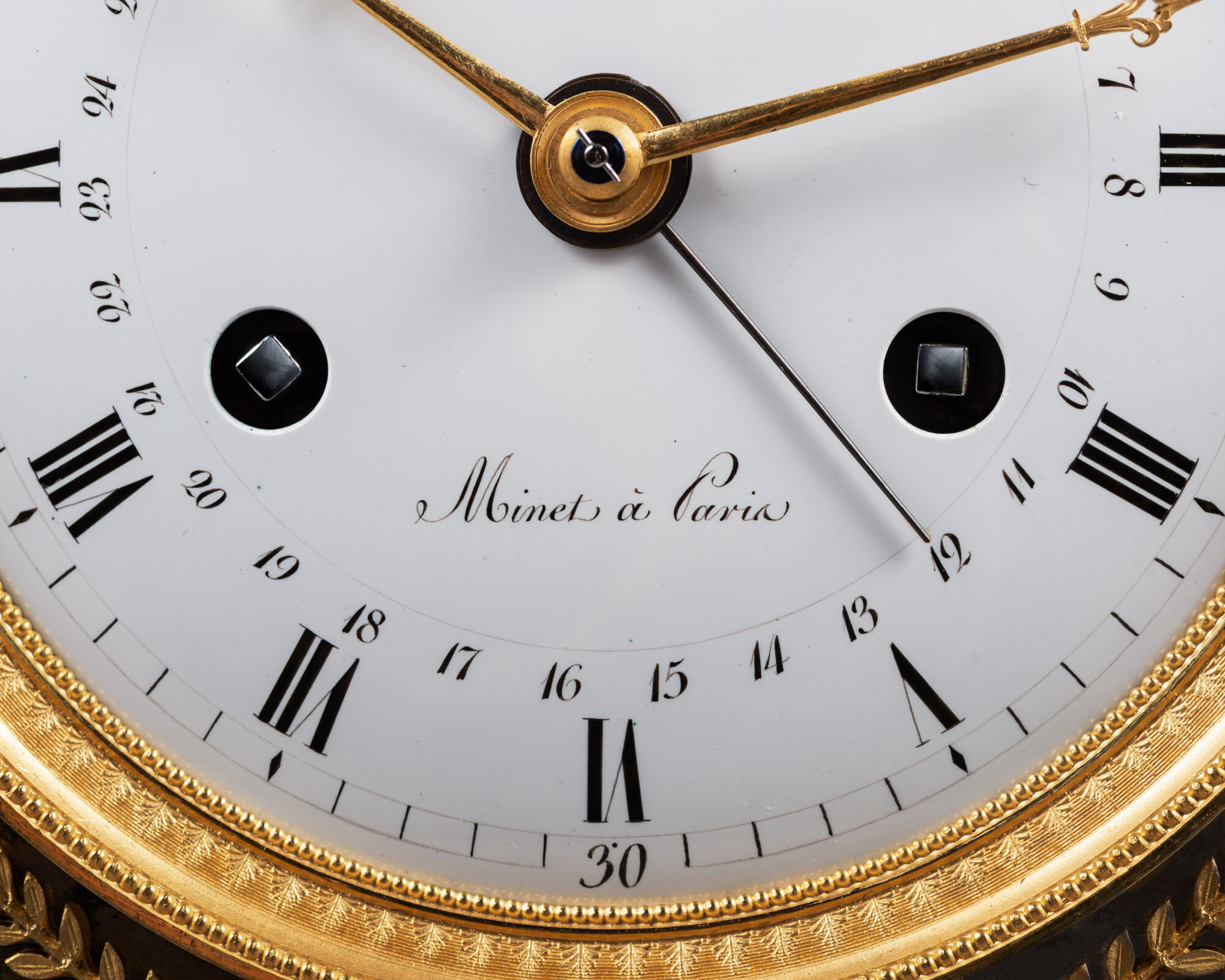
Dial signed “Minet à Paris” by clockmaker Nicolas Minet

Case attributed to bronze-caster Claude Galle

Paris, Empire period, circa 1805-1810

Height62 cm Width50.5 cm Depth15 cm

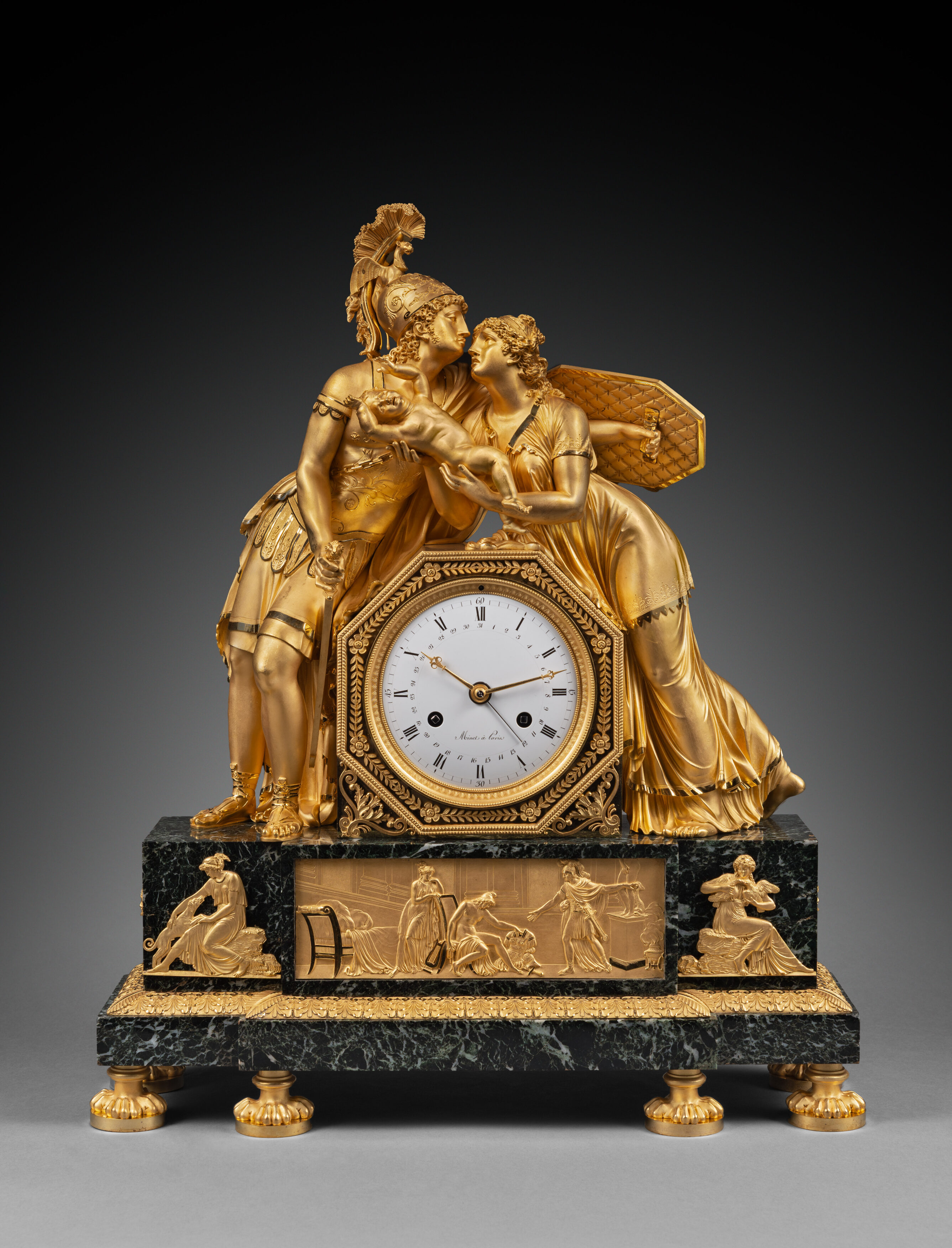
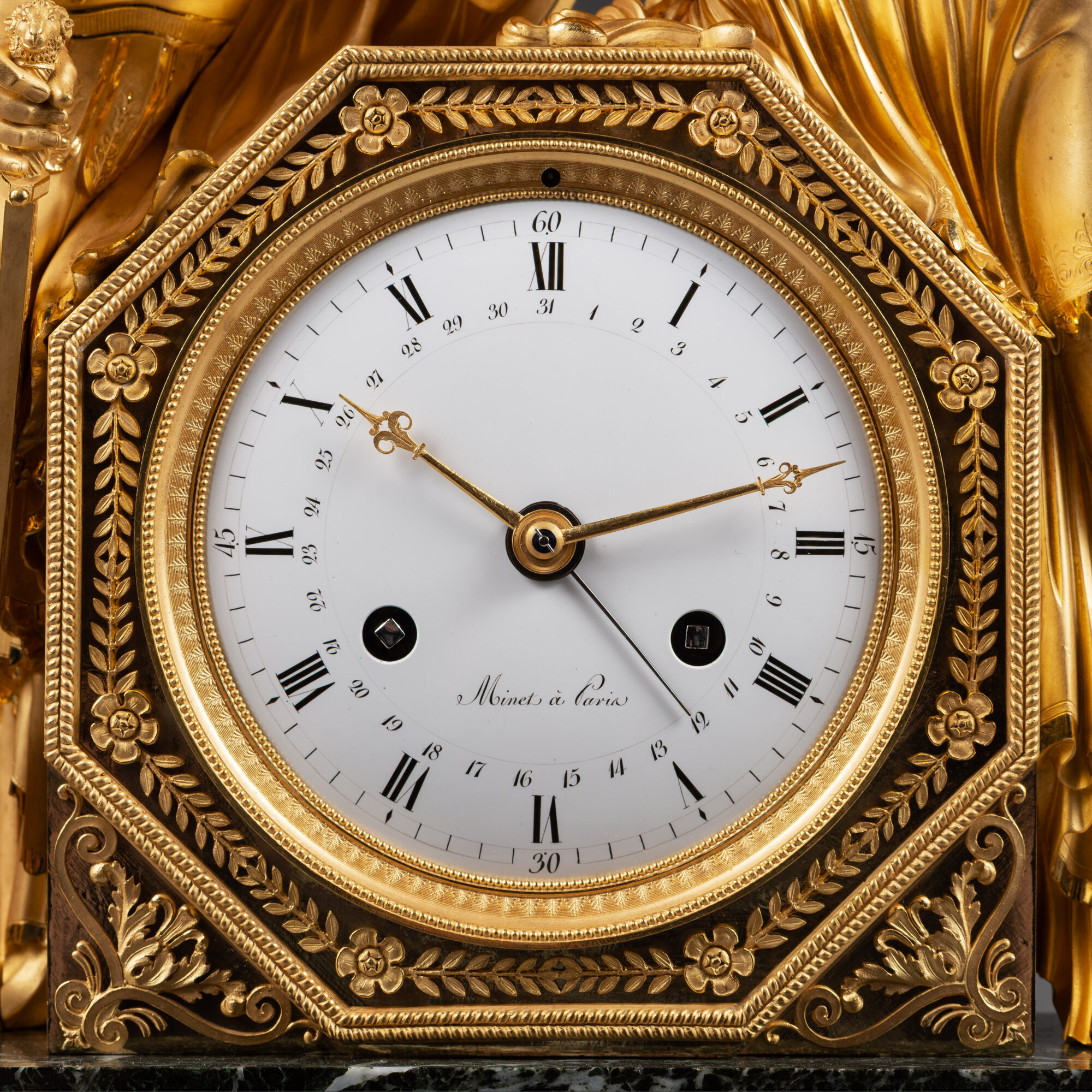
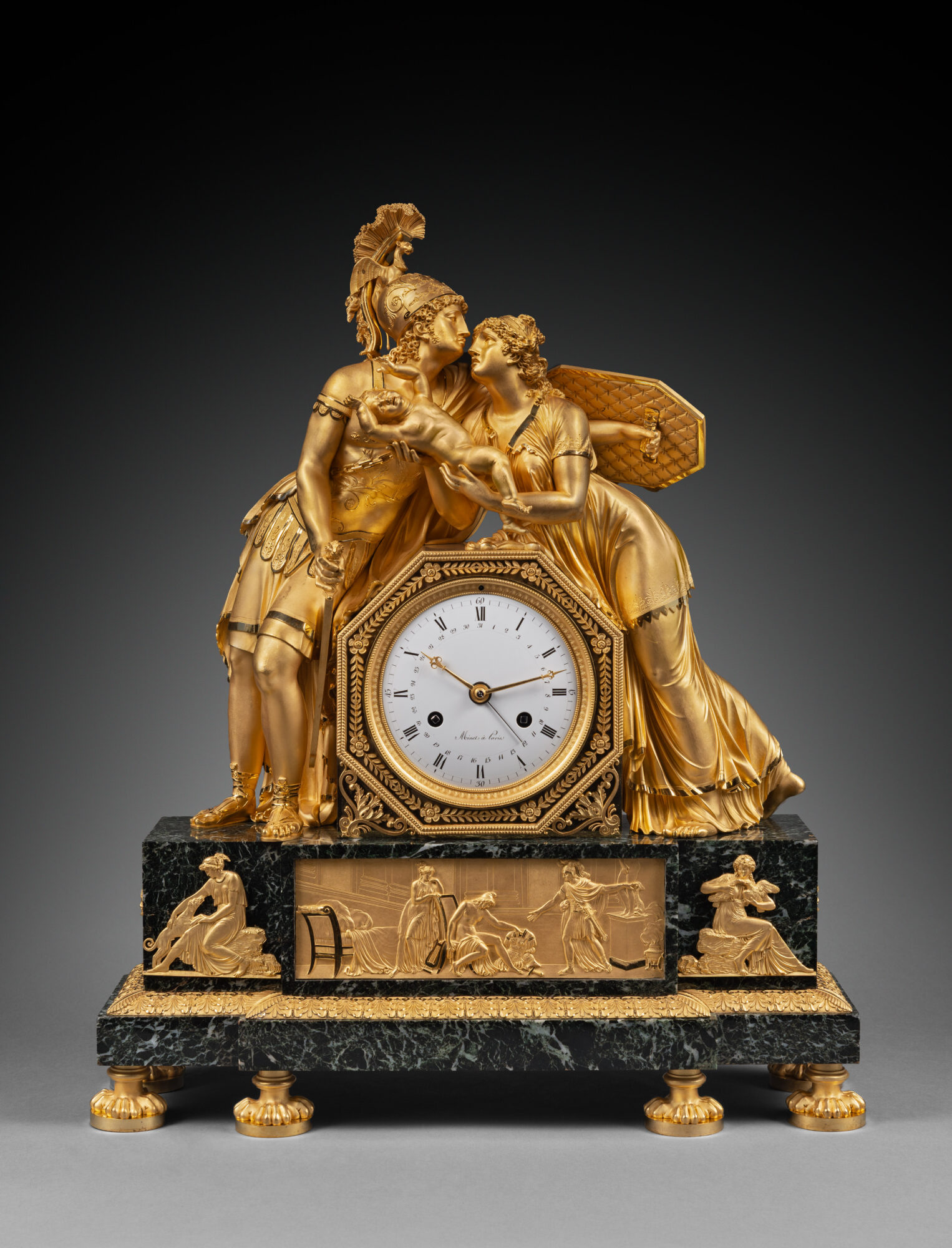
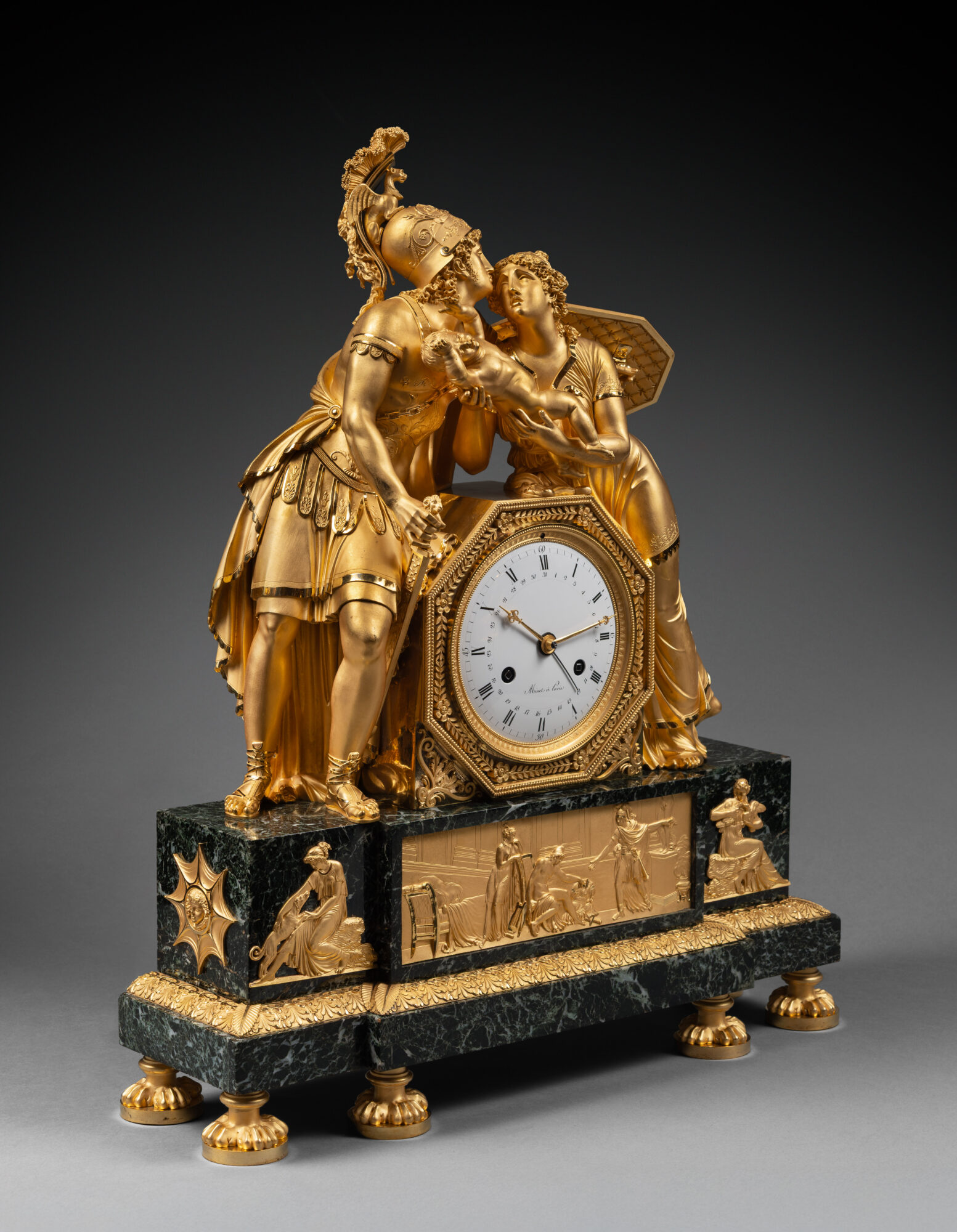
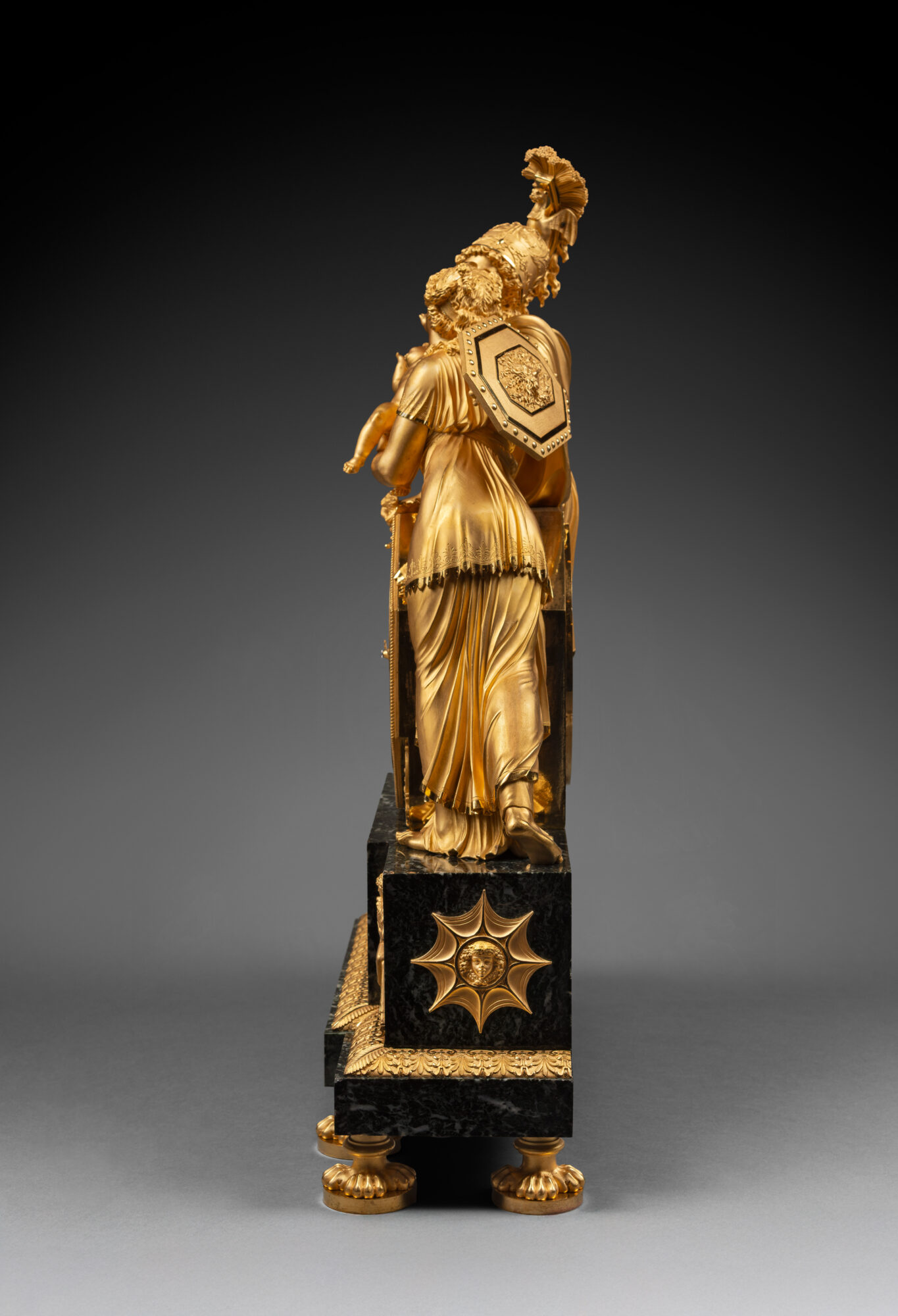
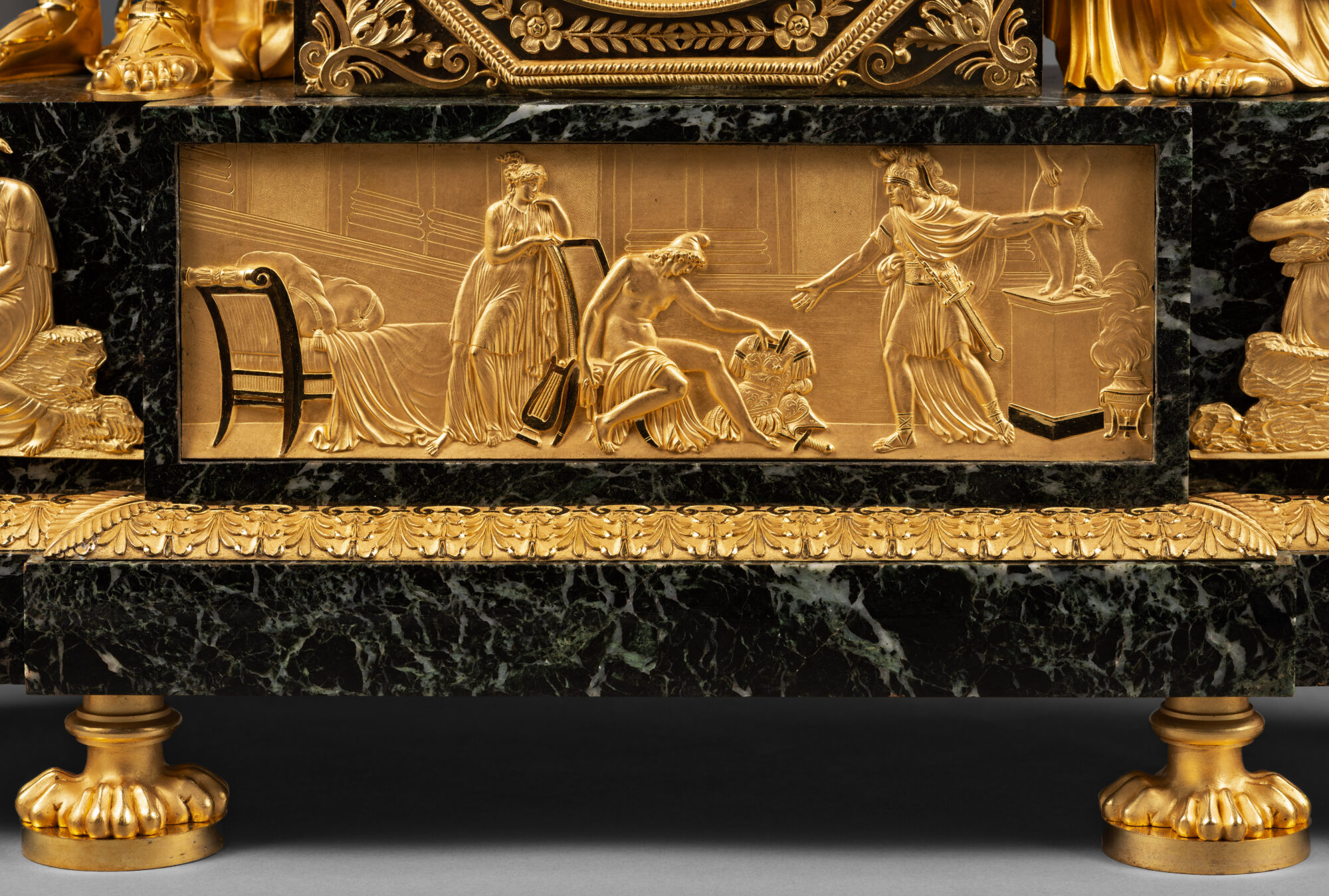
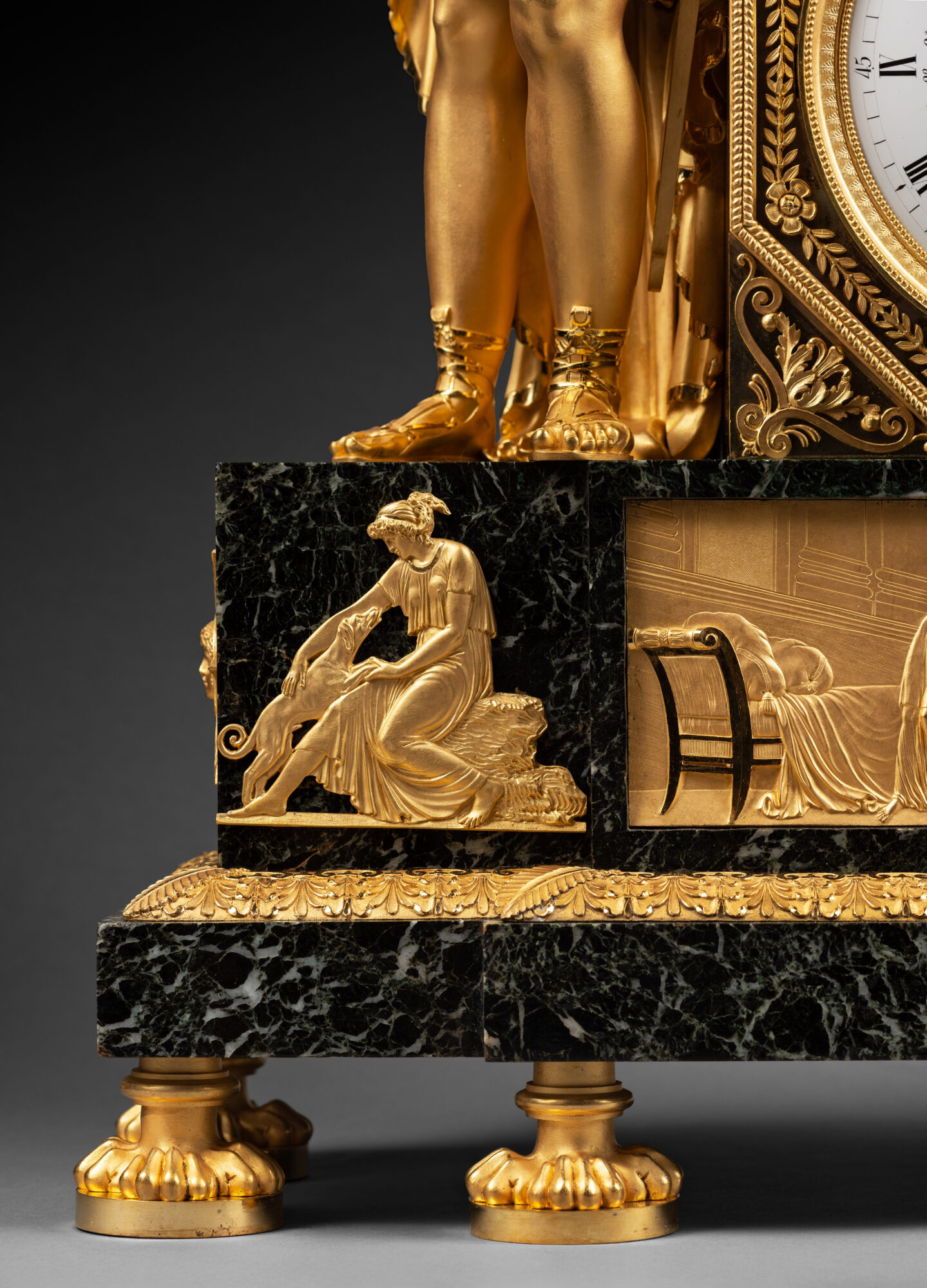
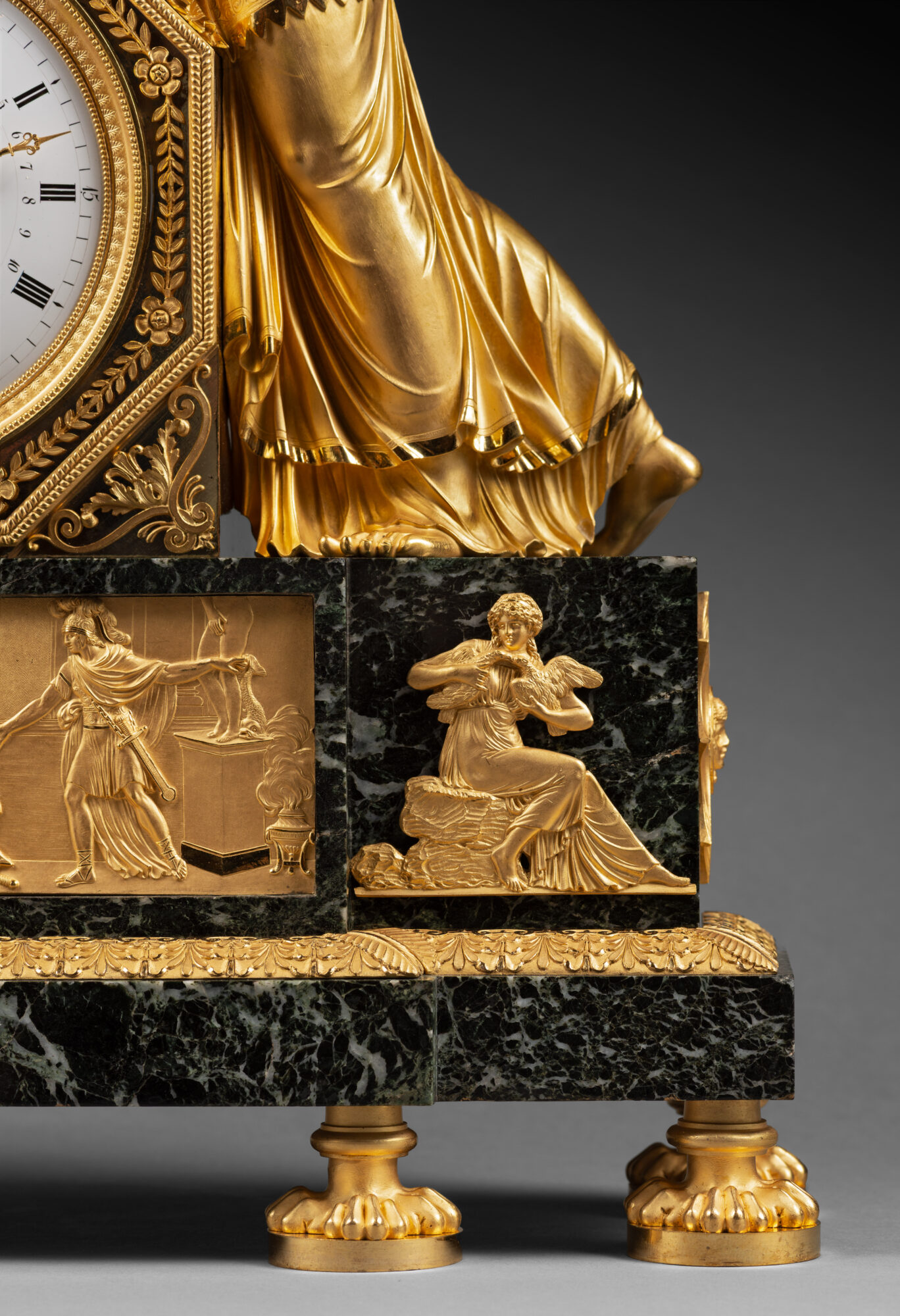
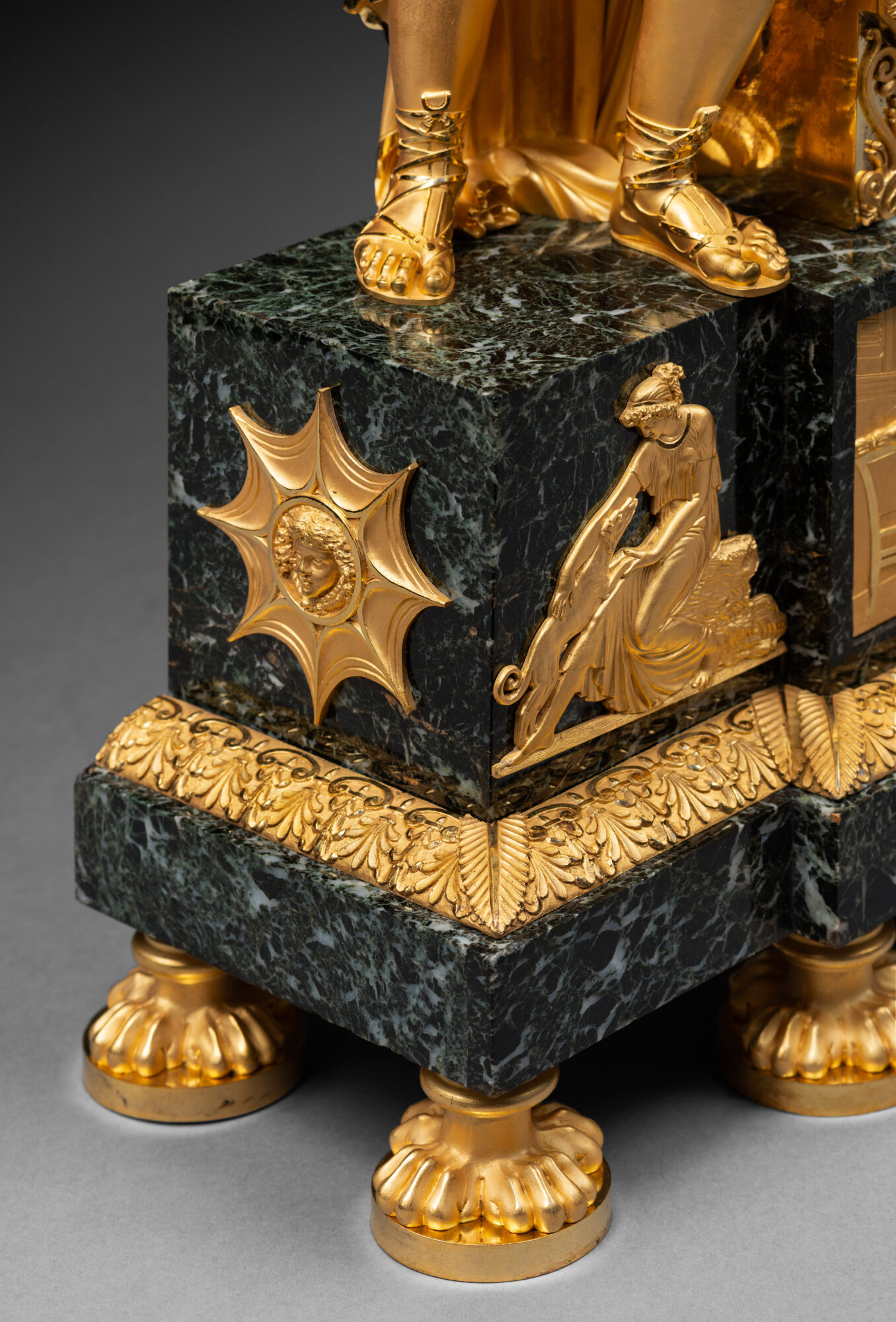
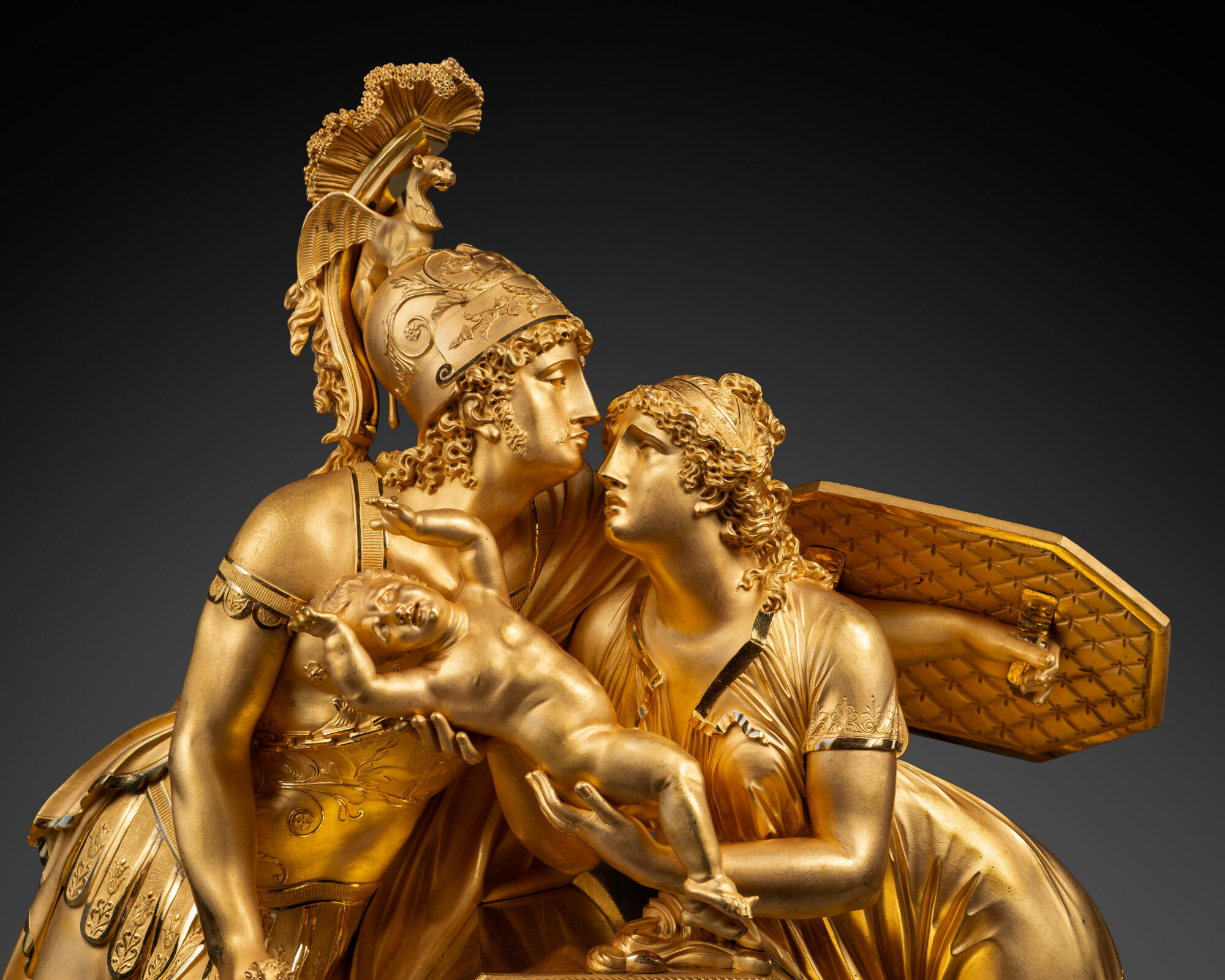
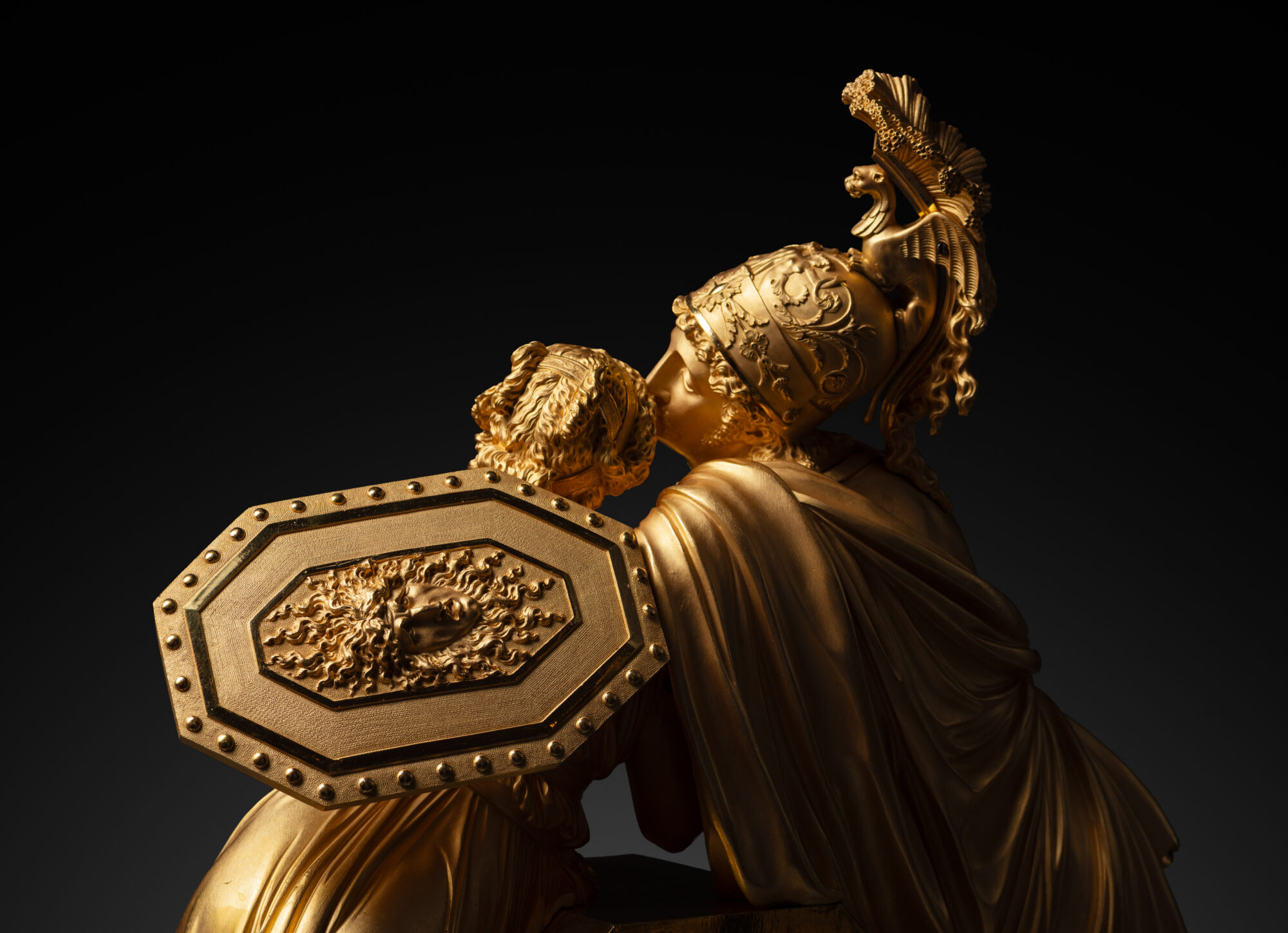
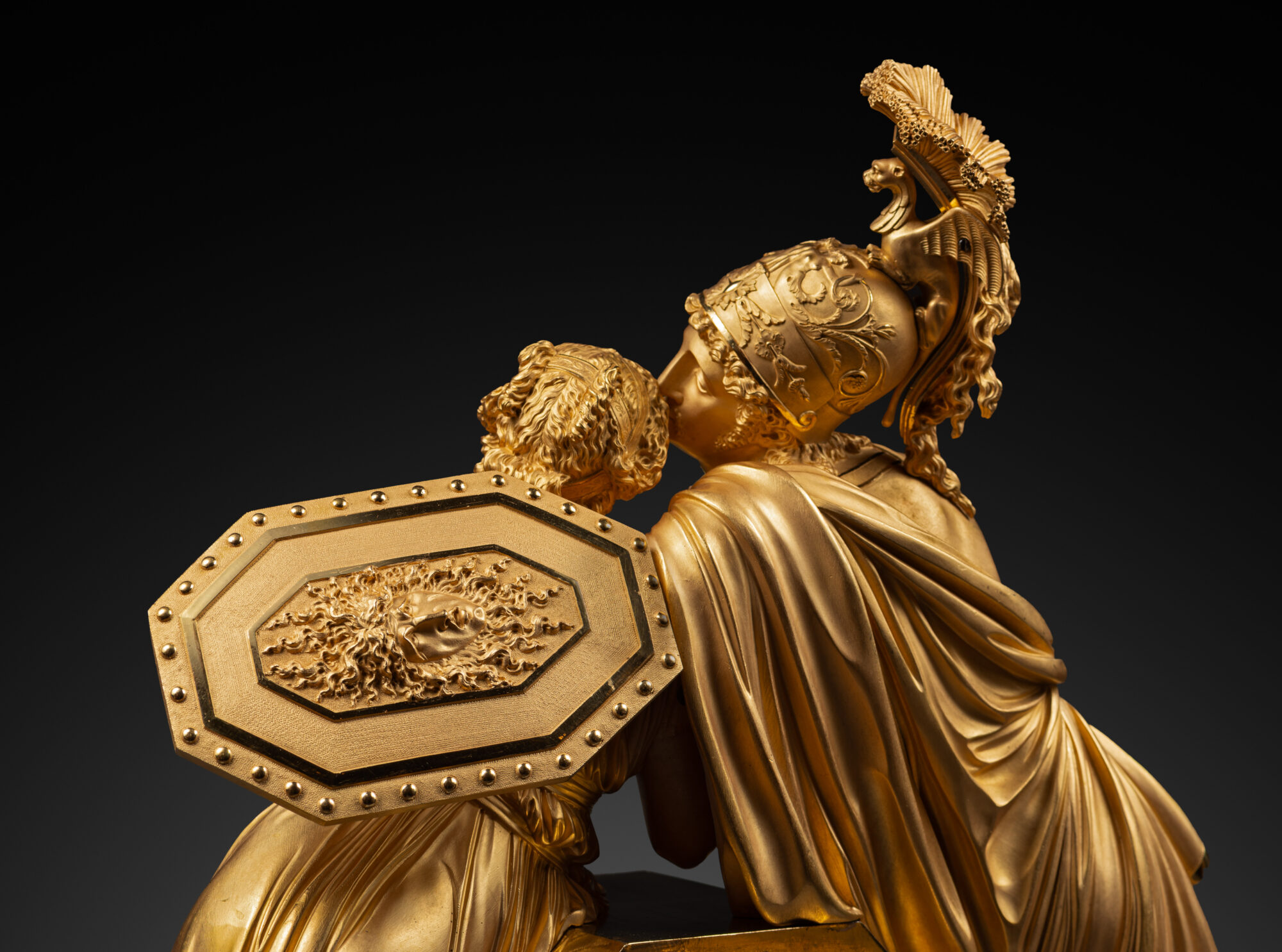
The enamel dial is signed “Minet à Paris. It features Roman numeral hours, the minute graduations and the date of the month graduated from 1 to 31 in Arabic numerals, indicated by two pierced gilt bronze hands and the third in blued steel. Housed in a case made of vert-de-mer (green-sea) marble and finely chased and gilt bronze in matte and burnished finishing, the dial is enclosed in an octagonal box, framed by a rare decoration of finely chased flowerets and leaves, on which two superb figures stand. A warrior in antique dress, with a crested helmet embellished with a small dragon, holds his ram-headed sword and shield decorated with a mask of the divinity Medusa. He is about to kiss a woman dressed in antique drapery, who tenderly holds out a baby to him. This scene from the Trojan War depicts the farewell between Hector, his wife Andromache and their young son, Astyanax. The moulded rectangular base is decorated with low-relief scenes relating to the main subject, with allegories of conjugal love and fidelity at the corners and in the centre, a depiction of Hector asking his brother Paris to fight to defend the city of Troy. Finally, four finely worked feet composed of lion’s paws finish the composition.

This clock depicts a scene from Homer’s famous epic poem the Iliad that Racine mentions in his “Andromache”, recounting the Trojan War, waged by the Greeks against Troy, a city in Asia Minor. The Trojan prince Hector, brother of Paris, bids farewell to his wife Andromache and their son. The moment is both tragic and moving, for Hector, who has killed Achilles’s friend Patrocles, is about to face the Greek hero in combat. Both he and his wife know that he will die at the hands of Achilles, the son of Thetis.

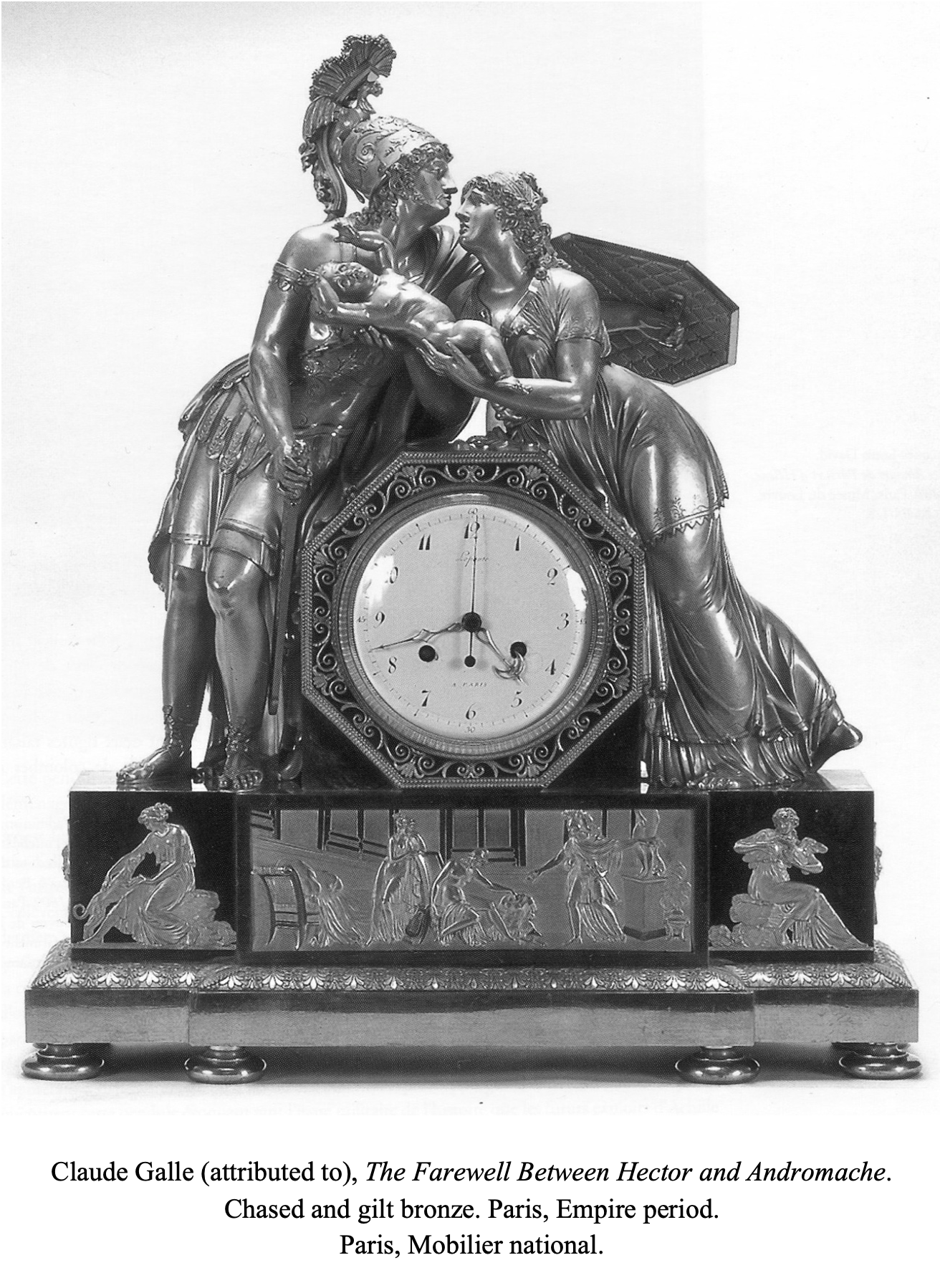
Among the very few identical clocks known, one example is in the Montplaisir Palace in Peterhof (illustrated in A. Chenevière, Splendeurs de mobilier russe 1780-1840, p. 188, fig. 193); a second, whose dial is signed Lepaute, was delivered in 1805 for the Grand Salon of the Petit Trianon; it in the collections of the Mobilier national in Paris (see M-F. Baylet-Dupuy, Pendules du Mobilier national 1800-1870, Dijon, 2006, p. 111); yet another example, with dial signed  “Galle rue Vivienne”, is in a private collection; it is pictured in H. Ottomeyer and P. Pröschel, Vergoldete Bronzen, Munich, 1986, p. 366, fig. 5.13.3.

Claude Galle (1759 - 1815)

One of the foremost bronziers and fondeur-ciseleurs of the late Louis XVI and Empire periods, Claude Galle was born at Villepreux near Versailles. He served his apprenticeship in Paris under the fondeur Pierre Foy, and in 1784 married Foy’s daughter. In 1786 he became a maitre-fondeur. After the death of  his father-in-law in 1788, Galle took over his workshop, soon turning it into one the finest, and employing approximately 400 craftsmen. Galle moved to Quai de la Monnaie (later Quai de l’Unité), and then in 1805 to 60 Rue Vivienne.

The Garde-Meuble de la Couronne, under the direction of sculptor Jean Hauré from 1786-88, entrusted him with many commissions. Galle collaborated with many excellent artisans, including Pierre-Philippe Thomire, and furnished the majority of the furnishing bronzes for the Château de Fontainebleau during the Empire. He received many other Imperial commissions, among them light fittings, figural clock cases, and vases for the palaces of Saint-Cloud, the Trianons, the Tuileries, Compiègne, and Rambouillet. He supplied several Italian palaces, such as Monte Cavallo, Rome and Stupinigi near Turin.

In spite of his success, and due in part to his generous and lavish lifestyle, as well as to the failure of certain of his clients (such as the Prince Joseph Bonaparte) to pay what they owed, Galle often found himself in financial difficulty. Galle’s business was continued by his son after his death by his son, Gérard-Jean Galle (1788-1846). Today his work may be found in the world’s most important museums and collections, those mentioned above, as well as the Musée National du Château de Malmaison, the Musée Marmottan in Paris, the Museo de Reloges at Jerez de la Frontera, the Residenz in Munich, and the Victoria and Albert Museum in London.


Discover our entire collection of rare clocks on La Pendulerie Paris.