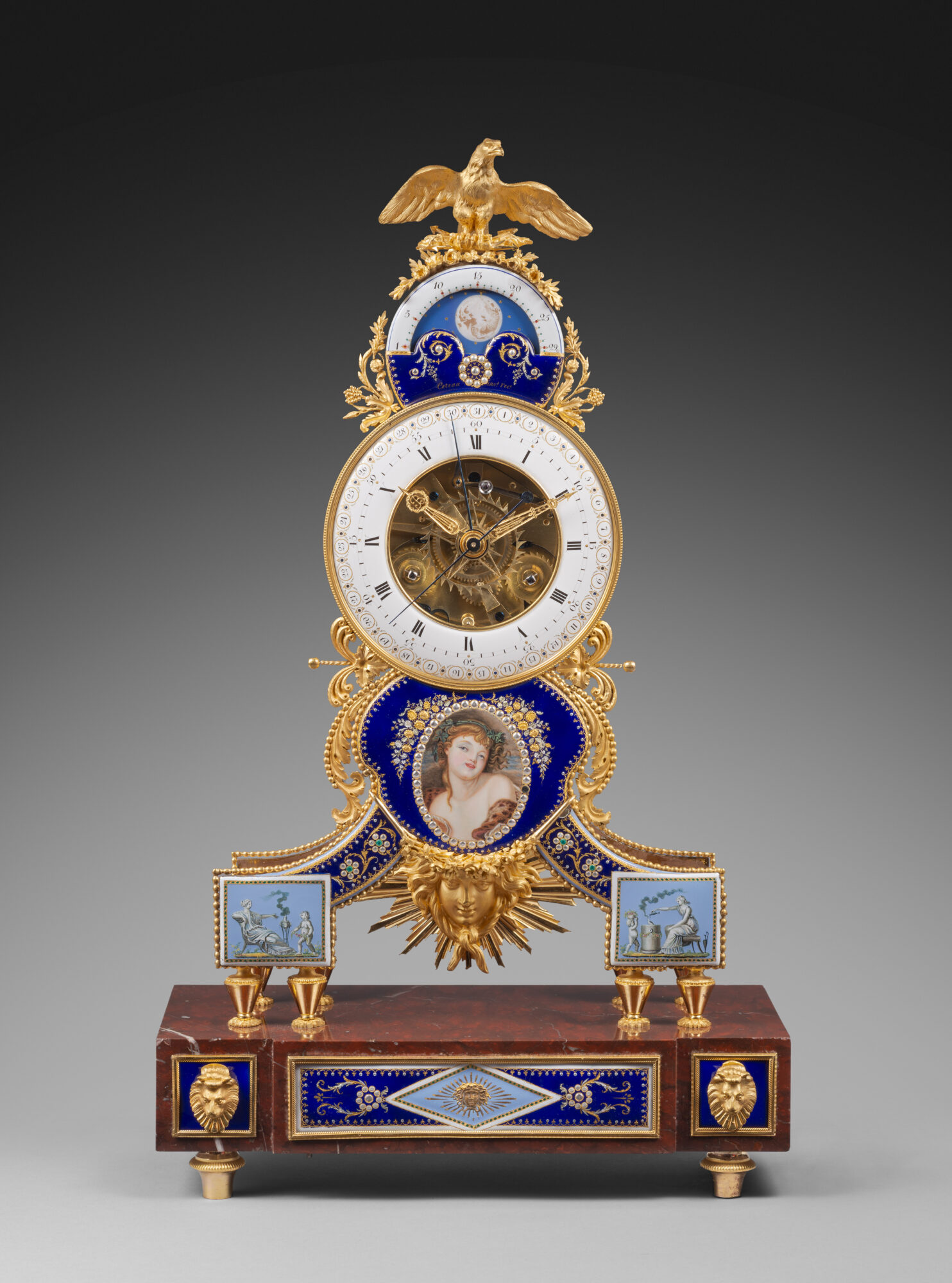
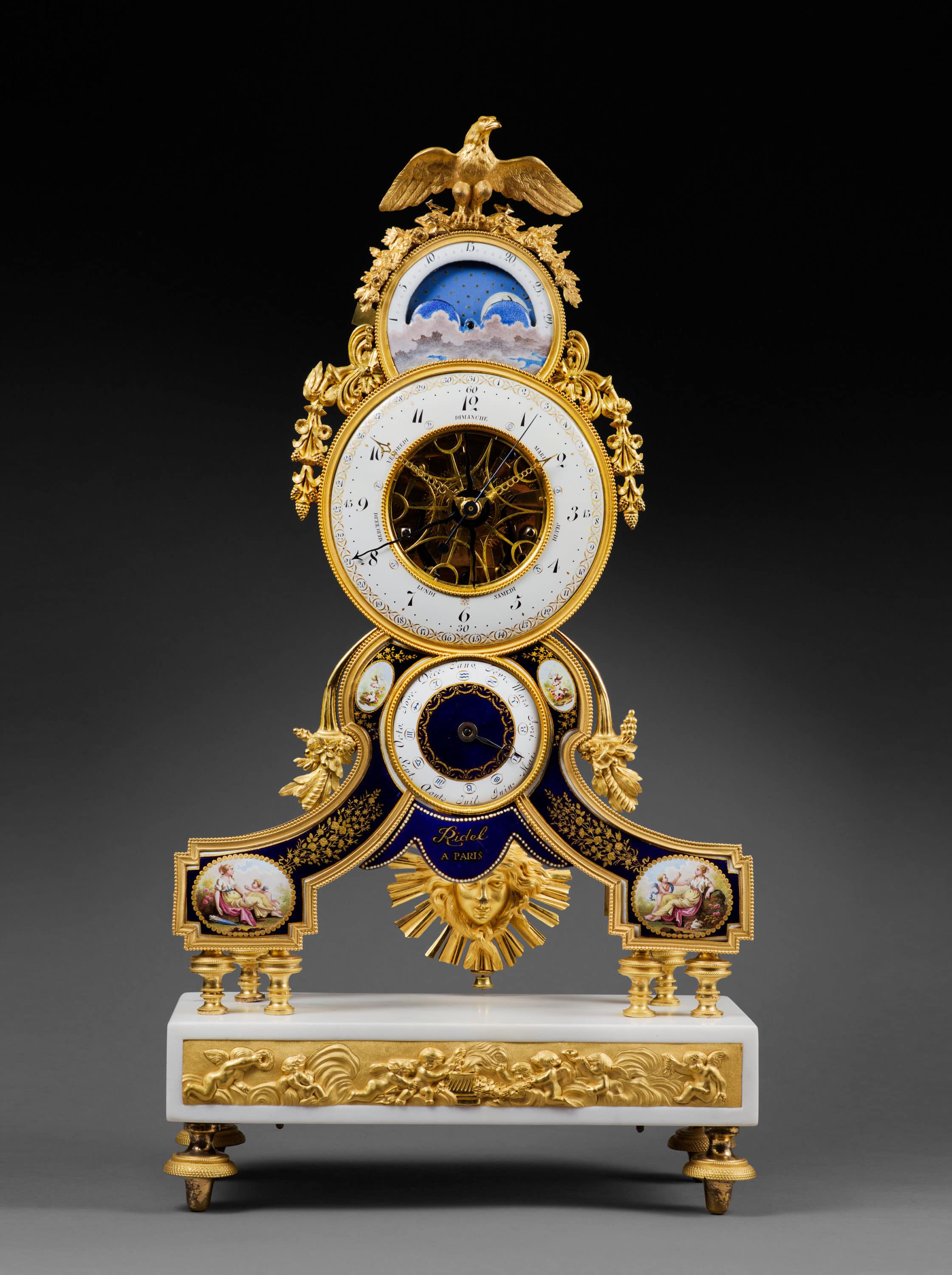
The enameled ring dial indicates the Roman numeral hours, the Arabic numeral five-minute intervals, and the date along its outer border, in medallions alternating with cabochons and linked by gilt garlands, by means of three hands, two of which are in pierced and chased gilt bronze, and one with a with a wreath centered by the letter “B“. It also indicates the seconds by means of a central blued steel hand. It is surmounted by an enameled disk signed “Coteau inv.t Fec.t” (from the Latin “Coteau Invenit et Fecit”, which means “Coteau invented and made”) – indicating the age and phases of the moon. The hour and half-hour striking movement, with its pendulum adorned with a mask of Apollo, is housed in a case in the form of an upside-down double Y, which is decorated on the front with enamel plaques and finely chased matte gilt bronze mounts. The clock is surmounted by an eagle with outstretched wings, holding a thunderbolt and standing on leafy foliage. The sides and the façade are adorned with flowers, foliage, scrolls, seeds, garlands of flowers and spiral rods. The tapering feet are adorned with beads. The clock is embellished with blue-ground enamel plaques decorated with flowers, garlands, and scrolls. Under the dial sous there is an oval medallion depicting a woman dressed in the skin of a feline and wearing on her head a wreath of grape vines, painted in the manner of Greuze and probably representing an actress playing the role of Omphale. The lower portion of the clock features two rectangular plaques with classical grisaille scenes depicting sacrifices to the god of Love. The clock stands on a quadrangular red griotte marble base with reserves adorned with three enamel plaques, those on the sides with a blue ground and lion’s heads, the protruding central one with a lozenge centered by a sun mask and framed by flowers. The clock is raised on four feet decorated with ove friezes.
The first skeleton clocks appeared during the last decade of the 18th century. These clocks feature a sober design with a main ring dial that reveals the beautiful movement with its gears, and the complexity of the mechanisms made by the finest European clockmakers, mostly Parisian. The new esthetic movement grew out of the admiration, on the part of horological enthusiasts, for the technical progress that had been made since the mid-18th century, and on the other hand the fact that the public had tired of clocks depicting allegorical subjects and figures from Greek and Roman mythology. The present clock was created in that particular context. Its luxurious design is typical of the finest work of the French decorative arts during the reign of Louis XVI.
In Greek and Roman mythology, Omphale, a princess of Lydia, freed Hercules from the slavery he had entered into after being punished by Apollo’s oracle. She then became Hercules’ wife and, in an episode told by the poet Ovid, disguised herself as her husband, donning the Nemean lion’s skin, and carrying his quiver and heavy club. In the present portrait of Omphale, she is wearing the lion’s skin and an oak wreath, symbolizing strength and heroic virtue, and with which Hercules is sometimes depicted in 18th century’s art.
The present clock is remarkable due to its exceptional enamel decoration that highlights the medallion with the female portrait, an extremely rare ornamental motif that was no doubt created and commercialized directly by Coteau, which would explain the “Invt Fect” signature. To the best of our knowledge, only one other clock presents the portrait of a woman by the enameller: resting on a white Carrara marble base with reserves adorned with enamel plaques, it also bears the signature “Coteau Invenit Fecit” and was formerly in the Rothschild collection in Mentmore Towers (sold Sotheby’s, May 18, 1977, lot 6).
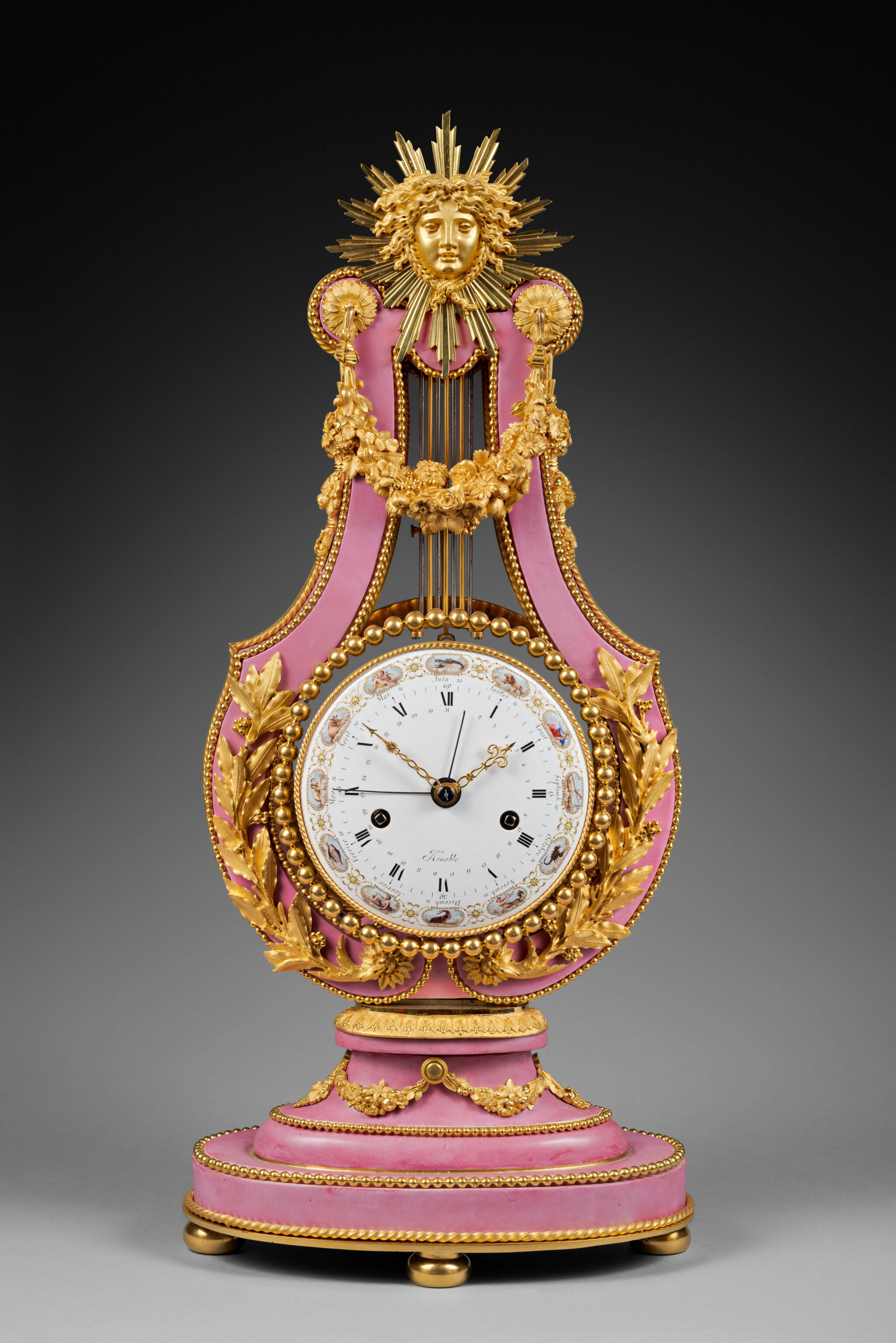
The most renowned enameller of his time, he worked with most of the best contemporary Parisian clockmakers. He was born in Geneva, where he was named master painter-enameler of the Académie de Saint Luc in 1766. Several years later he settled in Paris, and from 1772 to the end of his life, he was recorded in the rue Poupée. Coteau is known for a technique of relief enamel painting, which he perfected along with Parpette and which was used for certain Sèvres porcelain pieces, as well as for the dials of very fine clocks. Among the pieces that feature this distinctive décor are a covered bowl and tray in the Sèvres Musée national de la Céramique (Inv. SCC2011-4-2); a pair of “cannelés à guirlandes” vases in the Louvre Museum in Paris (see the exhibition catalogue Un défi au goût, 50 ans de création à la manufacture royale de Sèvres (1740-1793), Musée du Louvre, Paris, 1997, p. 108, catalogue n° 61); and a ewer and the “Comtesse du Nord” tray and bowl in the Pavlovsk Palace in Saint Petersburg (see M. Brunet and T. Préaud, Sèvres, Des origines à nos jours, Office du Livre, Fribourg, 1978, p. 207, fig. 250). A blue Sèvres porcelain lyre clock by Courieult, whose dial is signed “Coteau” and is dated “1785”, is in the Musée national du château in Versailles; it appears to be identical to the example mentioned in the 1787 inventory of Louis XVI’s apartments in Versailles (see Y. Gay and A. Lemaire, “Les pendules lyre”, in Bulletin de l’Association nationale des collectionneurs et amateurs d’Horlogerie ancienne, autumn 1993, n° 68, p. 32C).