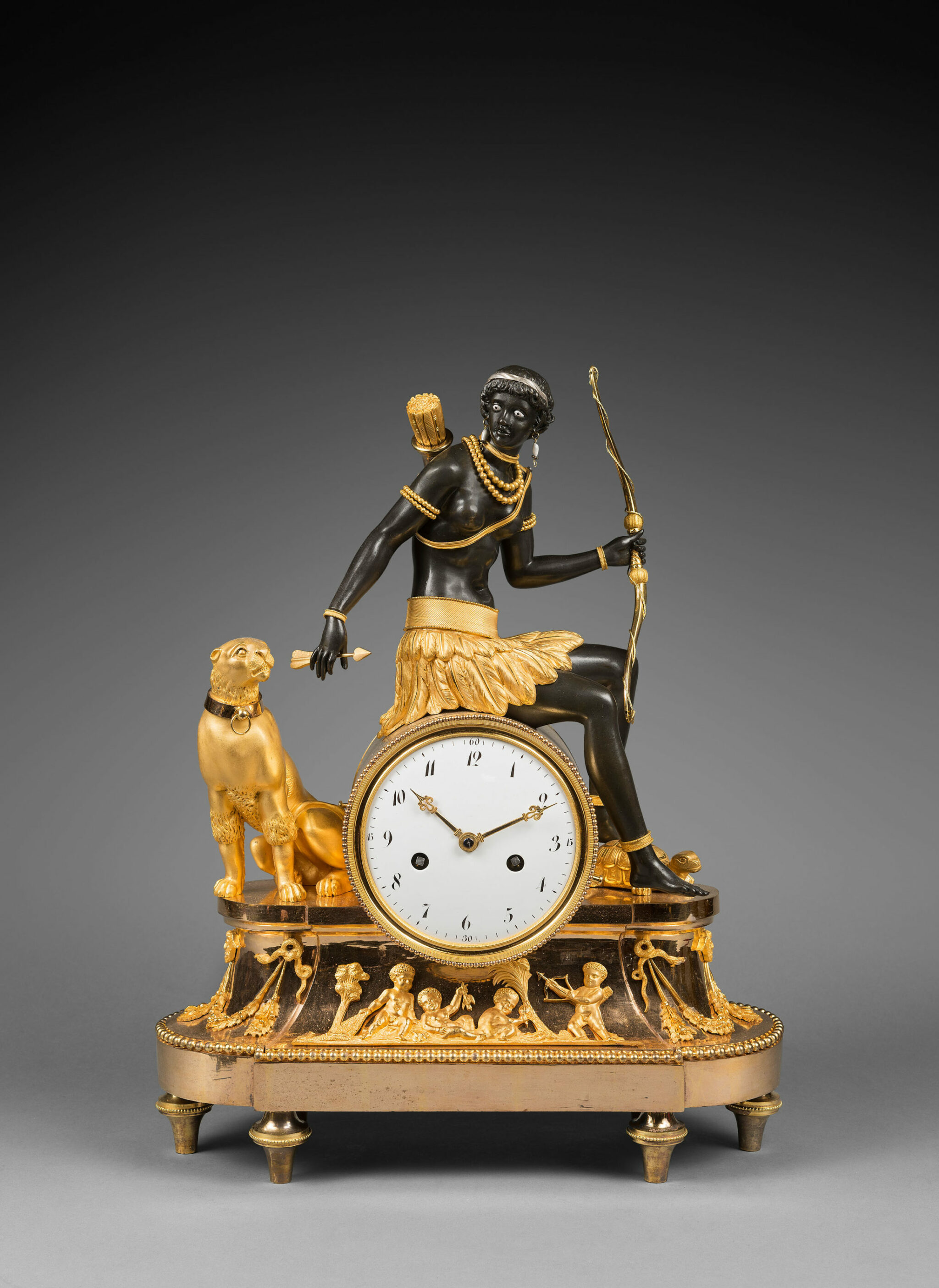
BIBLIOGRAPHY: Dominique and Chantal Fléchon, “La pendule au nègre”, in Bulletin de l’Association nationale des collectionneurs et amateurs d’horlogerie ancienne, Spring 1992, n° 63, p. 41.
The round enamel dial, signed “Gamot à Lille”, indicates the Roman numeral hours and the Arabic quarter hours and minute graduations by means of two gilt bronze hands. It is set in a gilt bronze barrel into which a young black man, barefoot and shirtless and holding a stick, pours a sack of coffee as he looks toward the spectator. His face is very expressive and greatly contribute to the clock’s realism. On the other side of the barrel, a naturalistic palm tree lends balance to the composition. The octagonal chased and gilt bronze base is decorated with bas-reliefs depicting bees and two young black children who are gathering twigs together. The base is raised upon five oval bead-decorated feet.
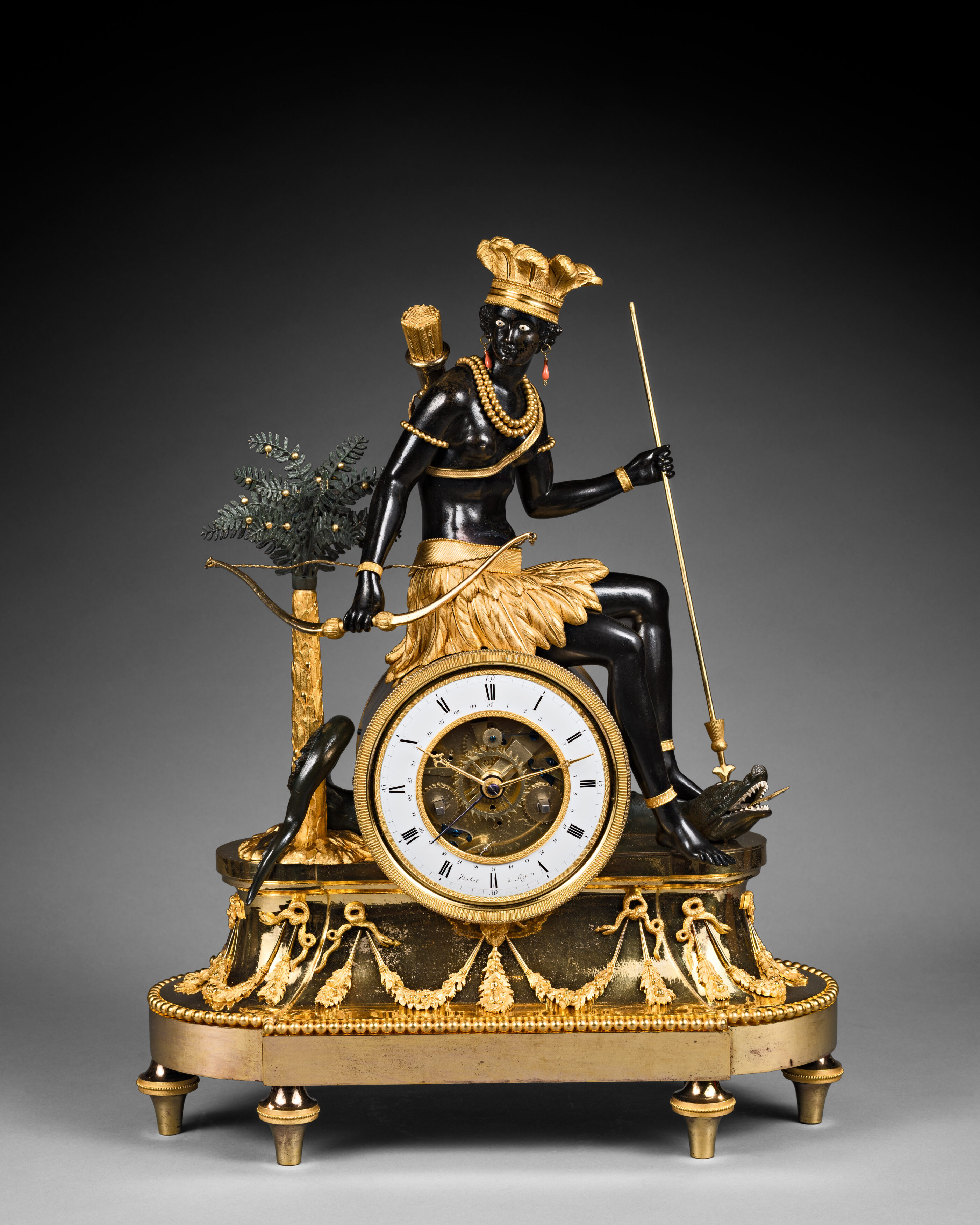
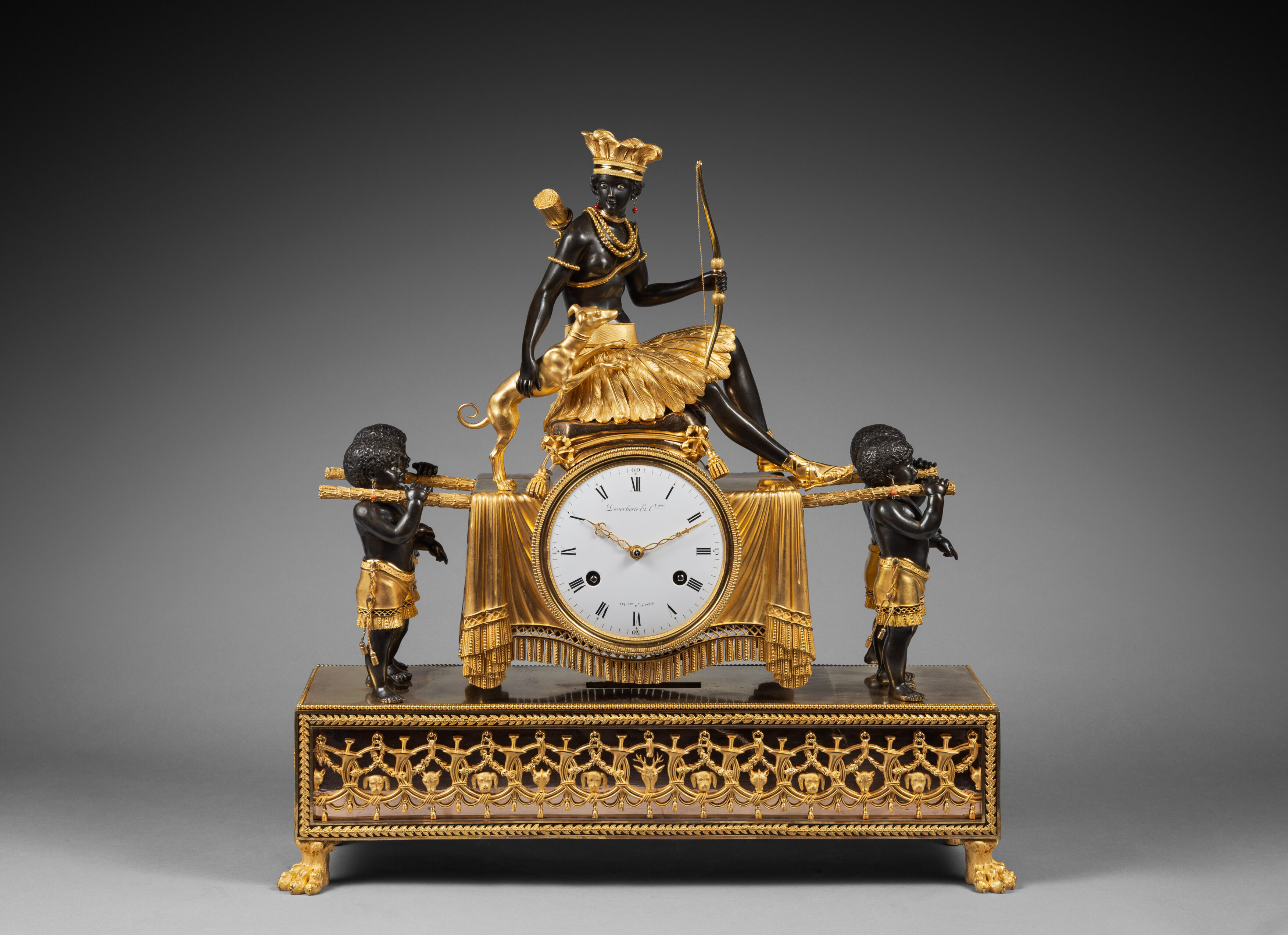
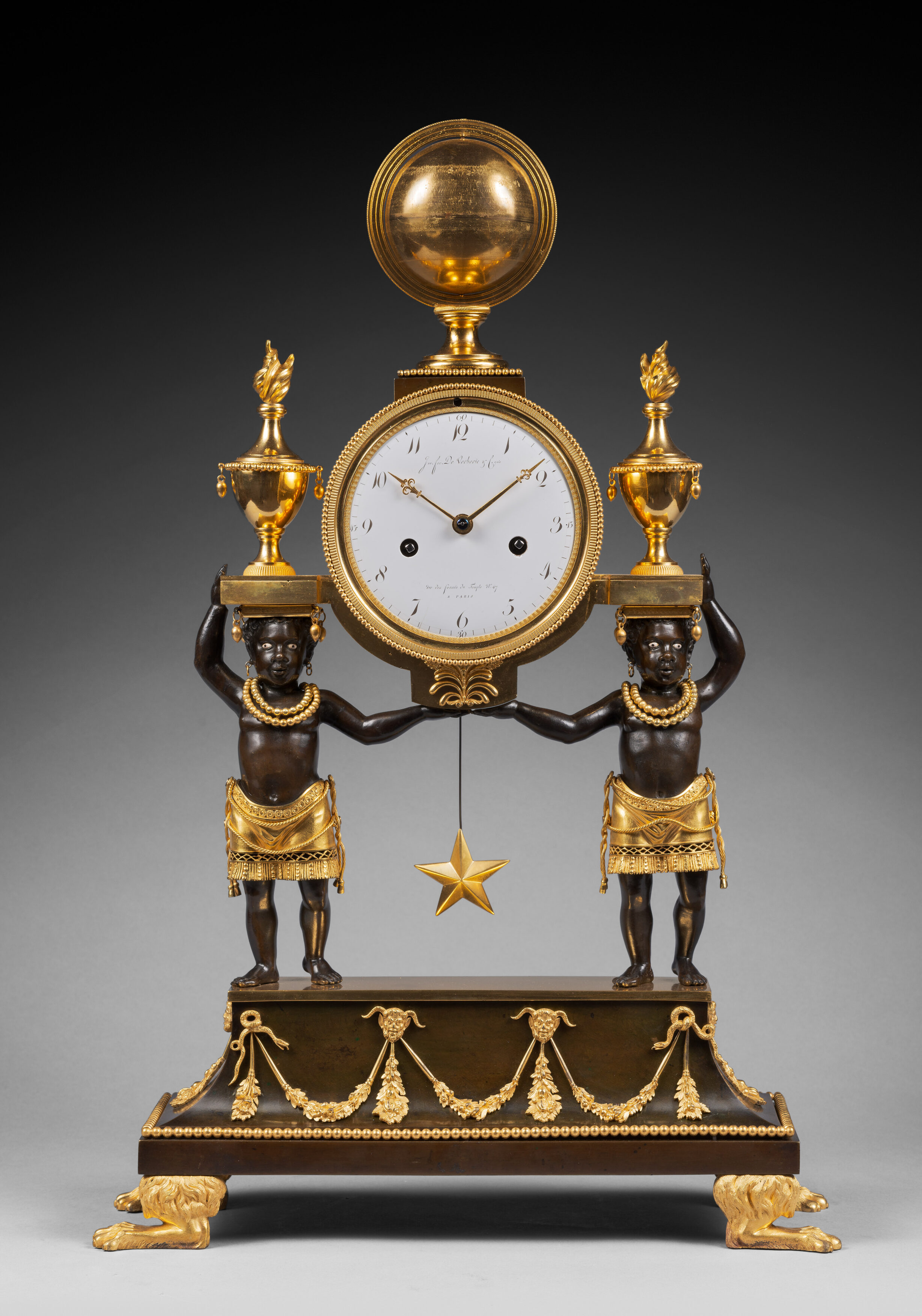
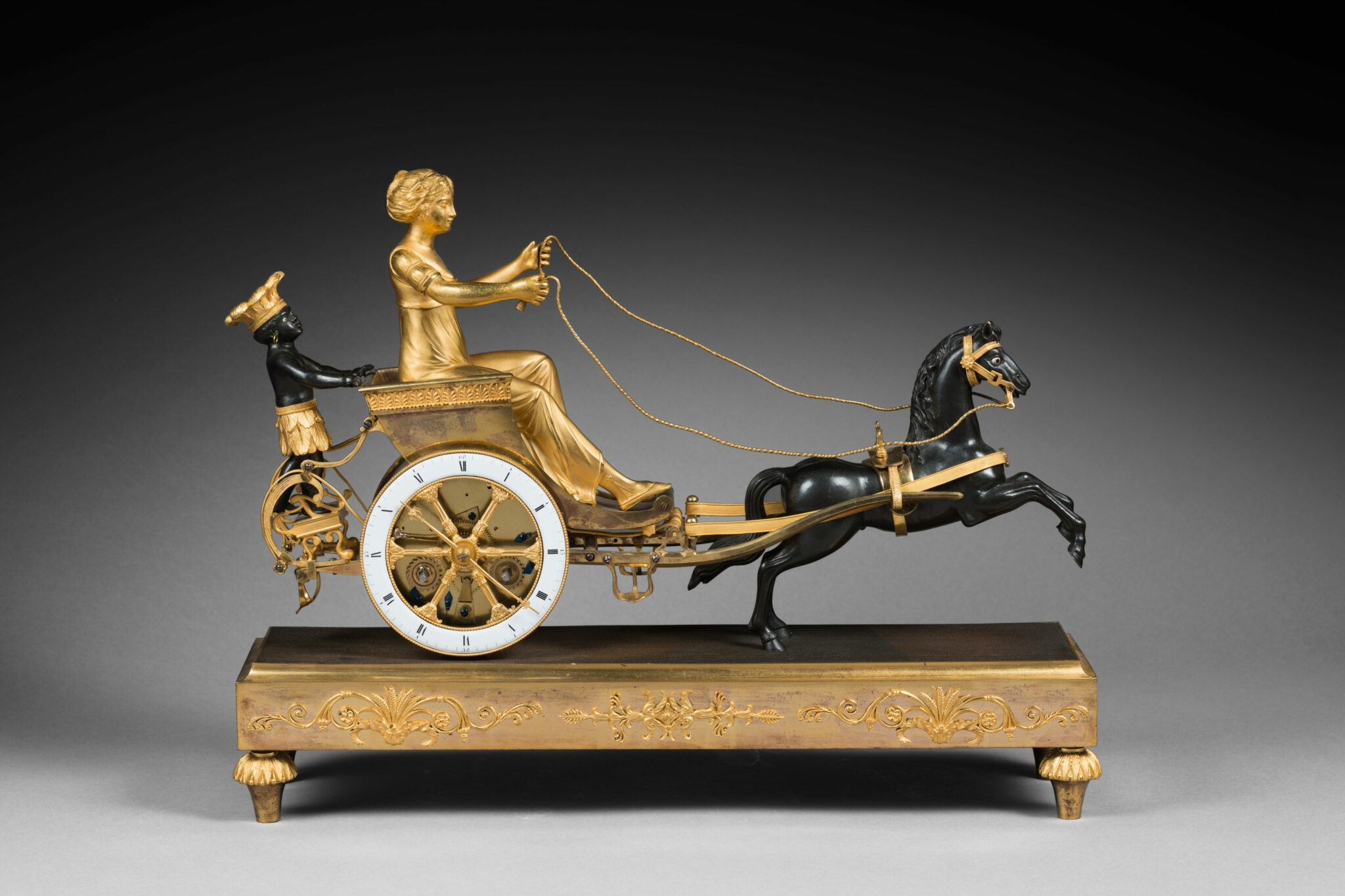
The black man as “noble savage” was rarely used as a decorative theme in French or European horological creations before the late 18th century. It was not until the end of the Ancien Régime (Old Regime) – and precisely during the final decade of the 18th century and the early 19th century- that the first clocks known as “au nègre” or “au sauvage” began to appear. They reflect a philosophical movement expressed in literary and historical works such as Paul et Virginie by Bernardin de Saint-Pierre (which was published in 1787 and depicted the innocence of man); Atala by Chateaubriand (which restored the Christian ideal); and Daniel Defoe’s masterpiece Robinson Crusoe (published in 1719). The present clock depicts a young black slave such as those who worked in colonial plantations. It may be attributed to Jean-Simon Deverberie, bronze-caster specialized in “noble savage” clocks.
Nowadays, there are very few similar clocks listed. Here are the ones of particular note:
– a first example was offered at auction at Sotheby’s, London, on December 5, 1980, lot 127
– a second signed “Sacré à Paris” is illustrated in P. Kjellberg, Encyclopédie de la pendule française du Moyen Age au XXe siècle, Paris, 1997, p. 344
– a third is signed “L. Grognot à Paris”, formerly in our gallery and now in the Parnassia collection in the Netherlands (illustrated in Jean-Dominique Augarde, Une Odyssée en pendules, Chefs-d’œuvre de la Collection Parnassia II, Dijon, Faton, 2022, pp. 454-455; Inv. 2.078.)
– a fourth model belongs to the collections of the Musée de l’Hôtel Sandelin in Saint-Omer, France (see the exhibition catalog Pendule au nègre, April 29-June 12, 1978, Musée de l’Hôtel Sandelin, Saint-Omer)
– finally, a last model, slightly different because it was designed without a palm tree, is currently kept in the collection of the Centraal Museum Utrecht in the Netherlands (inv. 29472), its dial signed “L. Grognot à Paris”
Jean-Simon Deverberie was one of the most important Parisian bronziers of the late 18th century and the early decades of the following century. Deverberie, who was married to Marie-Louise Veron, appears to have specialized at first in making clocks and candelabra that were adorned with exotic figures, and particularly African figures. Around 1800 he registered several preparatory designs for “au nègre” clocks, including the “Africa”, “America”, and “Indian Man and Woman” models (the drawings for which are today preserved in the Cabinet des Estampes in the Bibliothèque nationale in Paris). He opened a workshop in the rue Barbette around 1800, in the rue du Temple around 1804, and in the rue des Fossés du Temple between 1812 and 1820.
Alard François Joseph Gamot was a french clockmaker from Lille in the late 18th and early 19th centuries. He held the title of Graveur de la Monnaie (Engraver of the Mint) and became a clockmaker in 1790, according to Tardy (Tardy, Dictionnaire des Horlogers Français, 1972 Edition, p. 244). His workshop was located at 10 rue de la Monnaie in Lille. The signature “Gamot à Lille”, found on a clock known as “Le Porteur de café” (“The Coffee Bearer”), is probably the signature of this clockmaker.
It would appear that he worked with his father, probably Aimé Louis Gamot (1776-1862), also a clockmaker located on Rue de la Monnaie in Lille. There is indeed a clock signed “Gamot Père à Lille” dated around 1805, of the model known as “Hortensia” designed in honor of Queen Hortense (illustrated in François Duesberg, Catalogue du musée François Duesberg: arts décoratifs 1775-1825, p. 71).