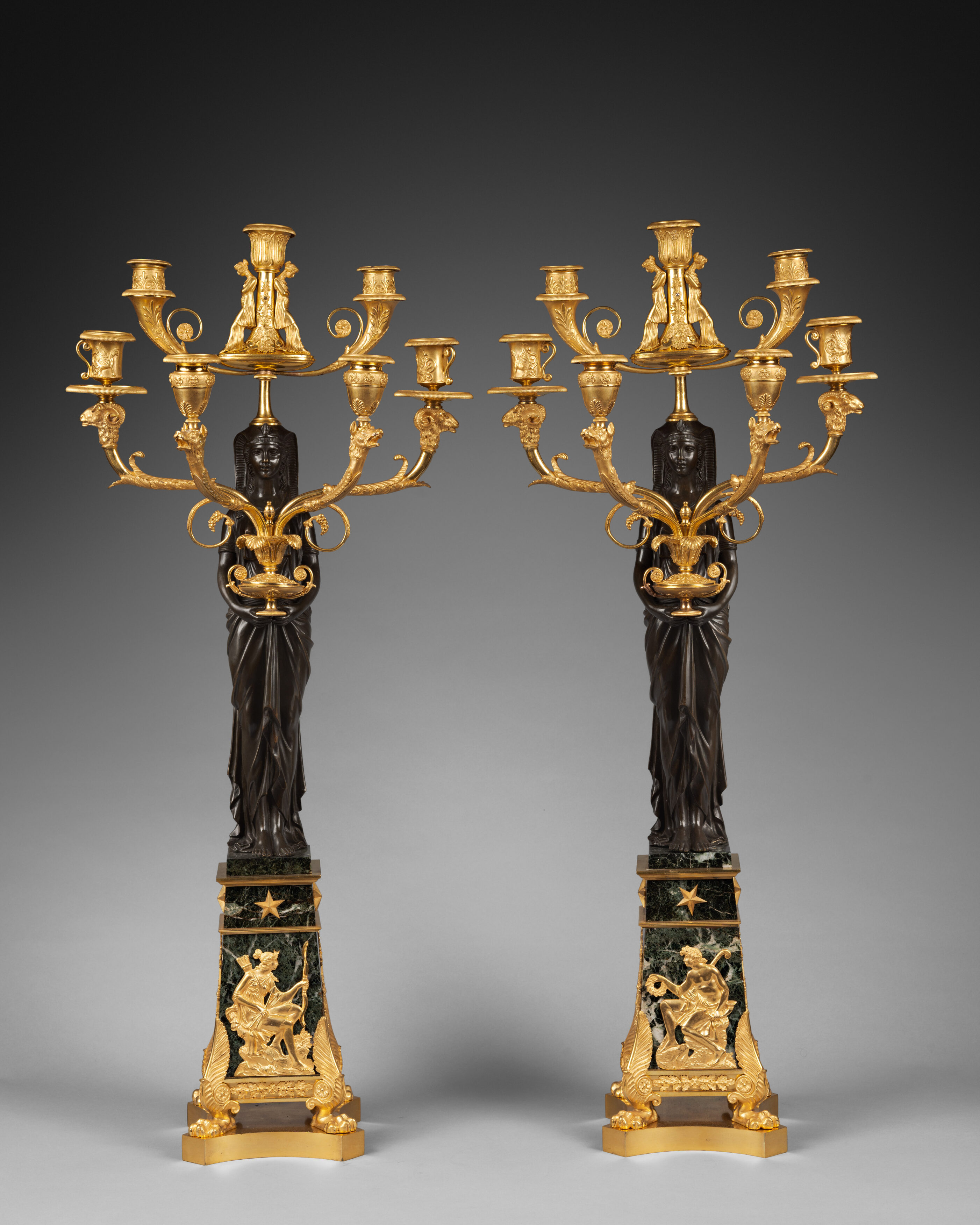
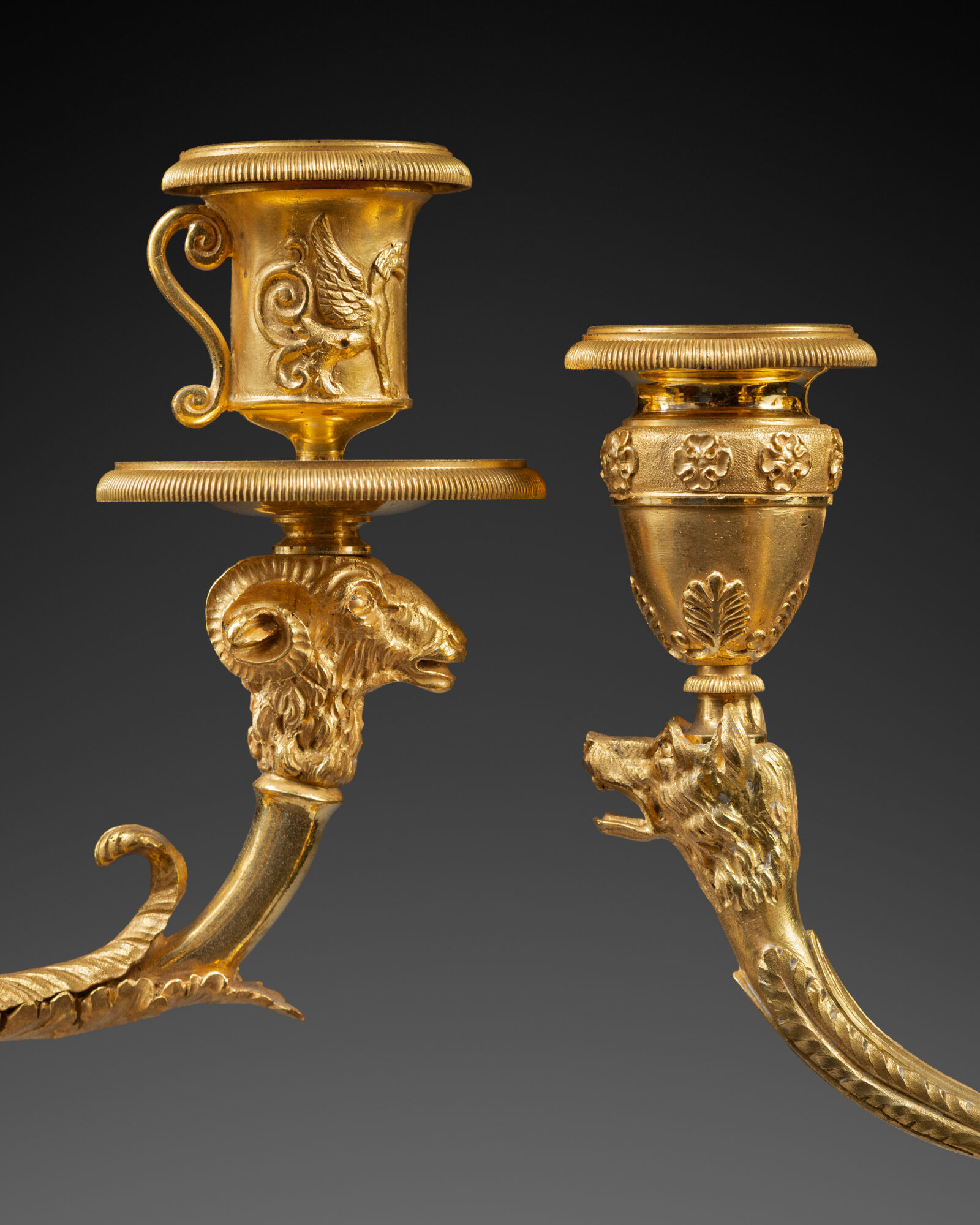
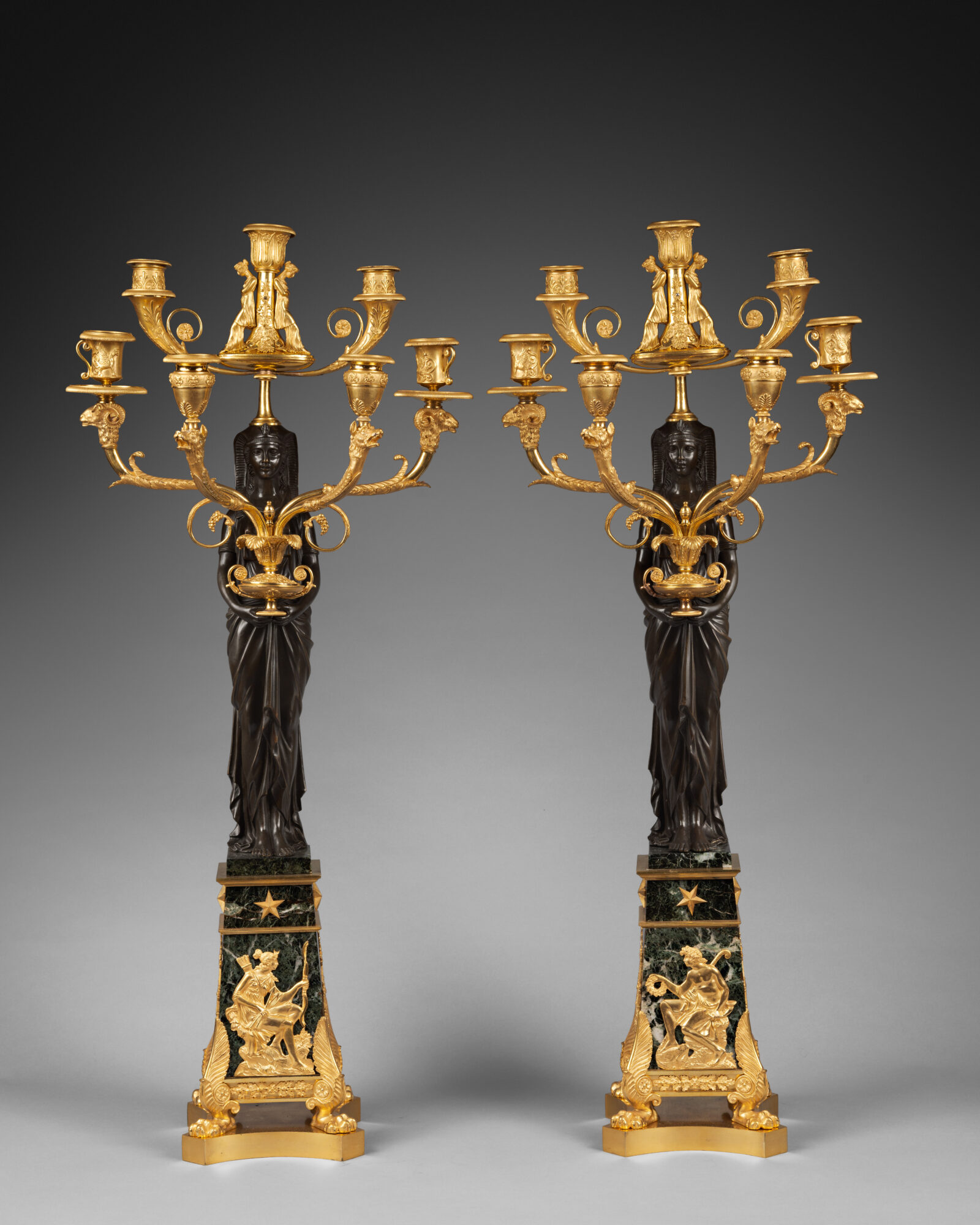
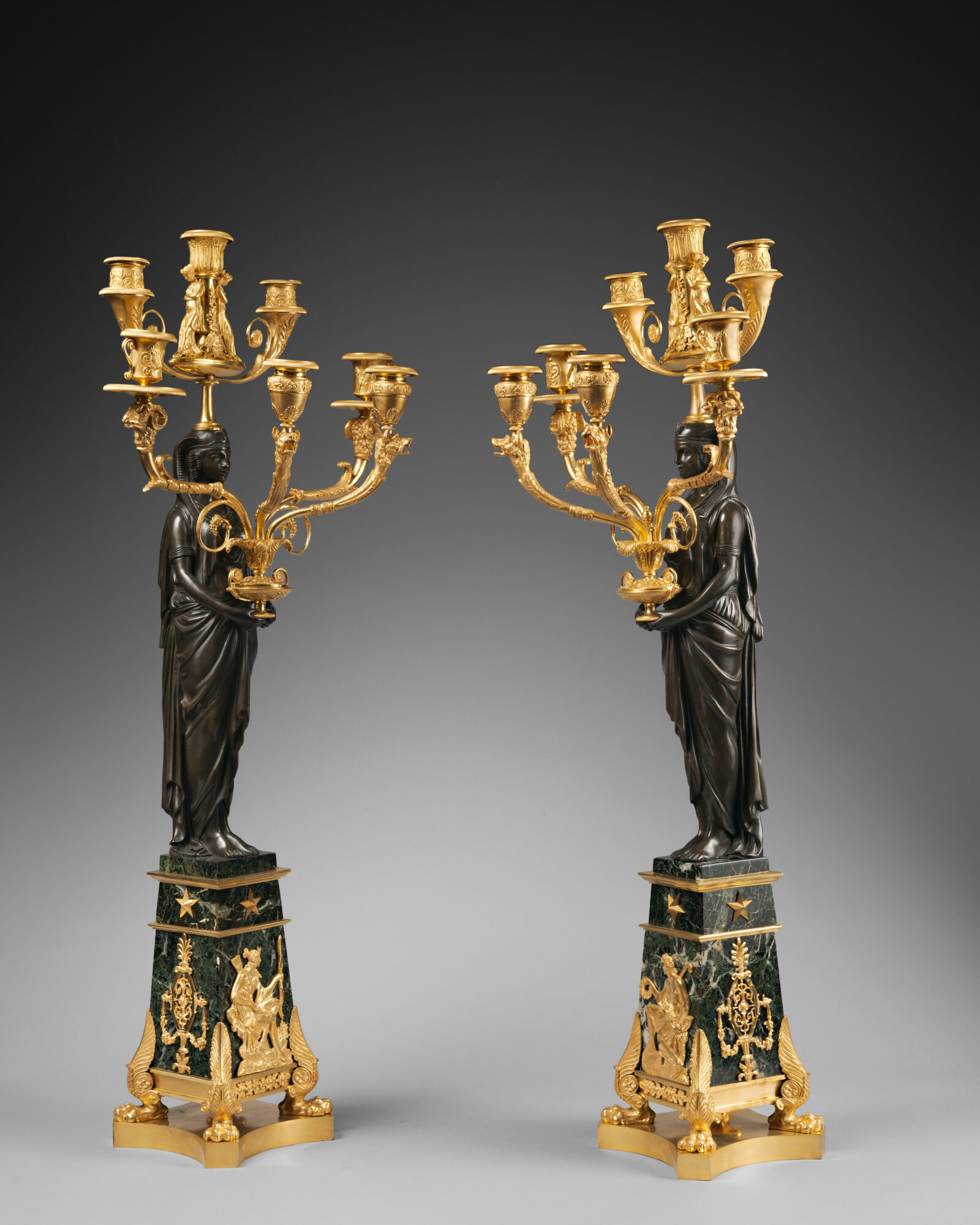
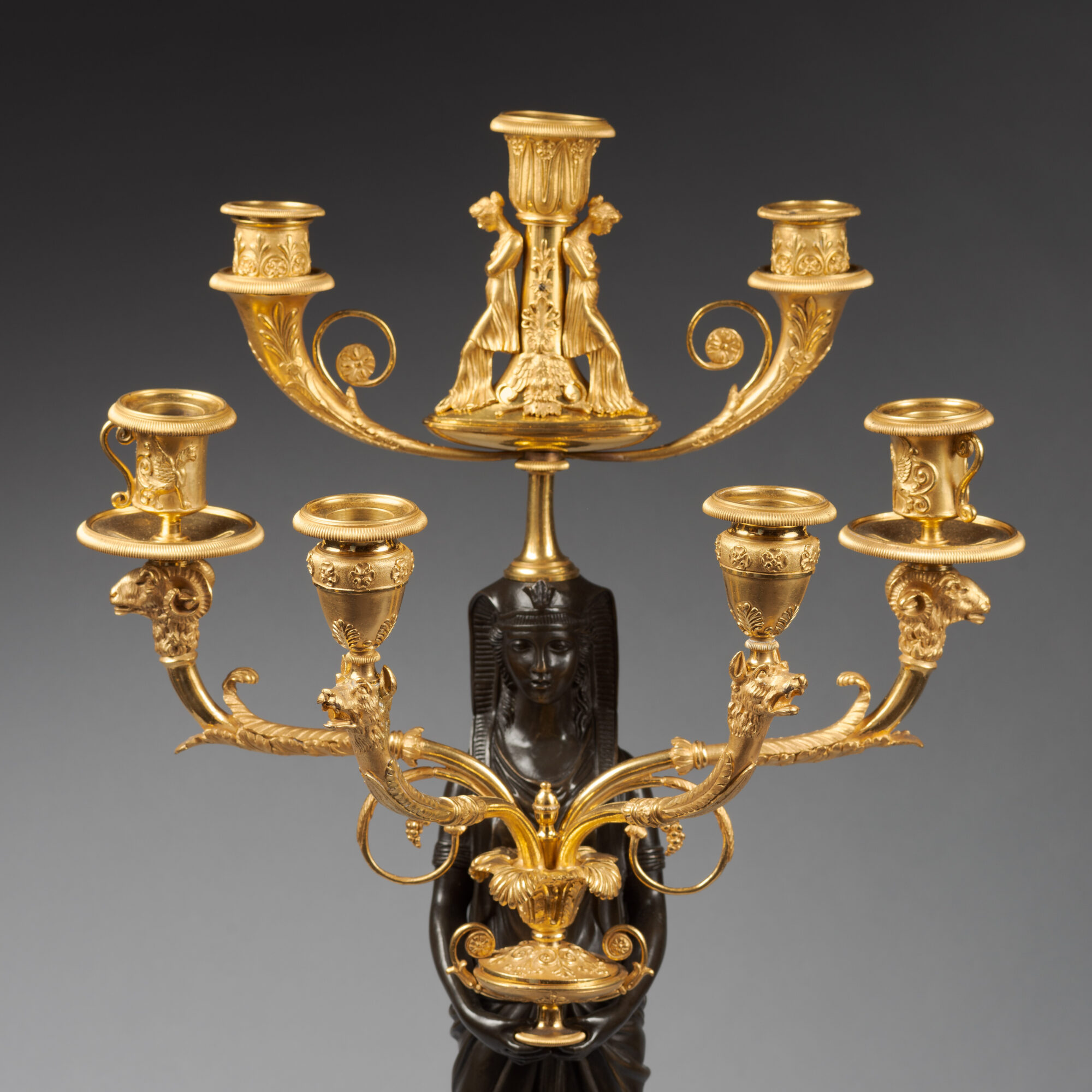
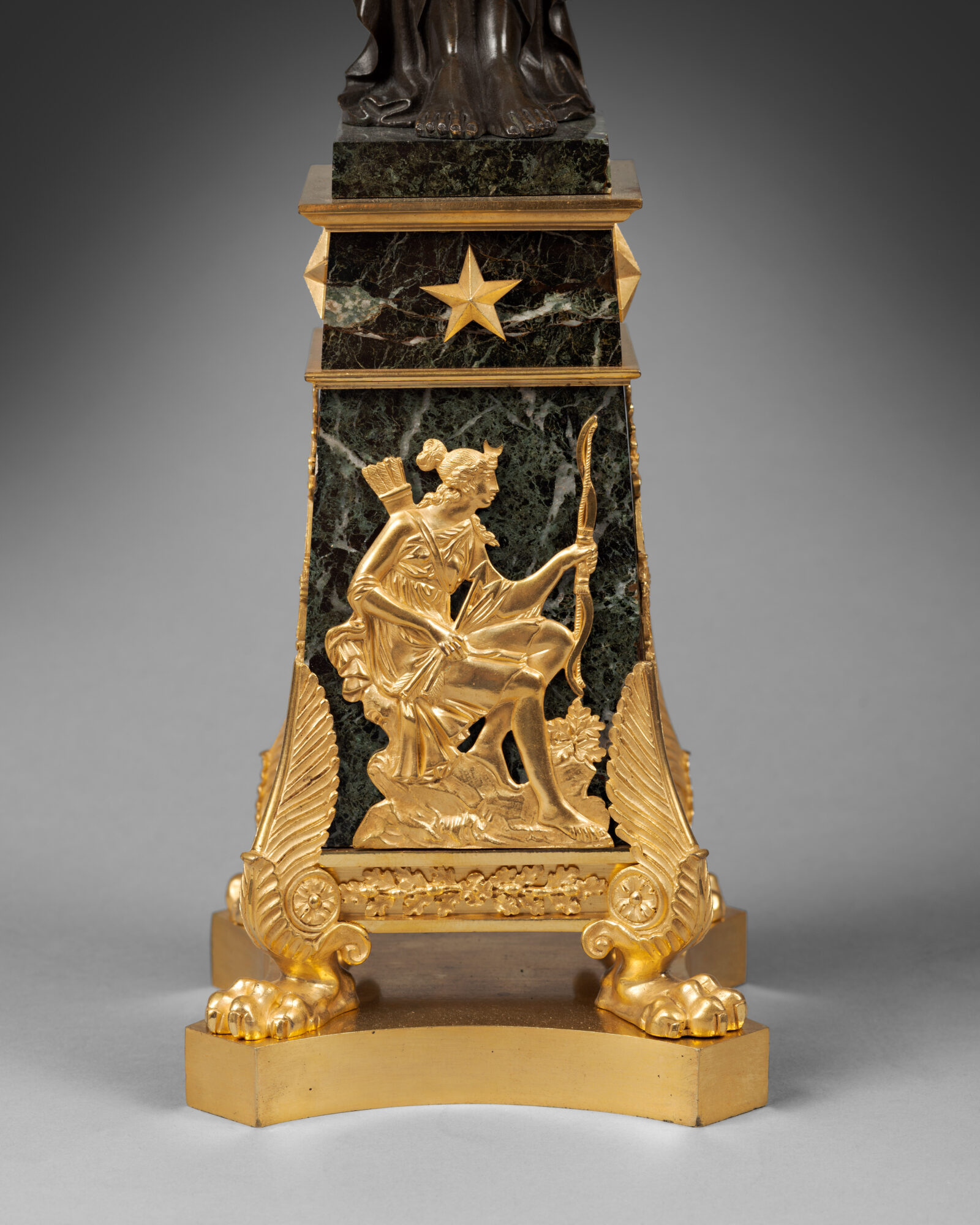
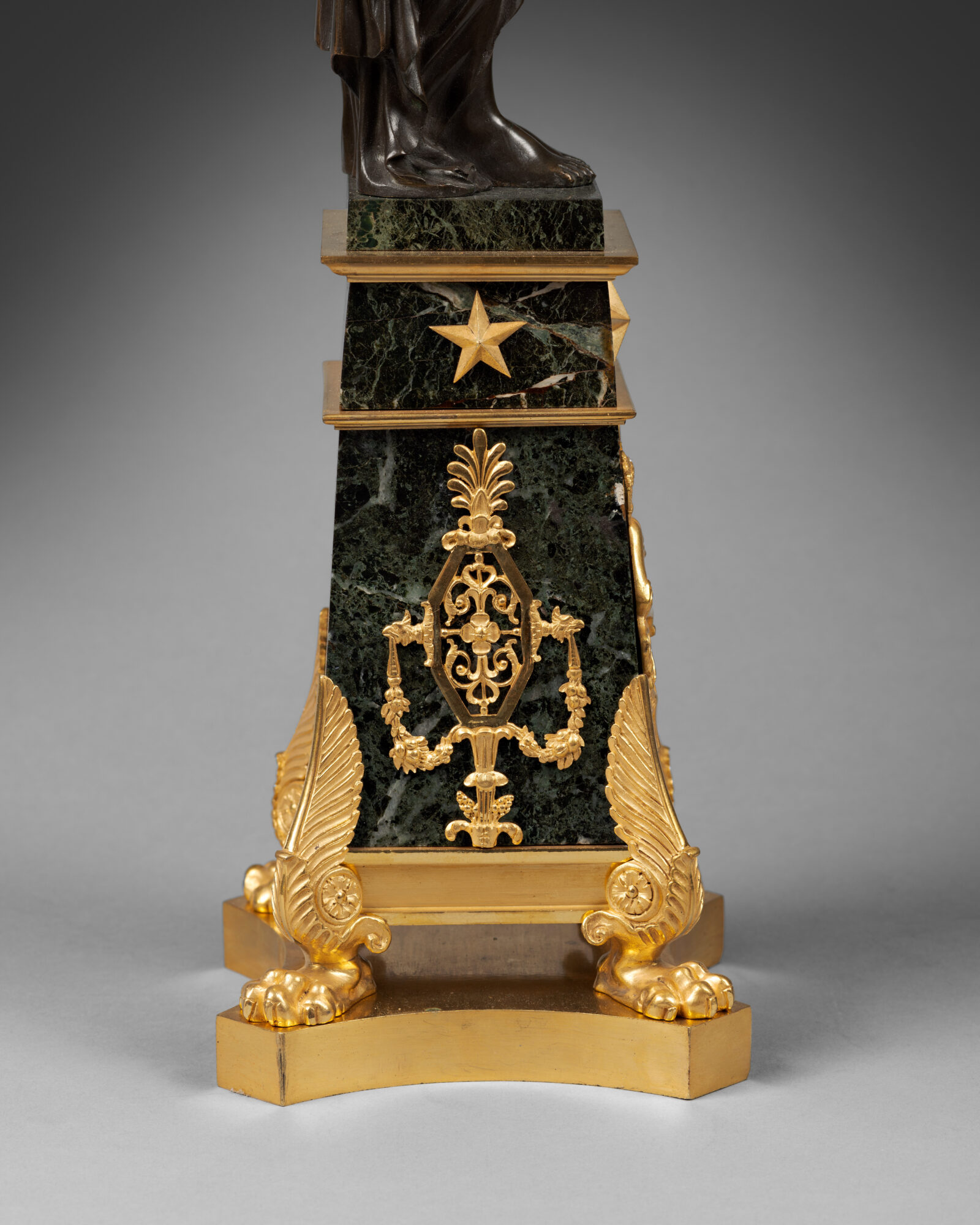
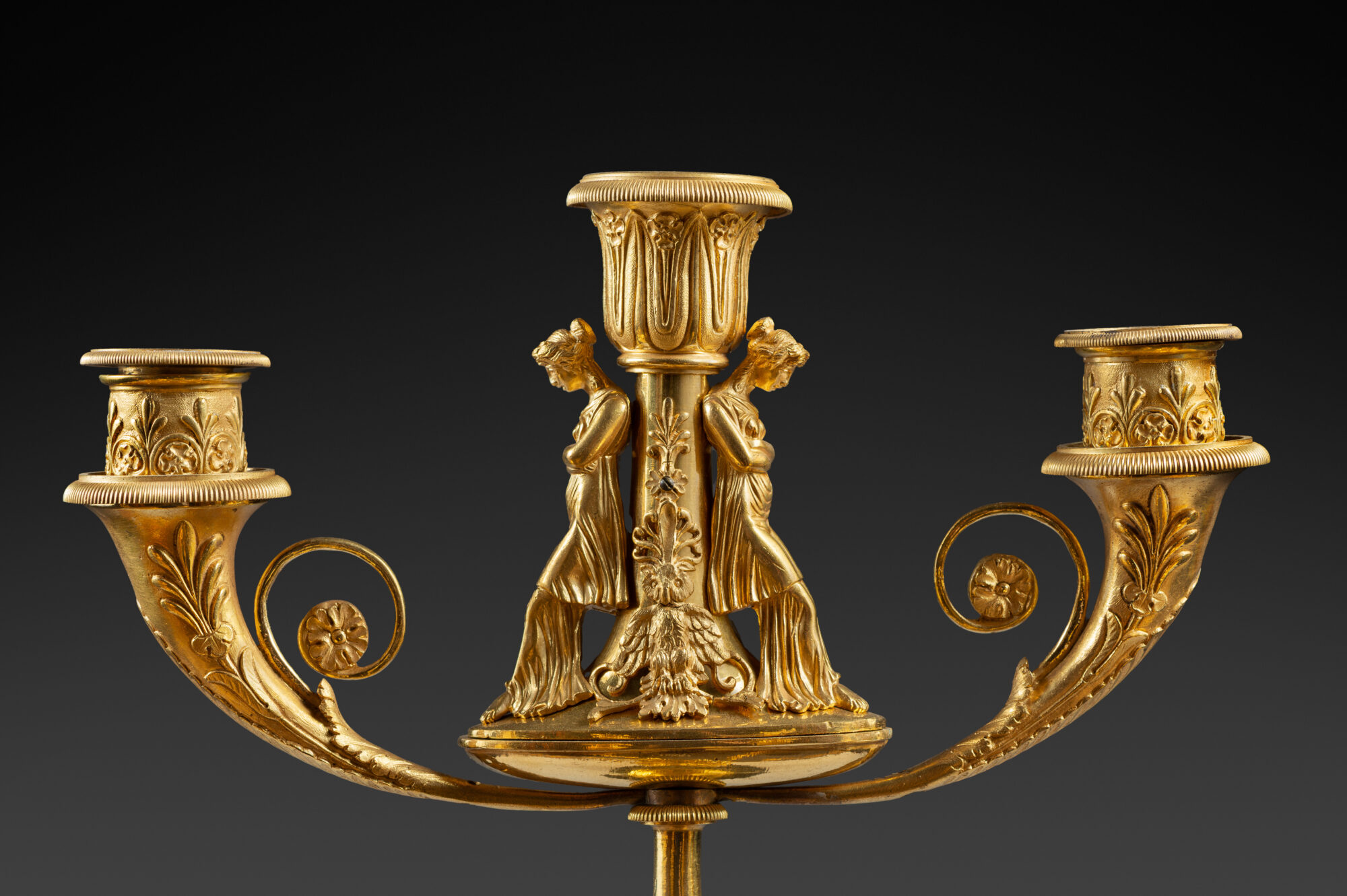
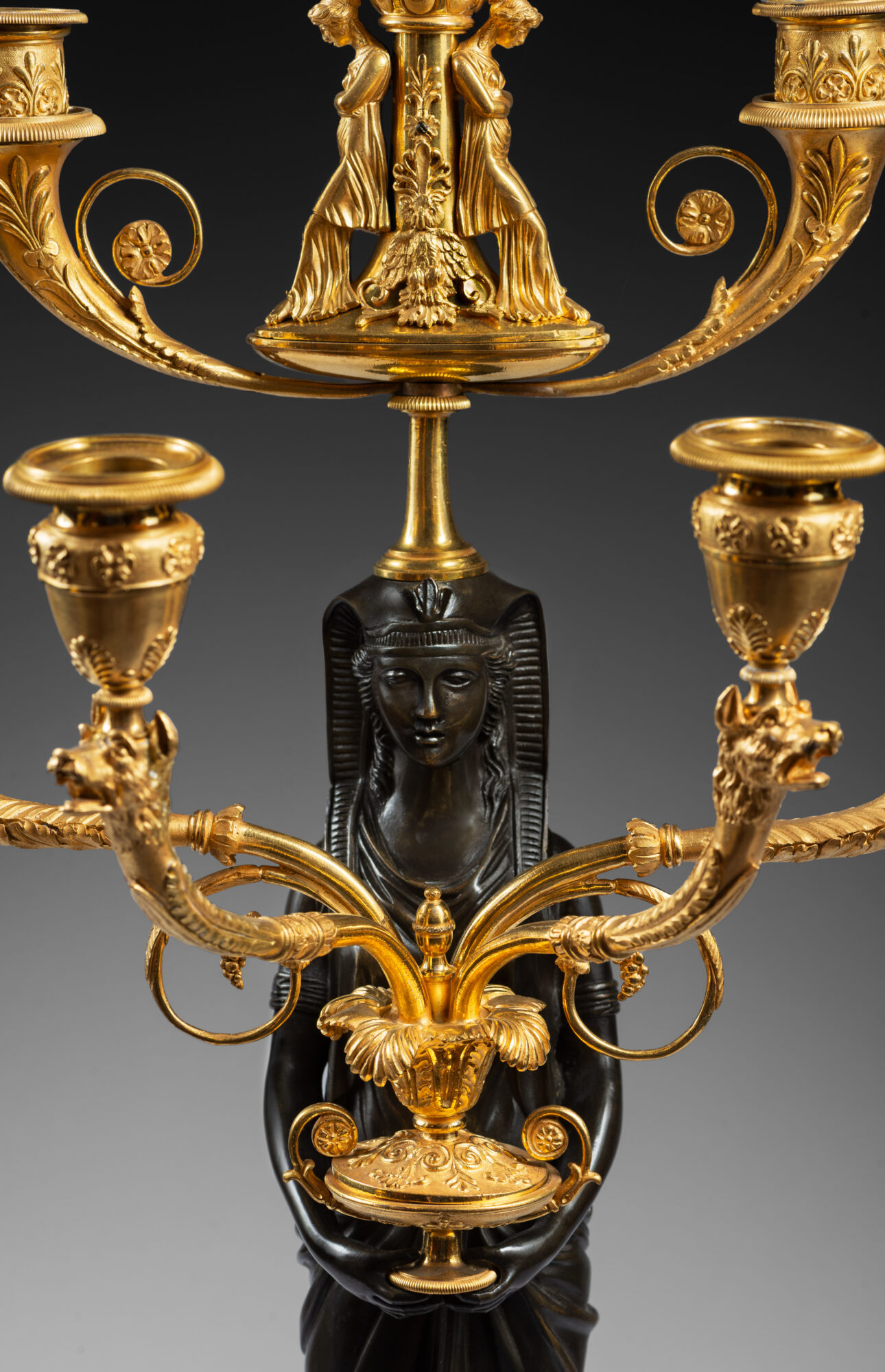
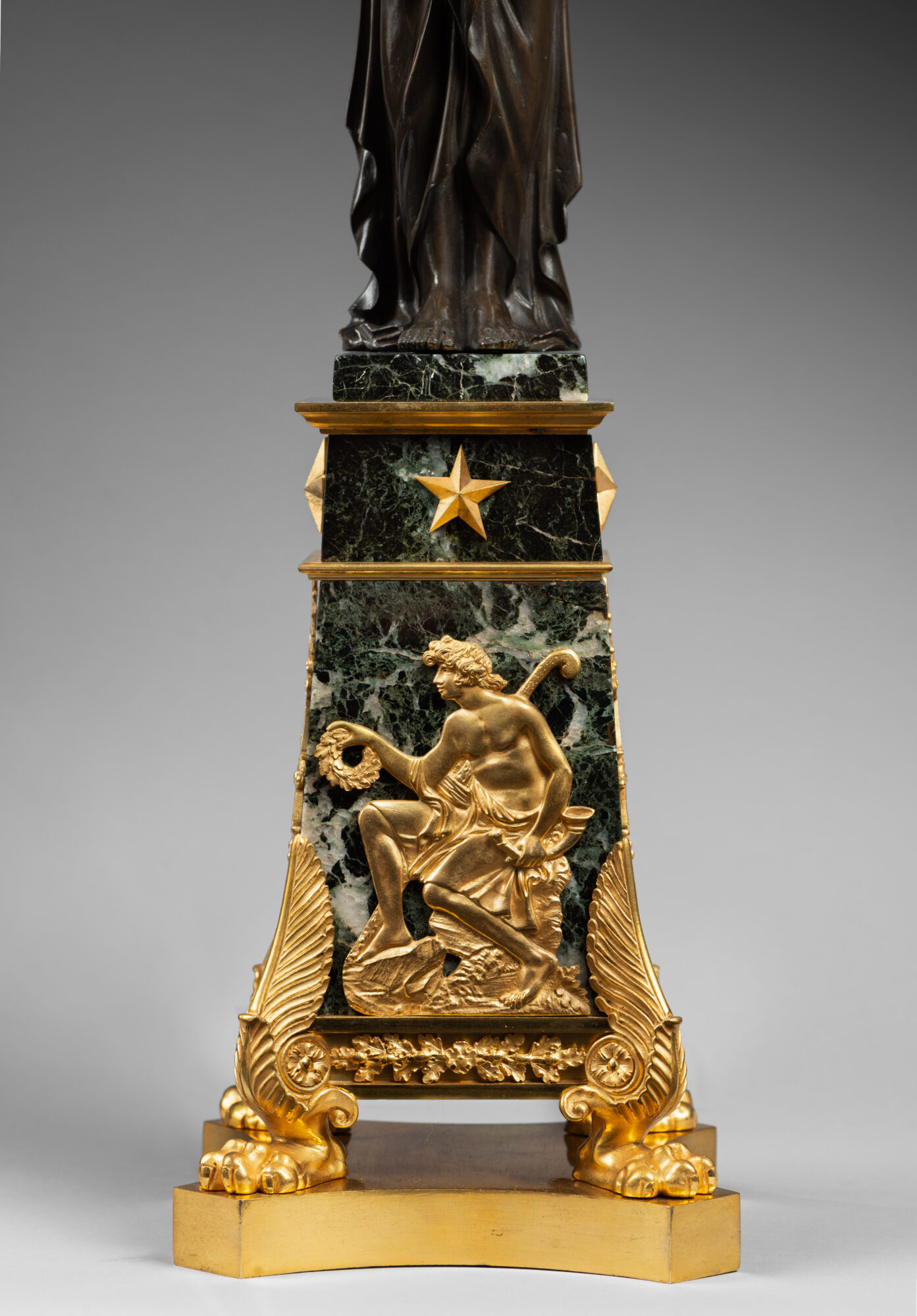
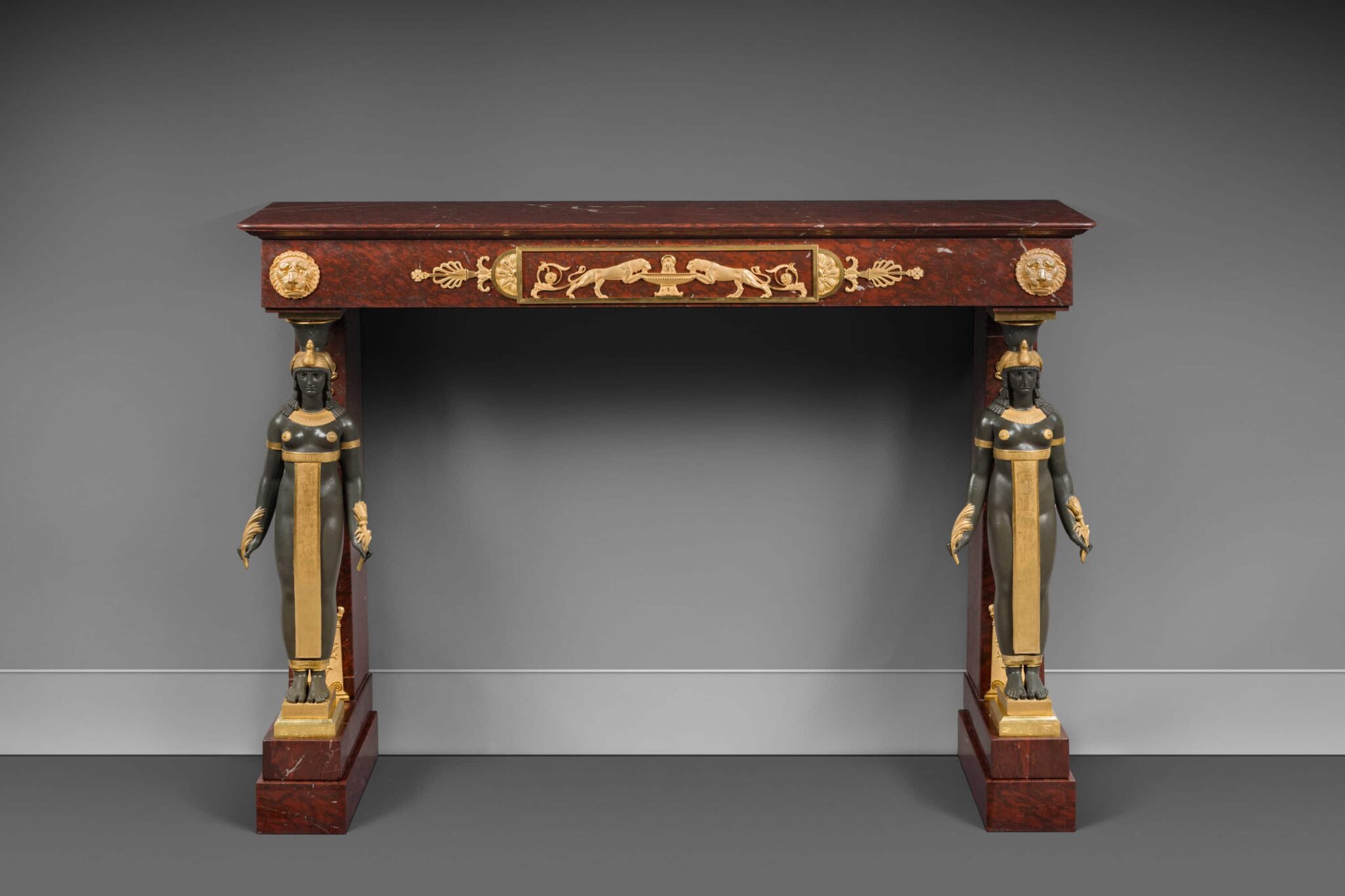
Made entirely of finely chased patinated and gilt bronze with matte and burnished finishing, the candelabra feature a sculptural stem depicting a standing Egyptian woman who is wearing a long tunic and a Nemes headdress. Each woman holds a flattened urn with scrolling handles centered by rosettes, from which emerges a bouquet of acanthus leaves issuing four curving light branches that are adorned with knops and foliage. The two light arms in the front terminate in wolves’ heads; they support sockets and drip pans decorated with palmettes and flowers. The two light arms in the back, embellished with seeded stems, terminate in ram’s heads; they support the sockets and mille-raie decorated drip pans. The sockets have applied handles and are adorned with griffons. On their heads, the figures bear a chalice with spreading foot, to which are attached two light branches adorned with palmettes, flowers and foliage. The chalice supports a foliate-decorated stem that terminates in a socket decorated with finely detailed leaves alternating with flowers, against which two opposite-facing female figures are leaning. The tall green marble base is embellished with applied motifs of stars and figures that are facing each other; those on the facade represent Artemis and Adonis. The goddess Artemis, also known as Diana the huntress, wears a crescent moon on her head, with a quiver of arrows slung across her back and a bow and arrows in her hands. Adonis, symbolizing male beauty, is holding a shepherd’s staff, a laurel wreath and a horn. On the sides of the base there are octagonal motifs with flowers, four-leaf clovers, palmettes and eagles’ heads with garlands of fruits and leaves. The base is raised on lions’ feet that are decorated with rosettes, scrolls and wide leaves, framing reserves embellished with oak branches. The whole stands on a plinth with concave sides.
In 1798 and 1801, France sent an expedition to Egypt, hoping to seize the country and dominate the region both politically and economically; they also aimed at undermining British trade routes in the Orient. Led initially by General Bonaparte, then by his successors, the military campaign was accompanied by a contingent of eminent scientists, historians and artists. After it returned to France, the mission had extraordinary repercussions, particularly in the field of the decorative arts. In 1802, Baron Vivant-Denon published his immensely successful Voyage dans la Basse et la Haute Égypte. Subsequently architects, painters and artisans began creating their own interpretations of Egyptian motifs, which they went on to make use of and interpret in their work. In the specific field of lighting, many candelabra were embellished with solemn female figures that were inspired by the monumental sculpture of ancient Egypt.
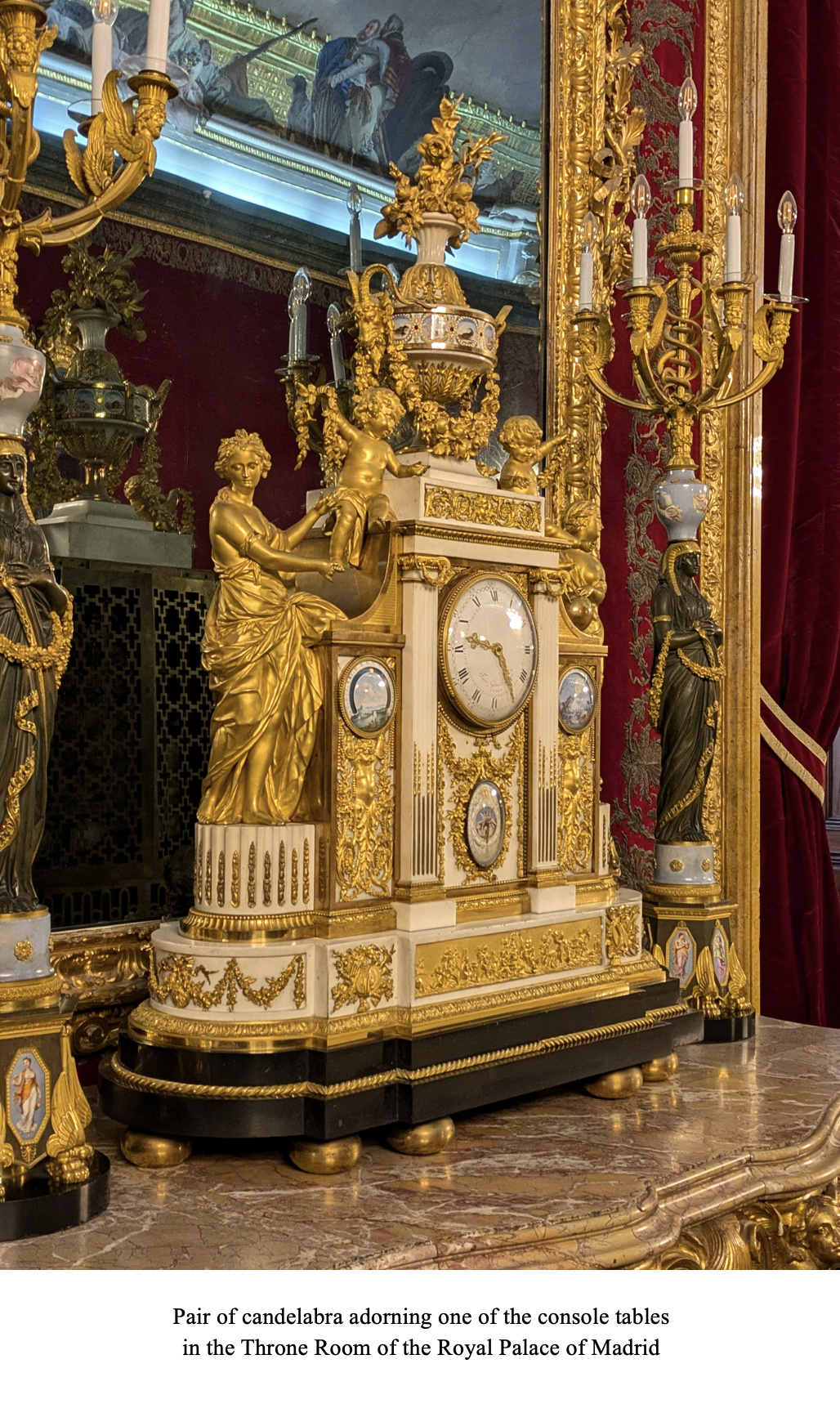
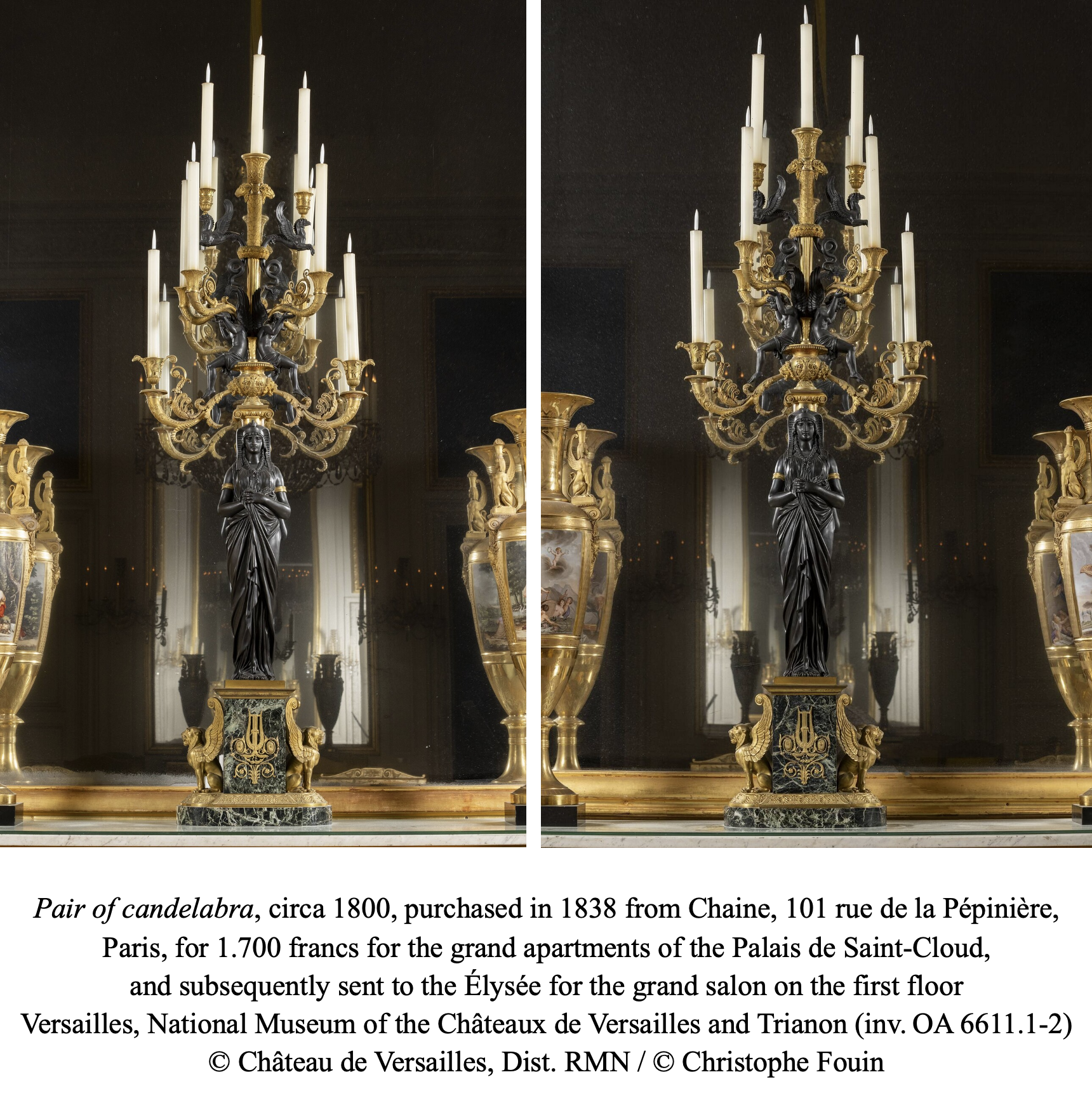
That is the context within which the present candelabra were produced. The supporting figures, inspired by the sculptures adorning Egyptian temples, are characteristic of the “Egyptomania” that prevailed following the return of the Egyptian campaign. Among known candelabra that are comparable, one pair is currently in the Ostankino Museum (illustrated in I. Efremova and I. Petuhova, Lighting devices, Collection of the Museum estate Ostankino, Moscow, 2005, p. 342, fig. 283). A pair of candelabra that may be attributed to the bronze caster Thomire, which is adorned with Egyptian figures, bouquets, and addorsed figures, is on display in the Grand Trianon in the gardens of the Château de Versailles (see P. Arizzoli-Clémentel and J-P. Samoyault, Le mobilier de Versailles, Chefs-d’œuvre du XIXe siècle, Editions Faton, Dijon, 2009, p. 266, catalogue n° 94).
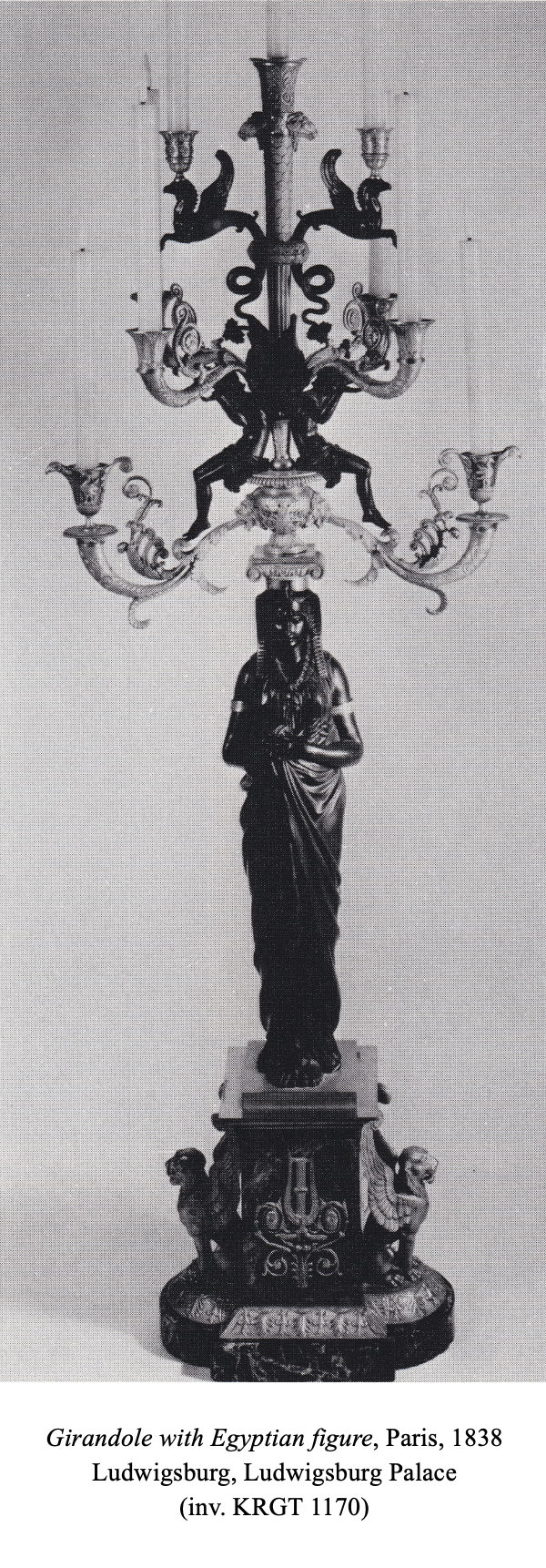
A second pair is in Ludwigsburg Palace (illustrated in H. Ottomeyer and P. Pröschel, Vergoldete Bronzen, Die Bronzearbeiten des Spätbarock und Klassizismus, Munich, 1986, p.392, fig. 5.17.8).
Pierre-Philippe Thomire was the most important Parisian bronzier of the last quarter of the 18th century and the first decades of the following century. Early on in his career he worked for Pierre Gouthière, ciseleur-fondeur du roi, and toward the mid-1770’s began working with Louis Prieur. He later became one of the bronziers attached to the Manufacture Royale de Sèvres, creating the bronze mounts for most of the important creations of the day. After the Revolution, he purchased the stock of Martin-Eloi Lignereux, thus becoming the most important suppliers of furniture bronzes for châteaux and Imperial Palaces. In addition, he worked for a wealthy private clientele, both French and foreign, including several of Napoleon’s Marshals. Thomire retired in 1823.