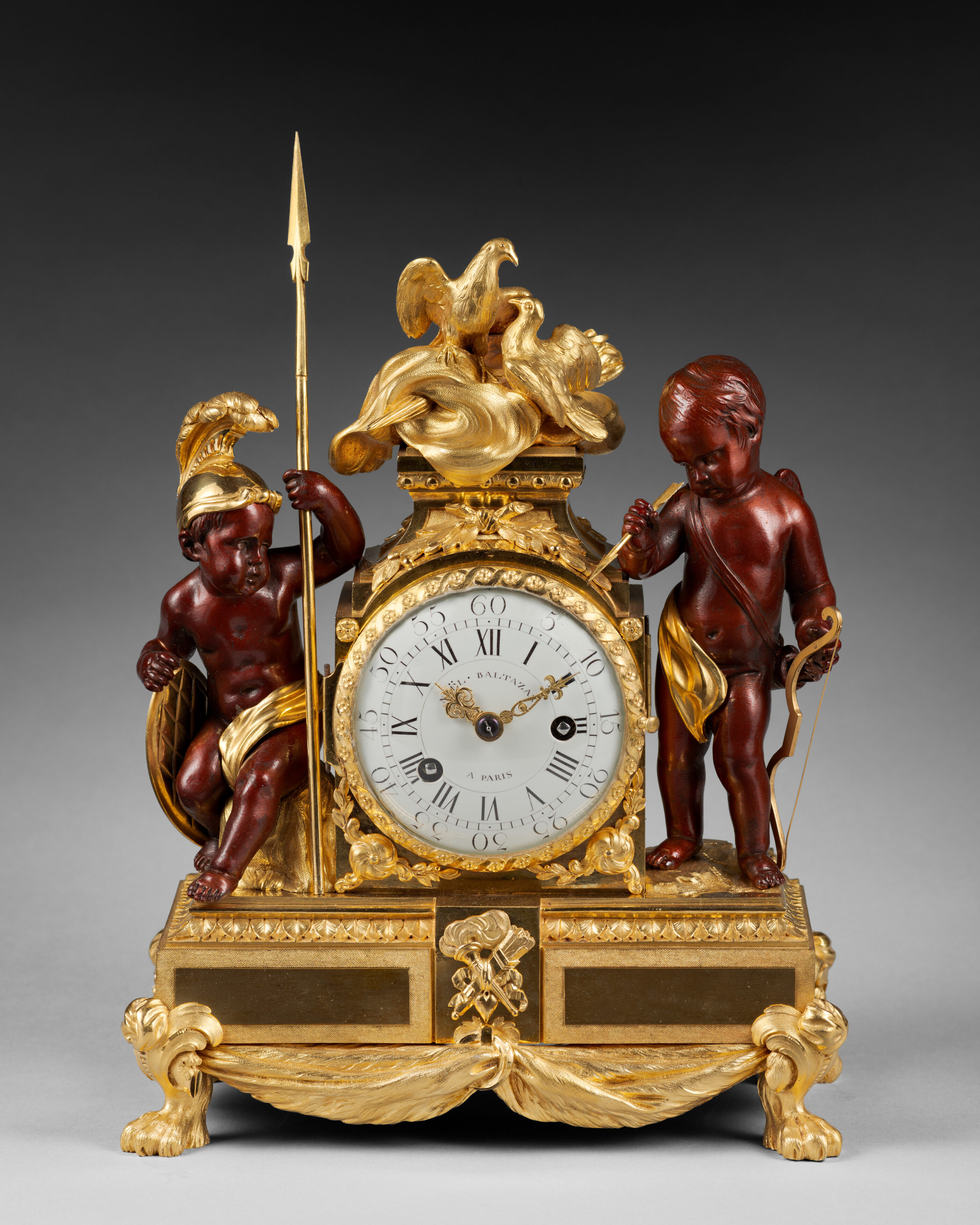
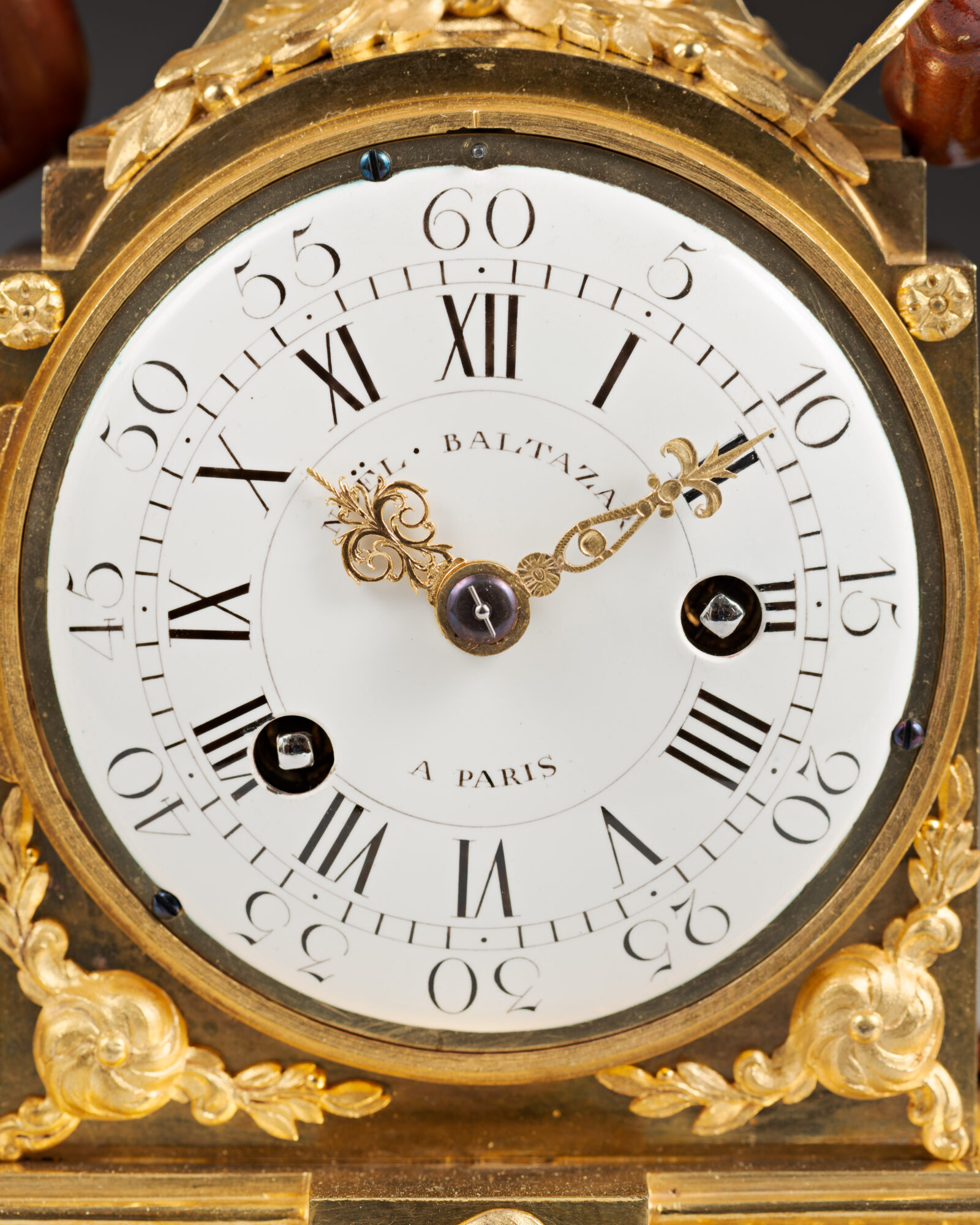
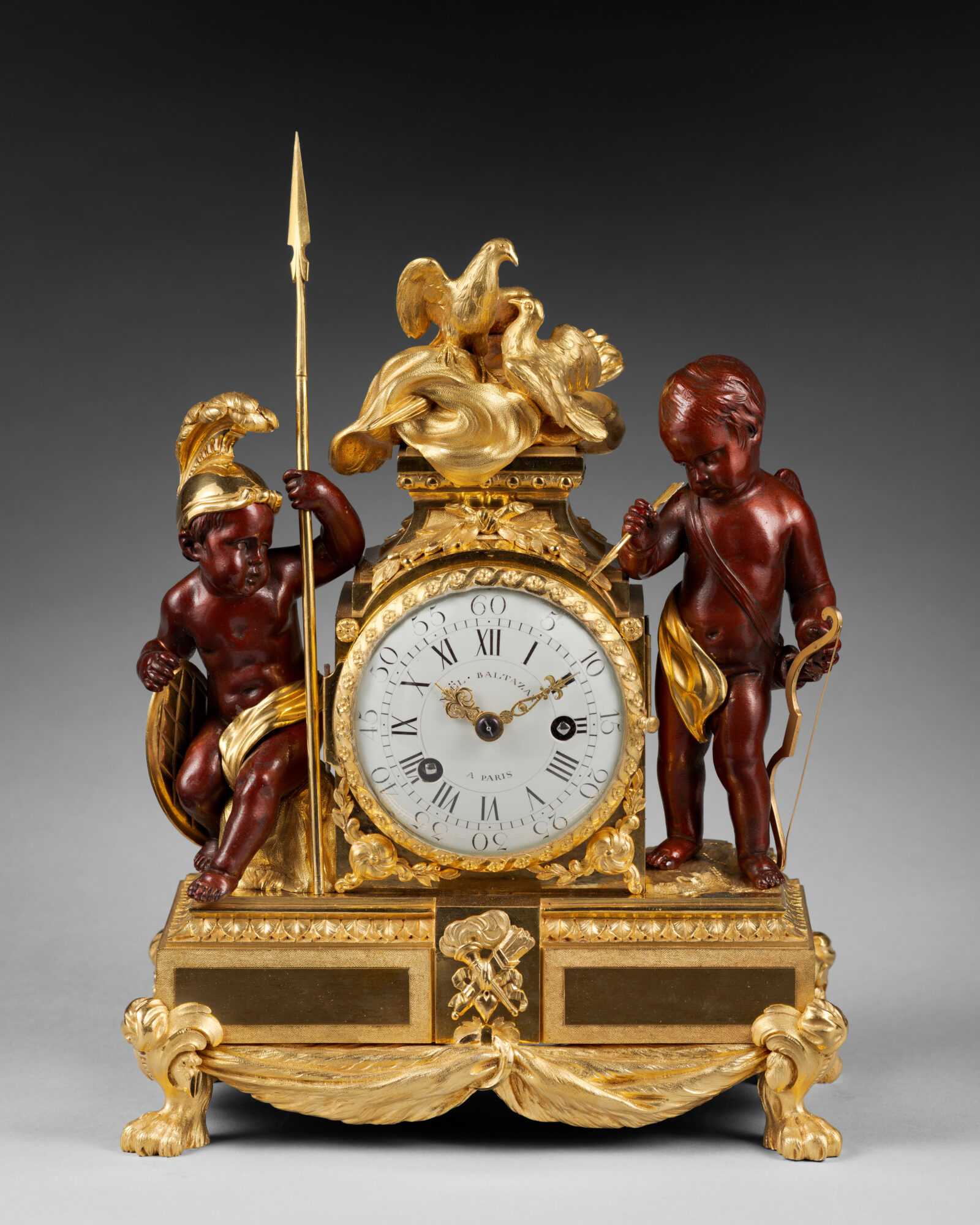
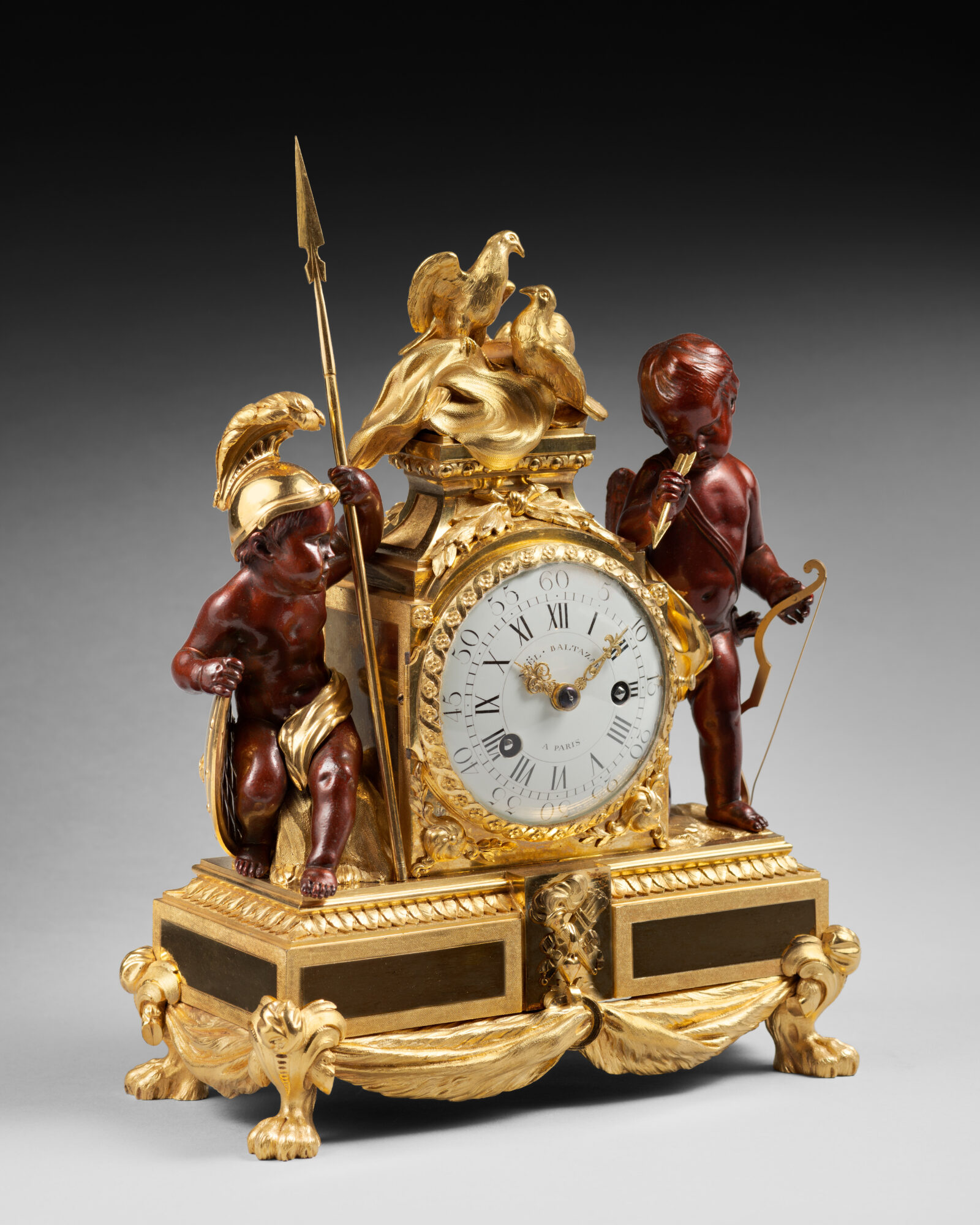
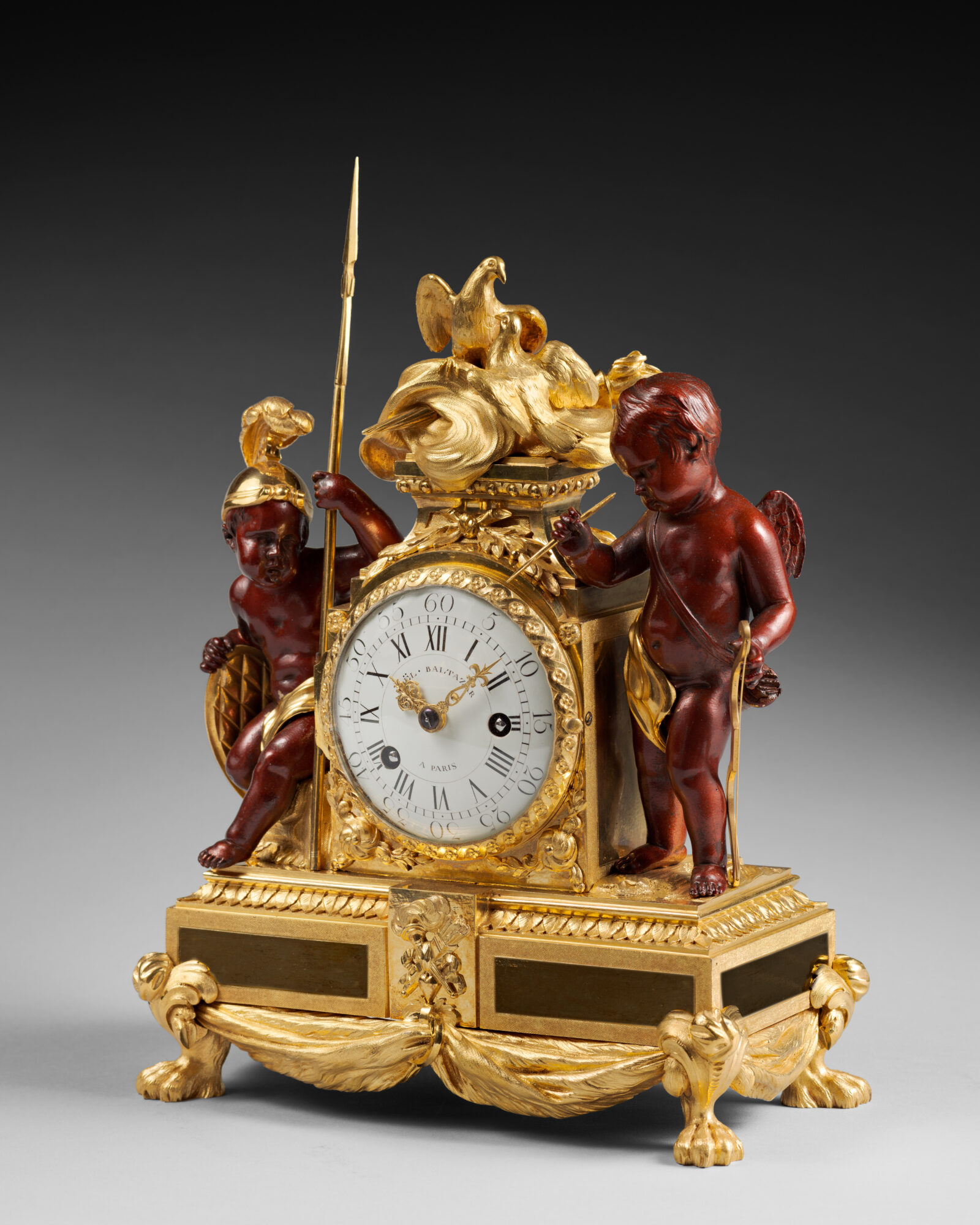
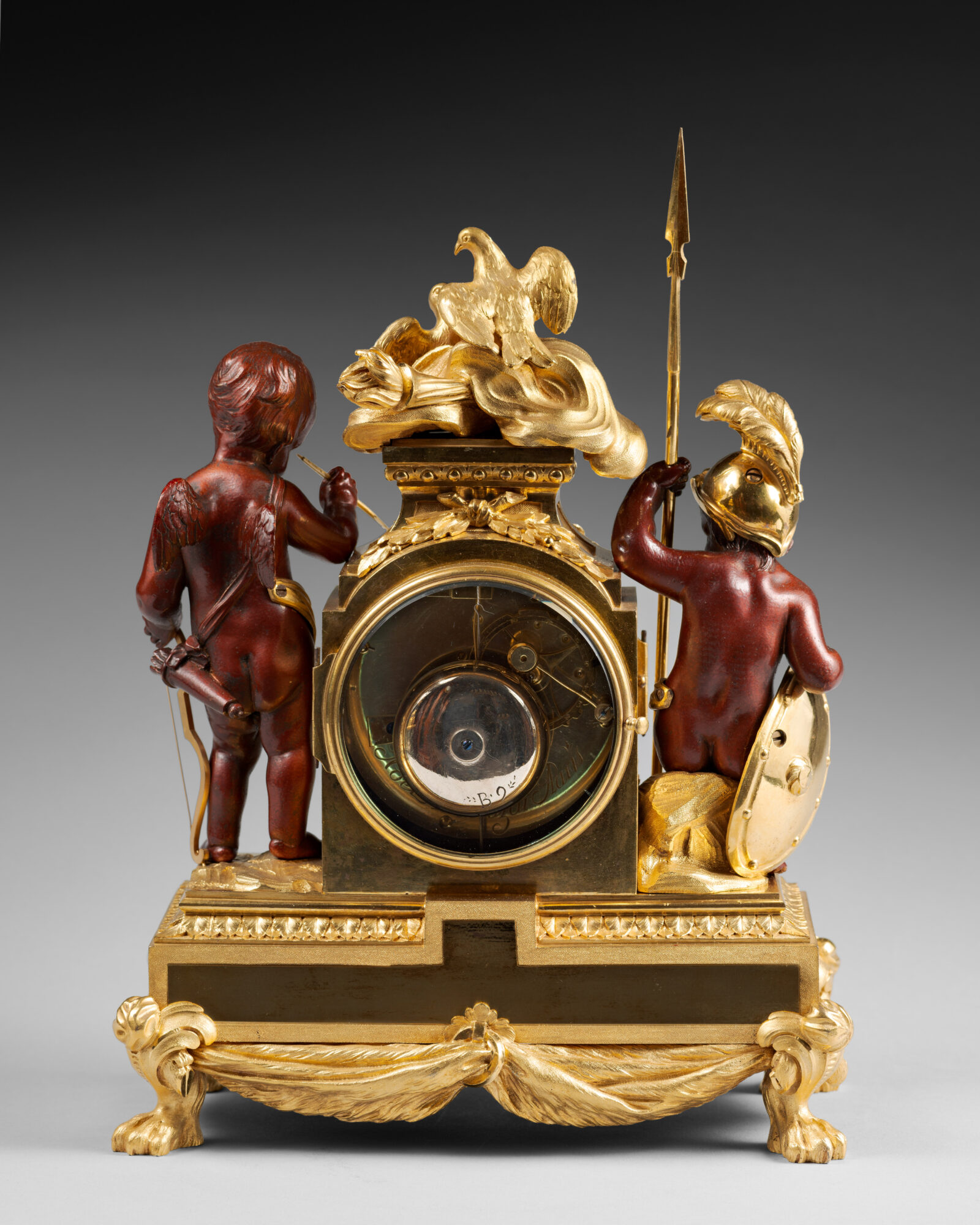
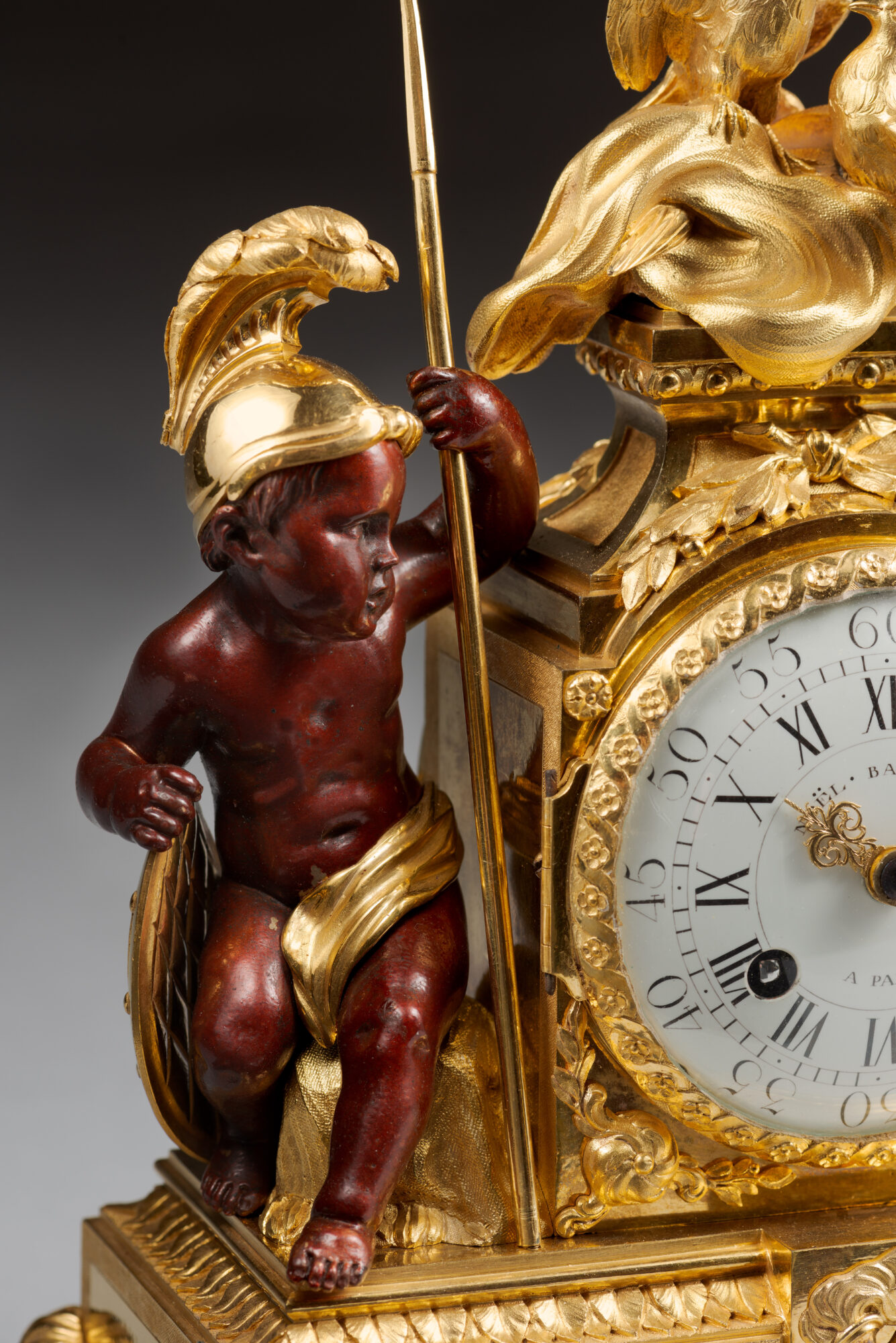
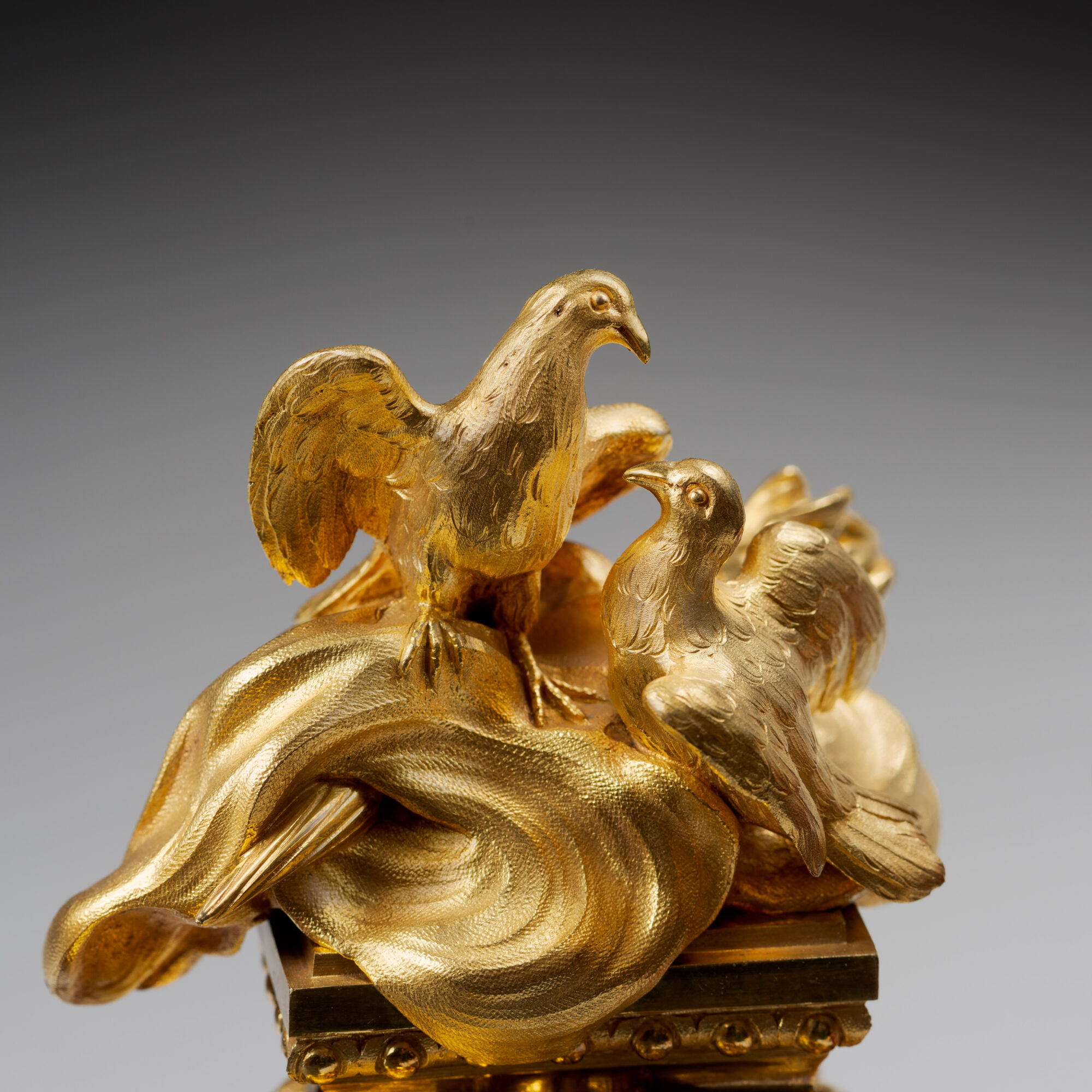
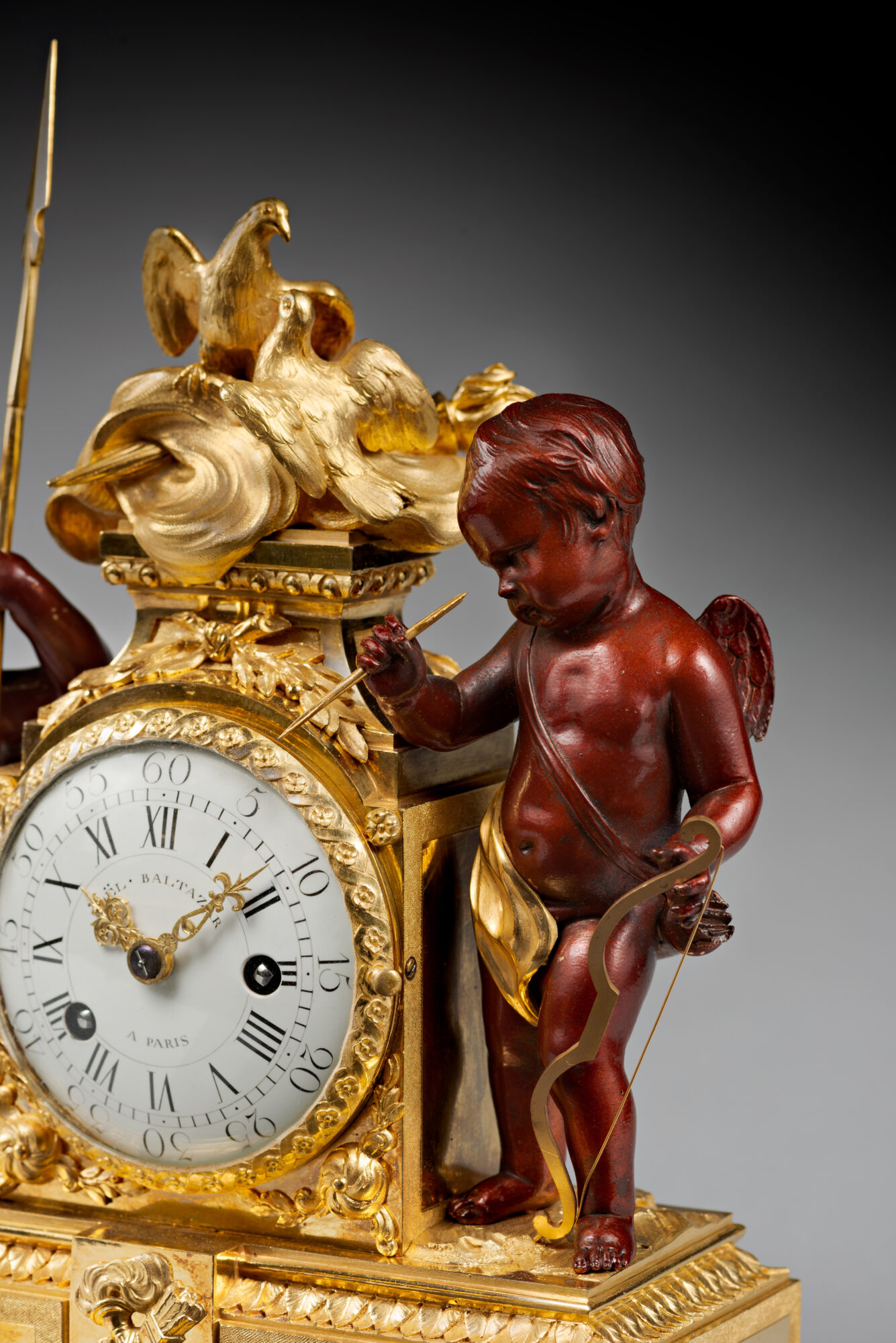
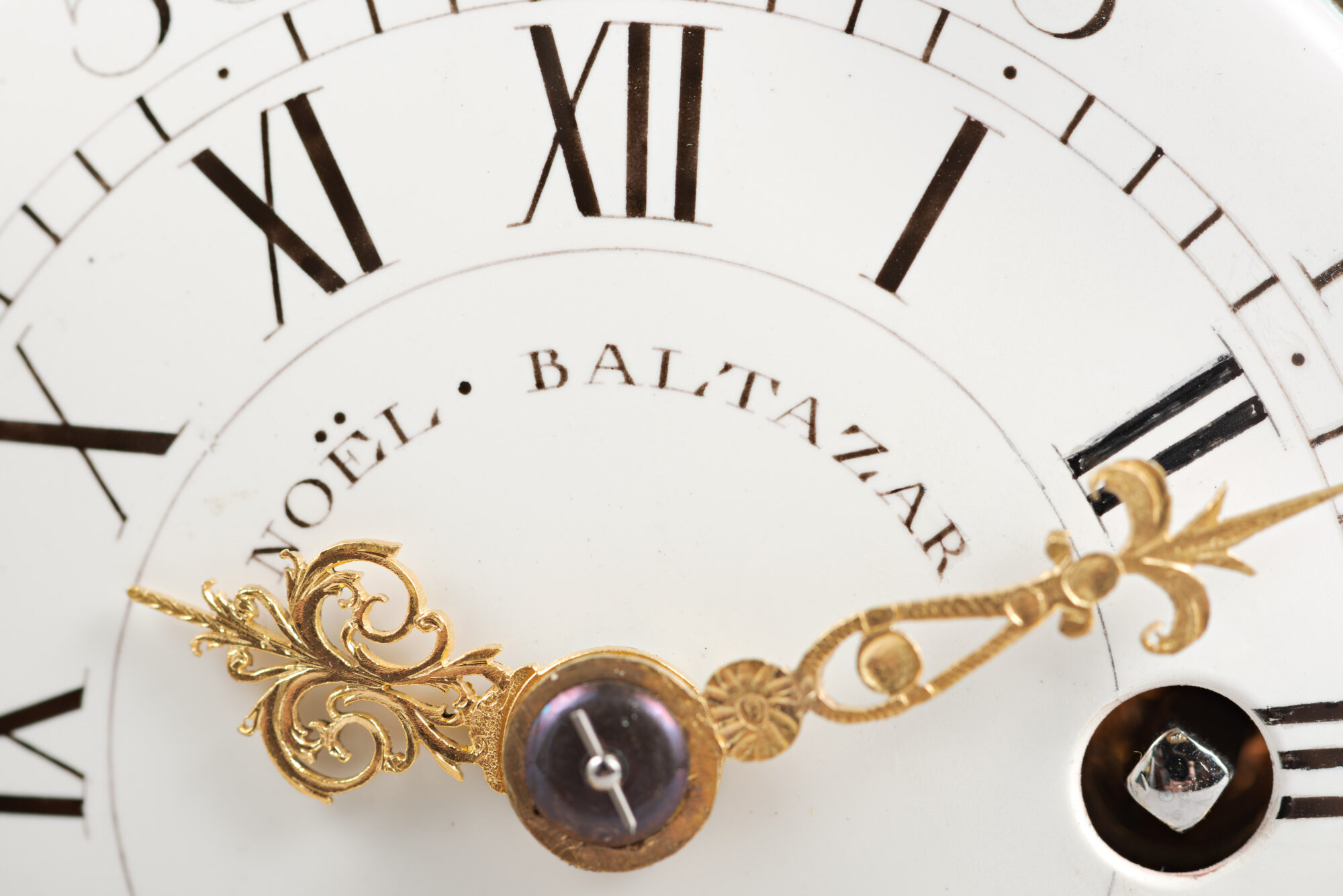
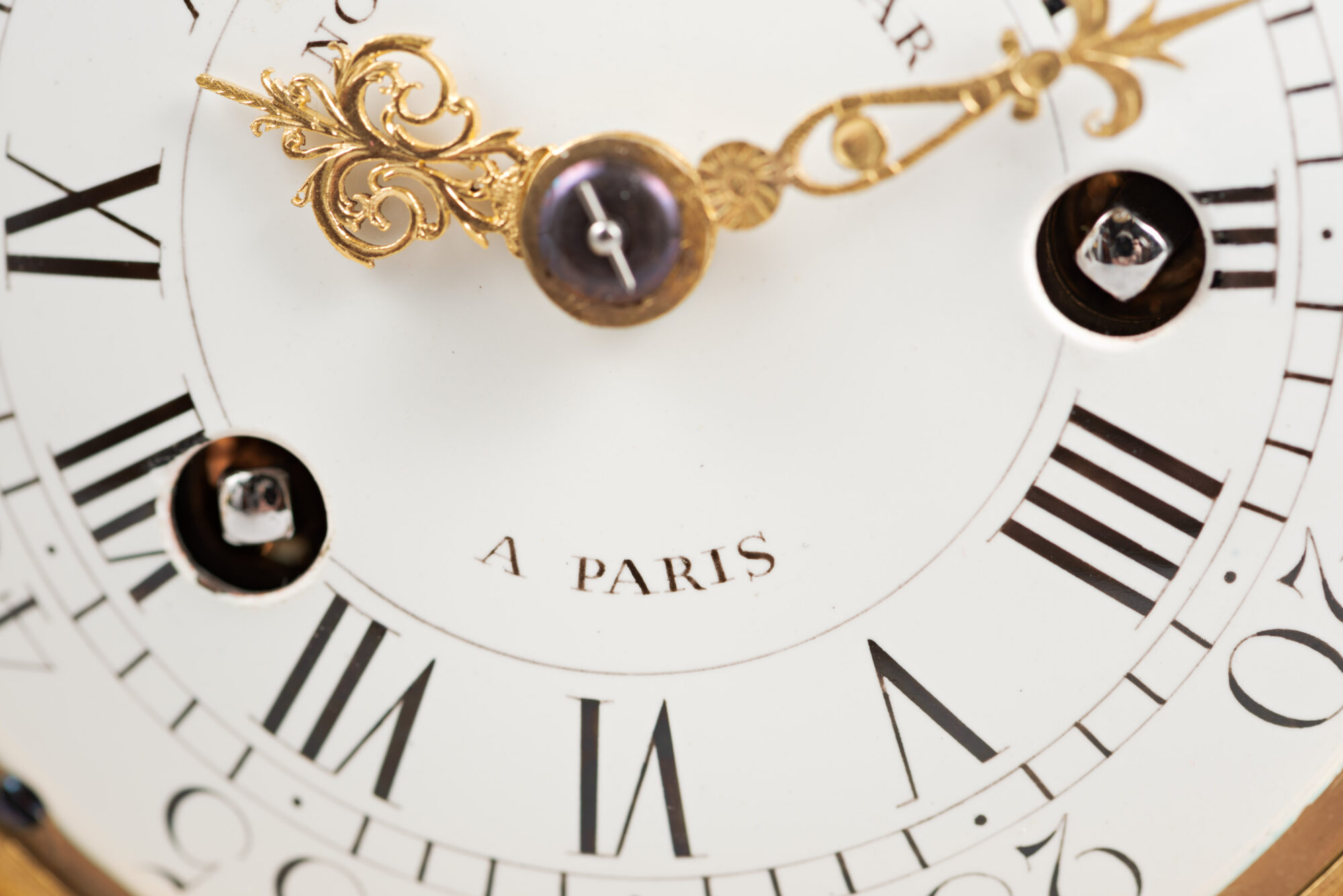
The circular white enamel dial, signed “Noël Balthazar à Paris“, indicates the Roman numeral hours and Arabic numeral five-minute intervals by means of two pierced, chased and gilt bronze hands. The hour and half-hour striking movement, whose plate is also signed Noël Balthazar à Paris“, is housed in a neoclassical case made of finely chased, red brown patinated, and gilt bronze with matte and burnished finishing. The clock is surmounted by a couple of doves on clouds that are supported by an entablature adorned with a frieze of oves. The bezel is adorned with an interlace frieze centered by flowers. The rectangular case is decorated with matted reserves, ribbon-tied laurel branches and spiral rosettes. The dial is flanked by two allegorical figures representing Mars – the god of War – in the form of a seated child wearing a helmet, who holds a spear and a shield; and Cupid – the god of Love – depicted by a winged child who holds an arrow and a bow. The quadrangular base is adorned with a waterleaf frieze, and features reserves with matte-finished frames that surround, on the façade, an allegorical trophy of Love. The base stands on four lion’s paw feet decorated with leafy volutes and draperies, with lion’s skins suspended from rings.
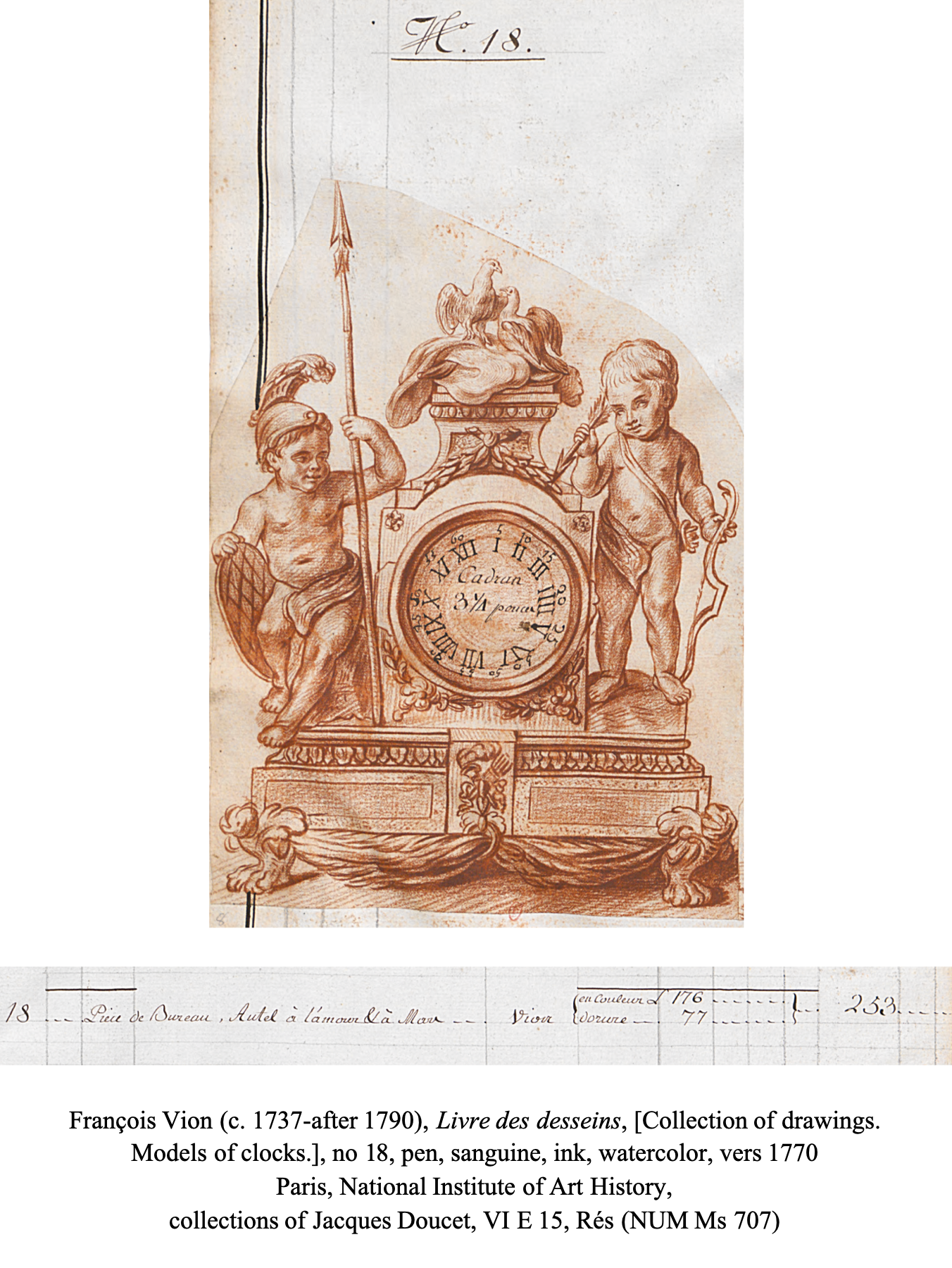
The composition of the present rare mantel clock was drawn from a sketch, either preparatory or commercial, that is reproduced as plate 18 in an album of horological pieces now in the Institut National d’Histoire de l’Art in Paris (Inv. MS 707), formerly the Bibliothèque Jacques Doucet (illustrated in H. Ottomeyer and P. Pröschel, Vergoldete Bronzen, Die Bronzearbeiten des Spätbarock und Klassizismus, Band I, Munich, 1986, p. 180, fig. 3.7.8).
The album offers precious information concerning the model’s conception, mentioning measurements, the theme, and the name of the bronze caster. The latter was François Vion, one of the most talented Parisian artisans of the late Louis XV period.
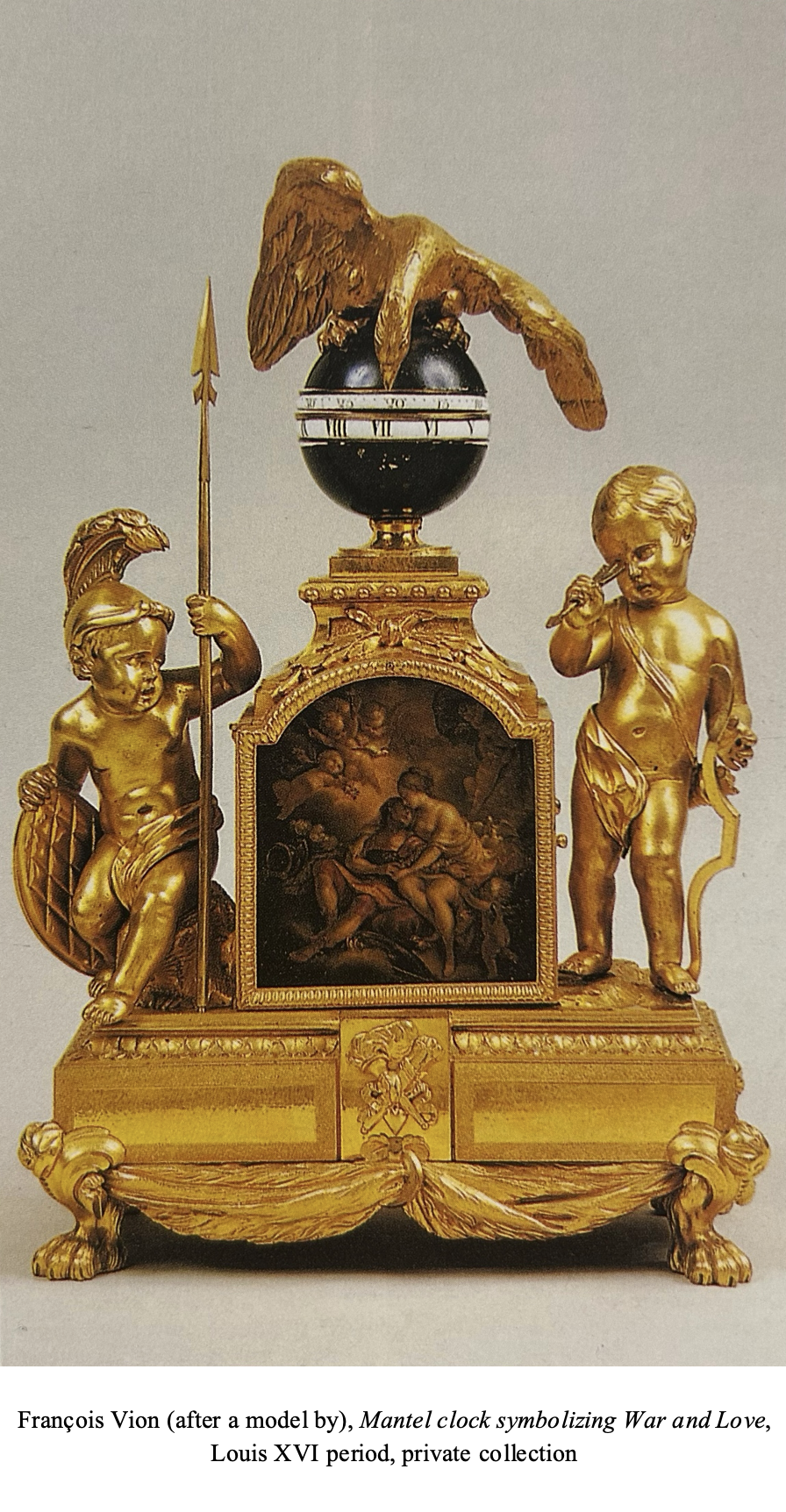
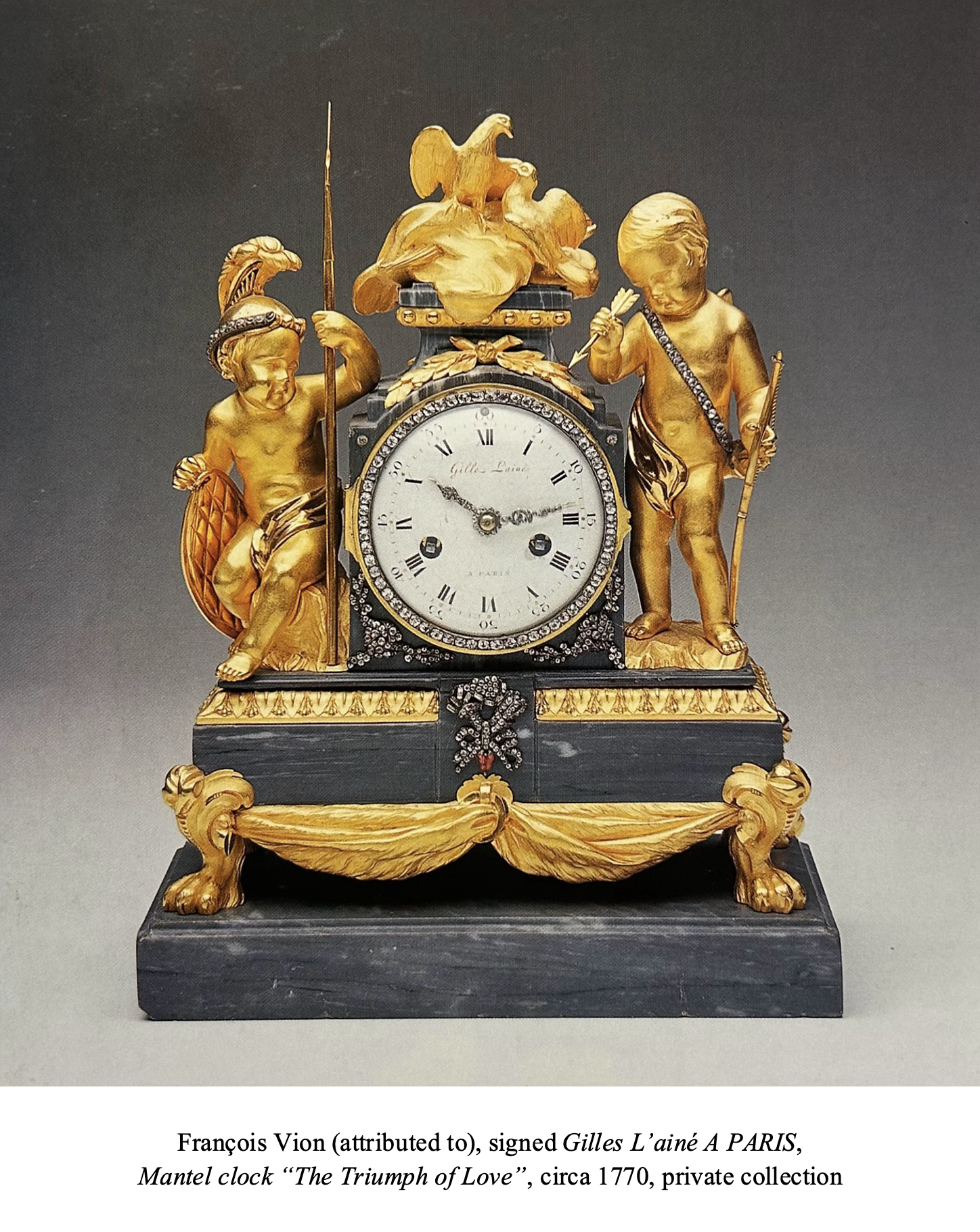
Today, among the small number of known identical clocks (which may feature variations in their decoration or ornamentation) one example, in gilt bronze and blue turquin marble, is illustrated in E. Niehüser, Die französische Bronzeuhr, Eine Typologie der figürlichen Darstellungen, Munich, 1997, p. 114, fig.180.
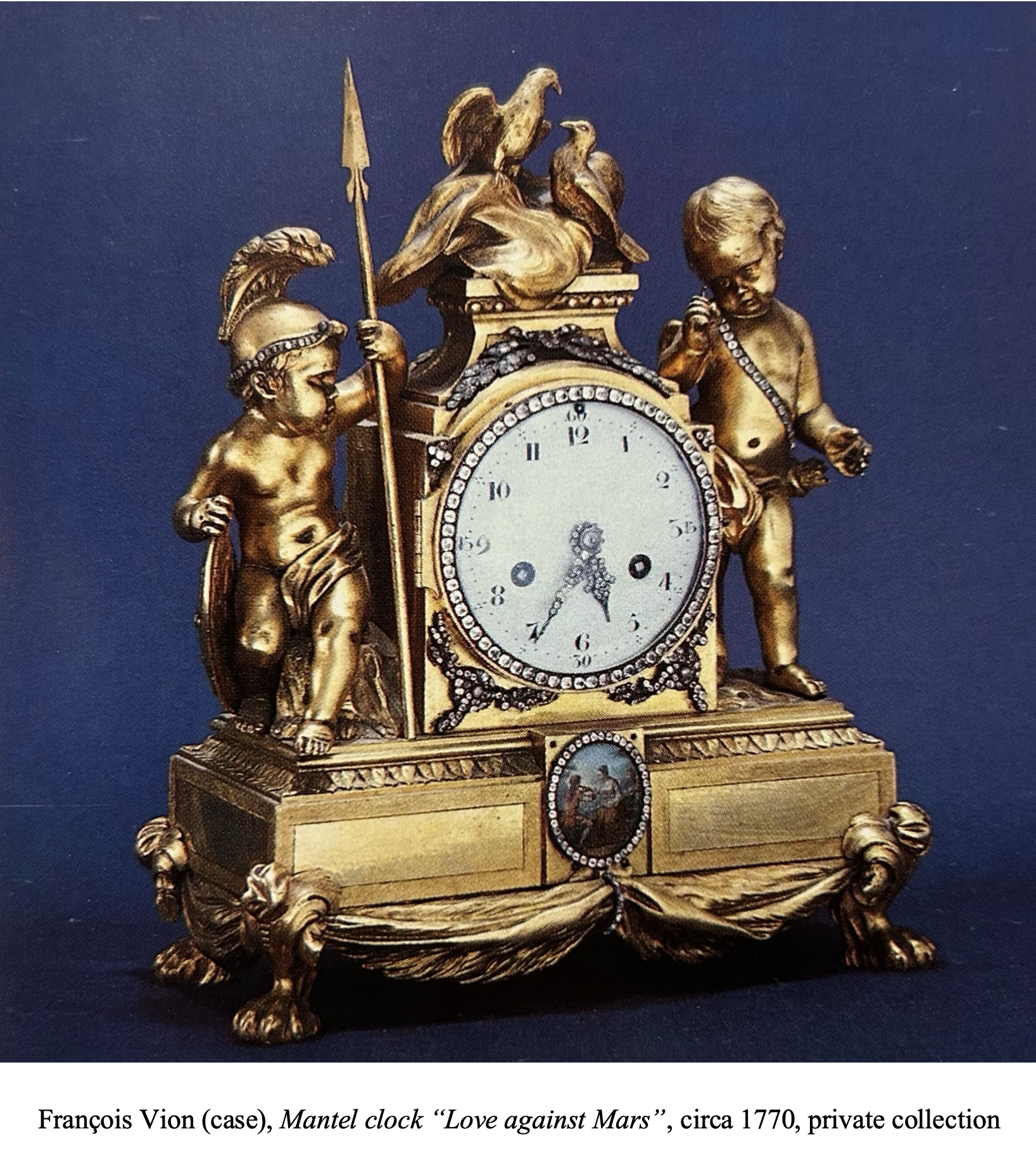
A second clock, adorned with a miniature on copper and surmounted by an enamelled globe, with cadrans tournants, is illustrated in P. Kjellberg, Encyclopédie de la pendule française du Moyen Age au XXe siècle, Les éditions de l’Amateur, Paris, 1997, p. 291.
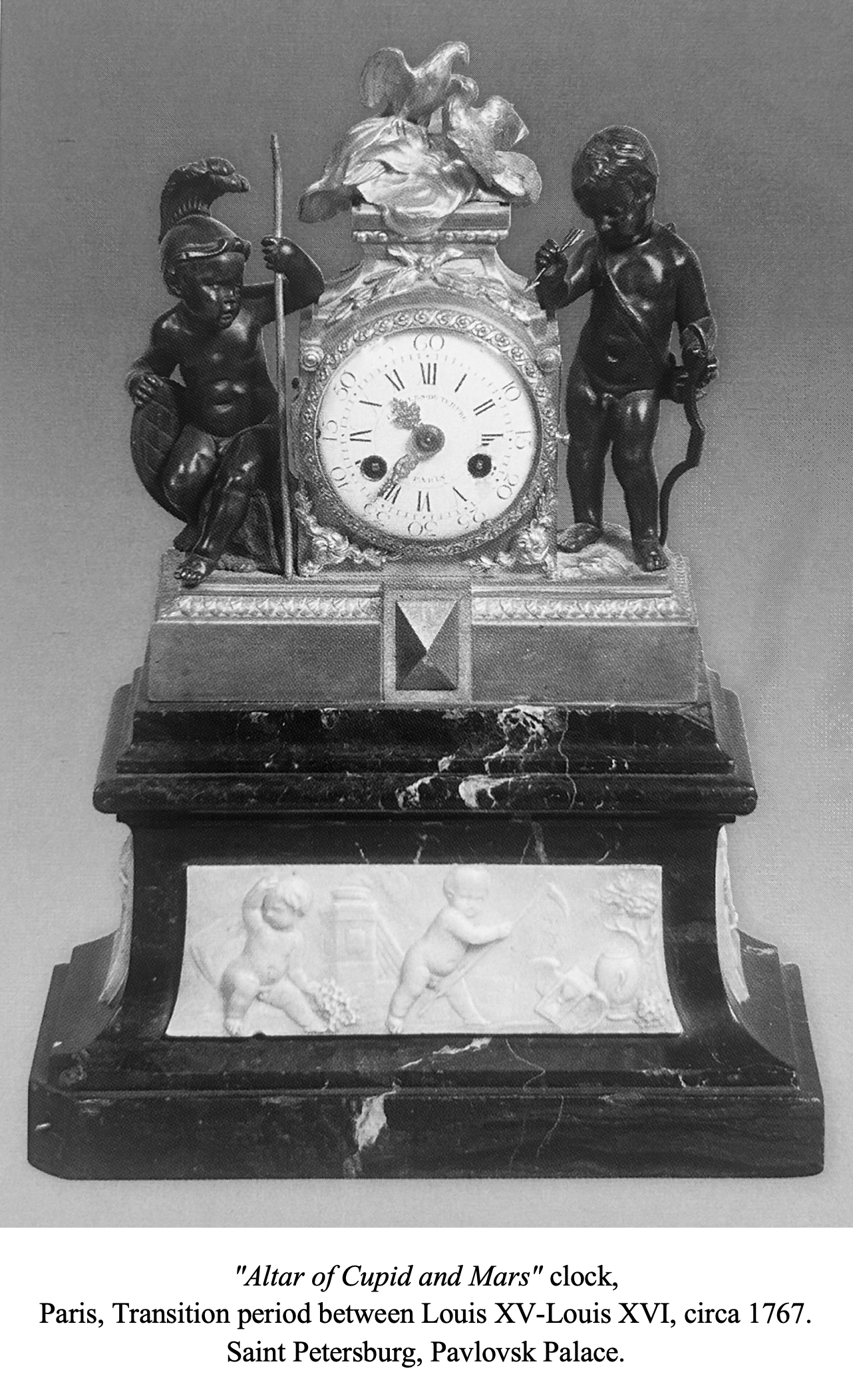
One further clock of this type, dated 1767, is in the Pavlovsk Palace in Saint Petersburg (see Palais de Pavlovsk, Catalogue complet des collections, Volume X, Métal Bronze, Tome I, Saint Petersburg, GMZ “Pavlovsk”, 2011, p. 15, catalogue n° 2).
One of the most important Parisian bronze casters of the second half of the 18th century. Having become a master bronze caster in 1764, he was a rival of the Osmonds and Jean-Joseph de Saint-Germain. He specialized in creating clock cases, several of which bear his signature, particularly those known as “Venus and Love” and “Love and the Three Graces”.
Noël Balthazar was one of the most important Parisian clockmakers of the Louis XV and Louis XVI periods. The son of a clockmaker, whose brothers also became horologists, he became a master in March 1717, immediately gaining recognition. At the end of the 18th century, some of his creations were mentioned as belonging to important connoisseurs of the time, including Louis-René de Bussy-Lameth, Claude Berthault de Chantereine, the king’s secretary and son the Farmer General Nicolas Dedelay de la Garde, as well as the widow of Philippe-Antoine-Gabriel-Victor de la Tour du Pin-Gouvernet, Marquess of la Charce.