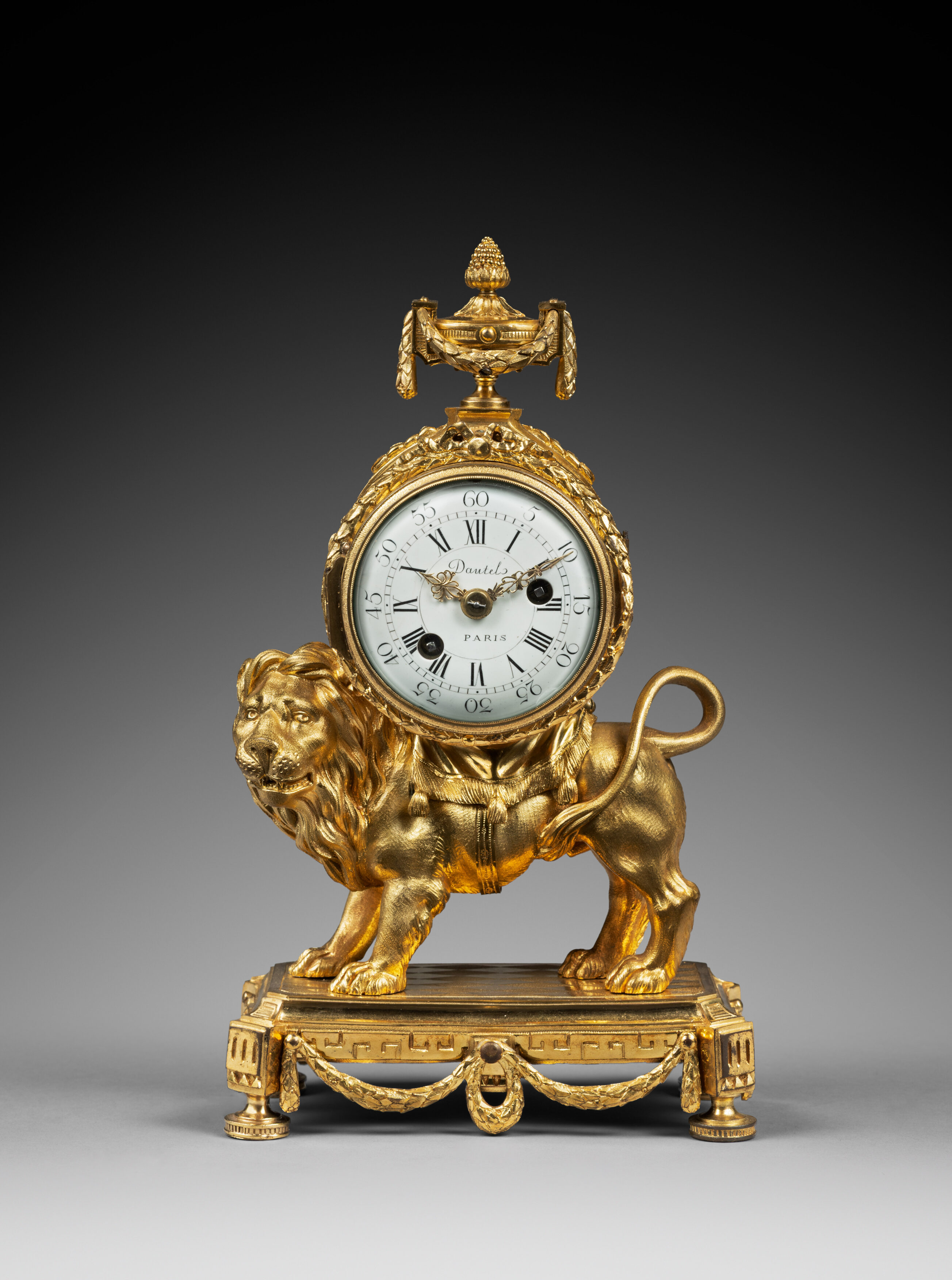
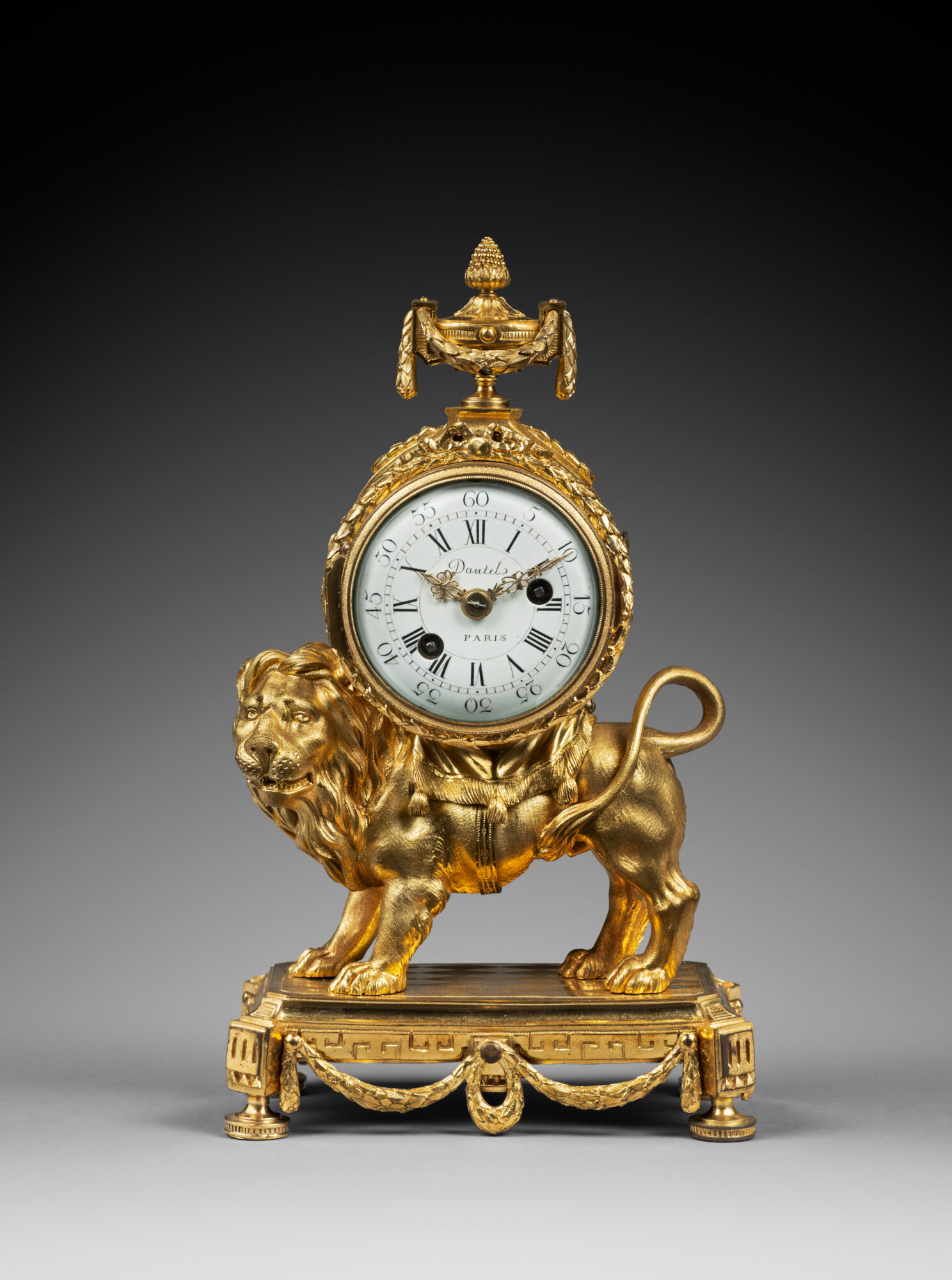
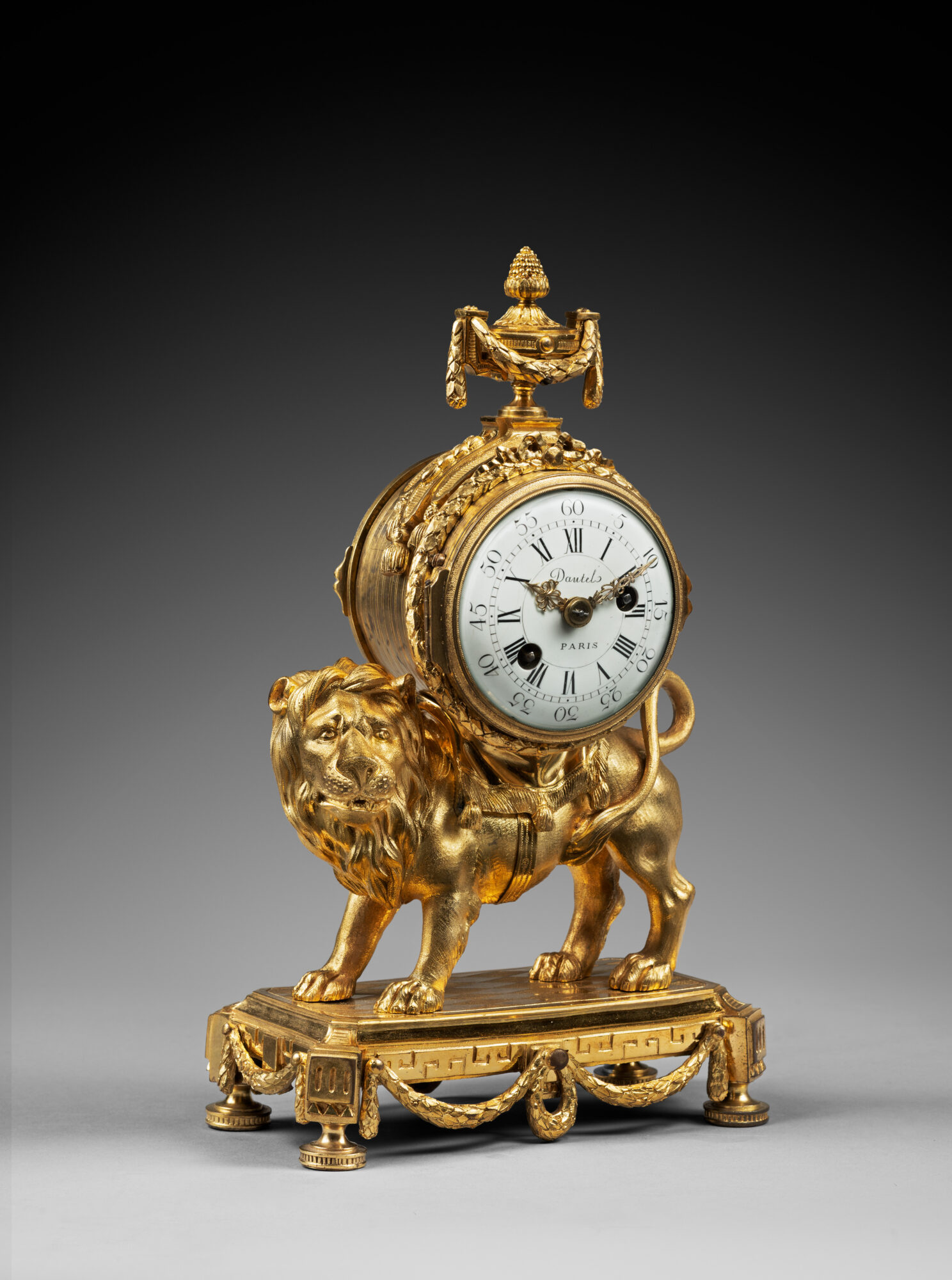
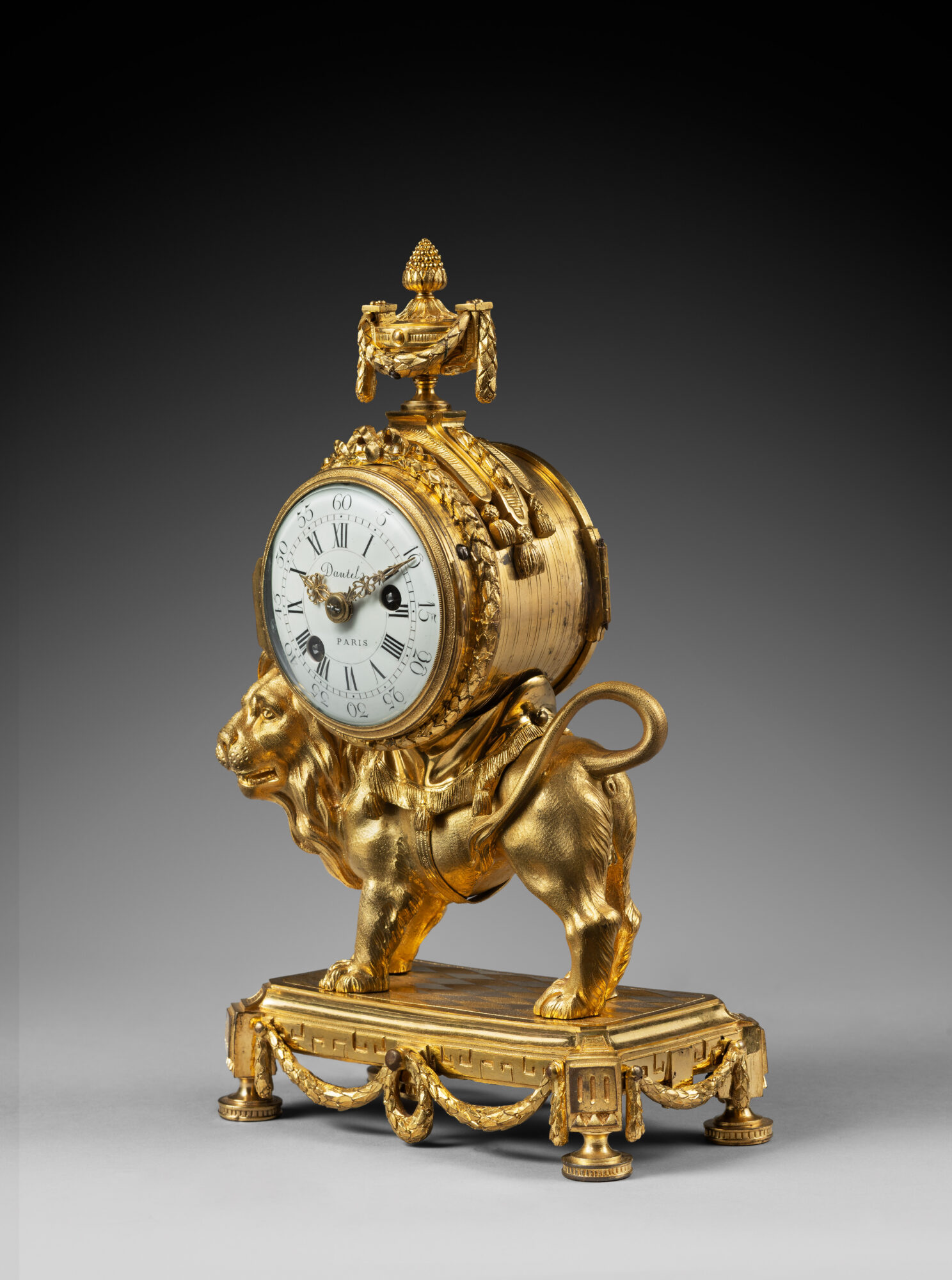
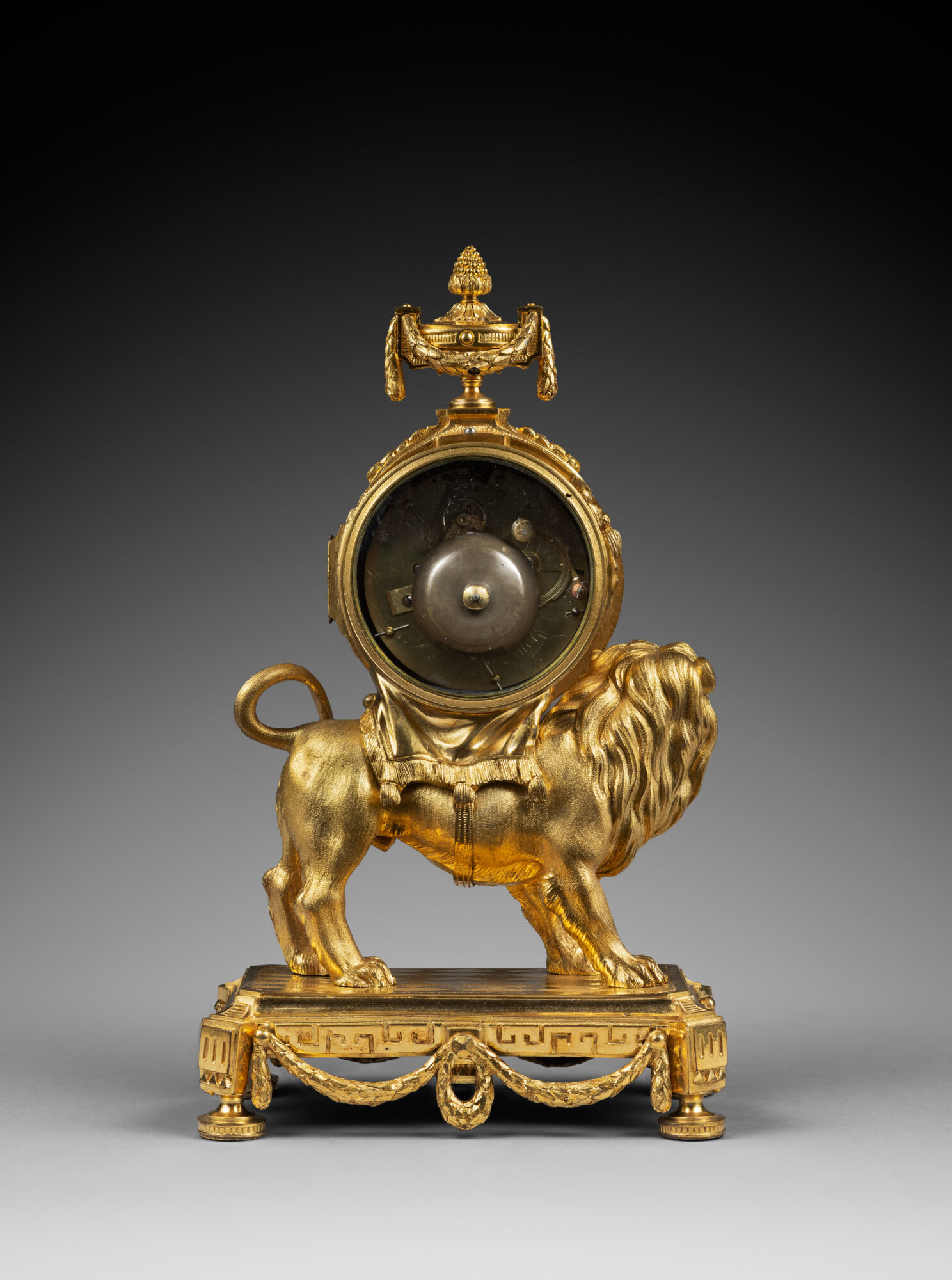
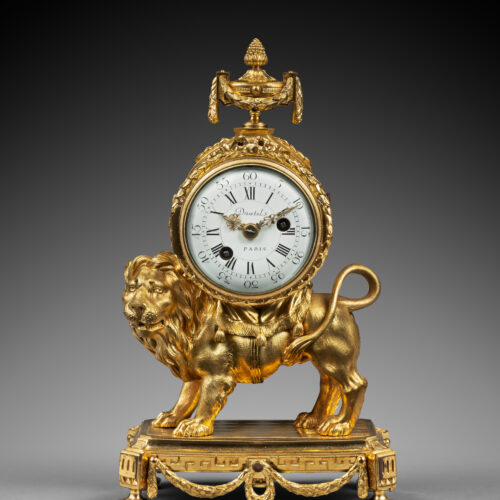
PROVENANCE: Probably previously in the collection of Louis-Hector-Cyr, Marquis de Sailly (1721-1779), valued at 110 livres in his posthumous inventory, which described it as being in the bedroom of his wife, née Letellier de Souvré: “A mantel clocksigned by Dautel in Paris, supported by a lion on a gilt copper base”.
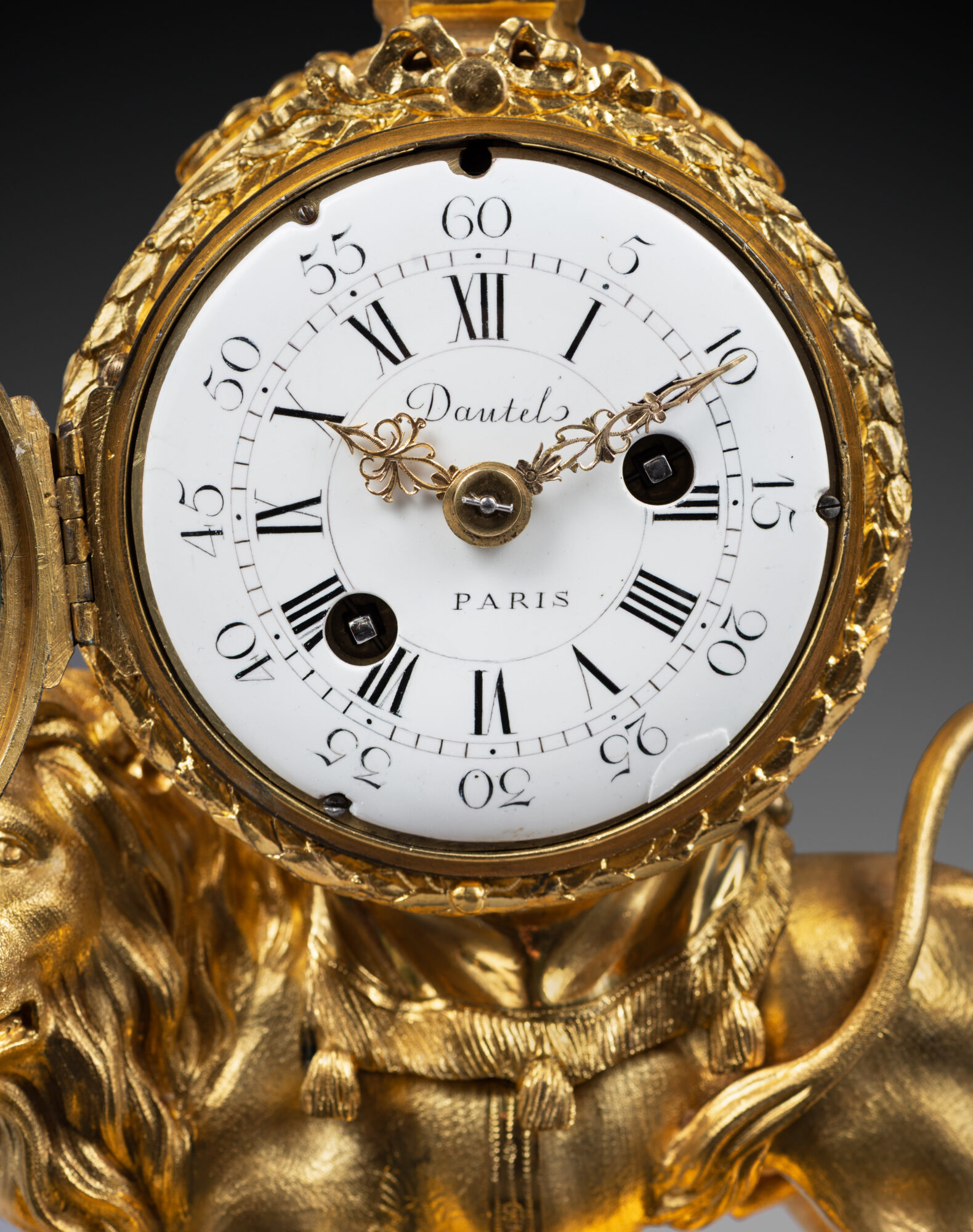
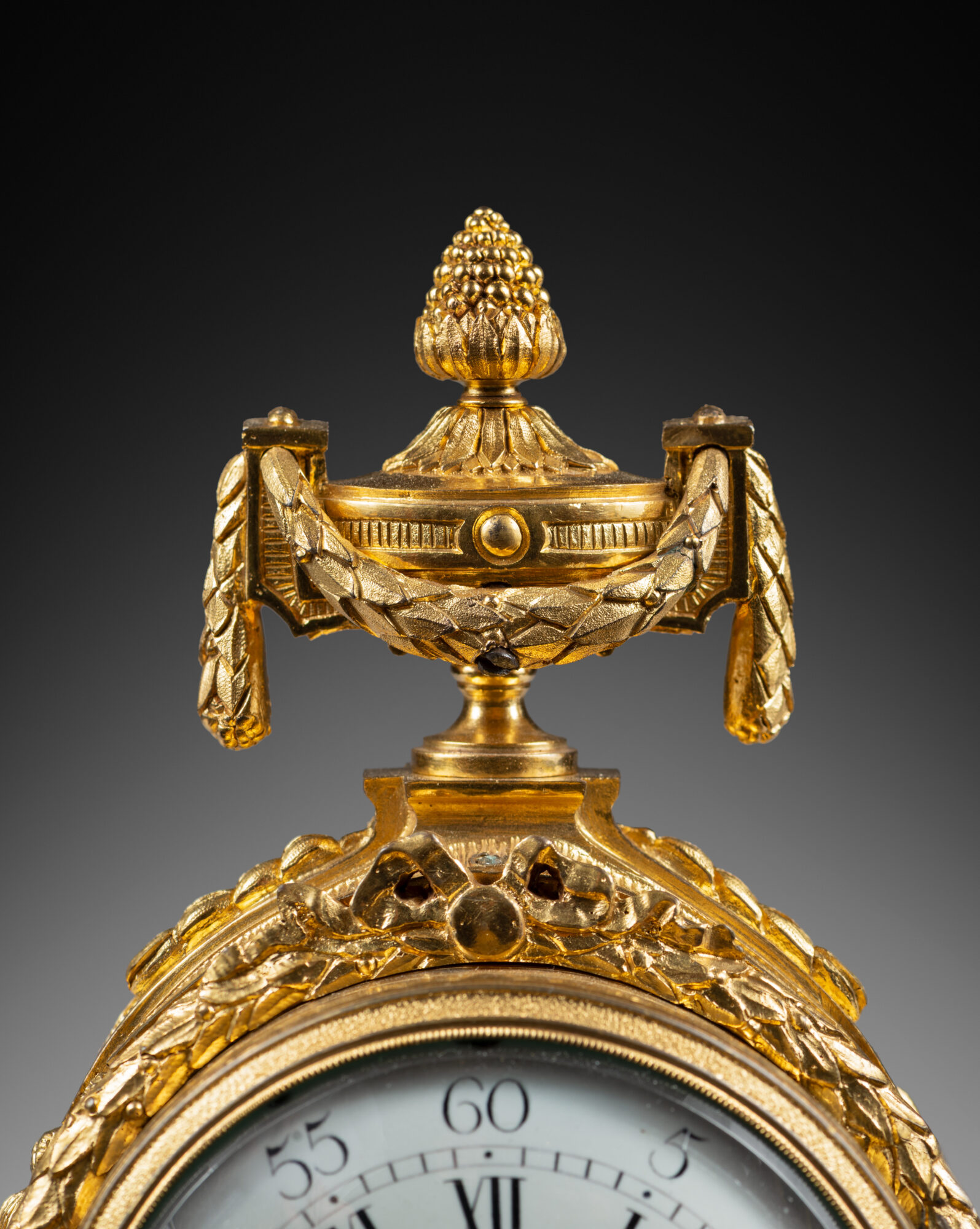
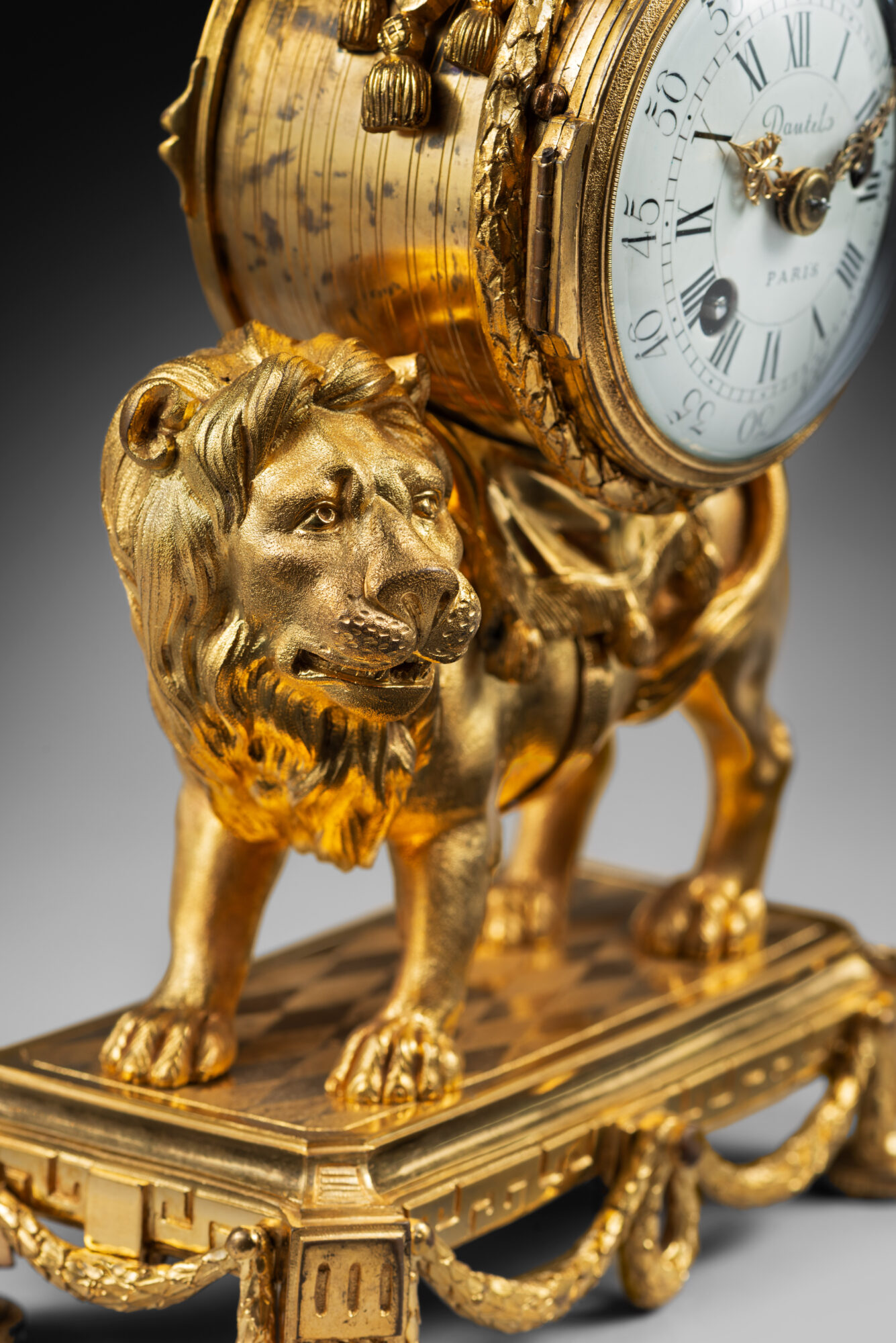
The white enamel dial, signed “Dautel à Paris”, indicates the Roman numeral hours and the Arabic numeral five-minute intervals by means of two pierced gilt bronze hands. The hour and half-hour striking movement is housed in a case made of finely chased gilt bronze with matte finishing. The clock is surmounted by a classical urn with Greek handles through which are threaded a laurel leaf; the urn has a seed finial that emerges from a leafy bouquet. The drum case, adorned with a bow and a laurel leaf garland, is supported on the back of a magnificent lion standing in a peaceful pose, with a curving tail and a finely chased mane. Looking toward the viewer, it stands on a lozenge-decorated terrace that forms the top of the architectural base. The quadrangular base, whose canted corners are adorned with triple fluting and triglyphs, features plain convex molding, Greek key friezes, and a garland of laurel leaves suspended from a roundel. The clock is raised upon four feet with mille-raie decorated bands.
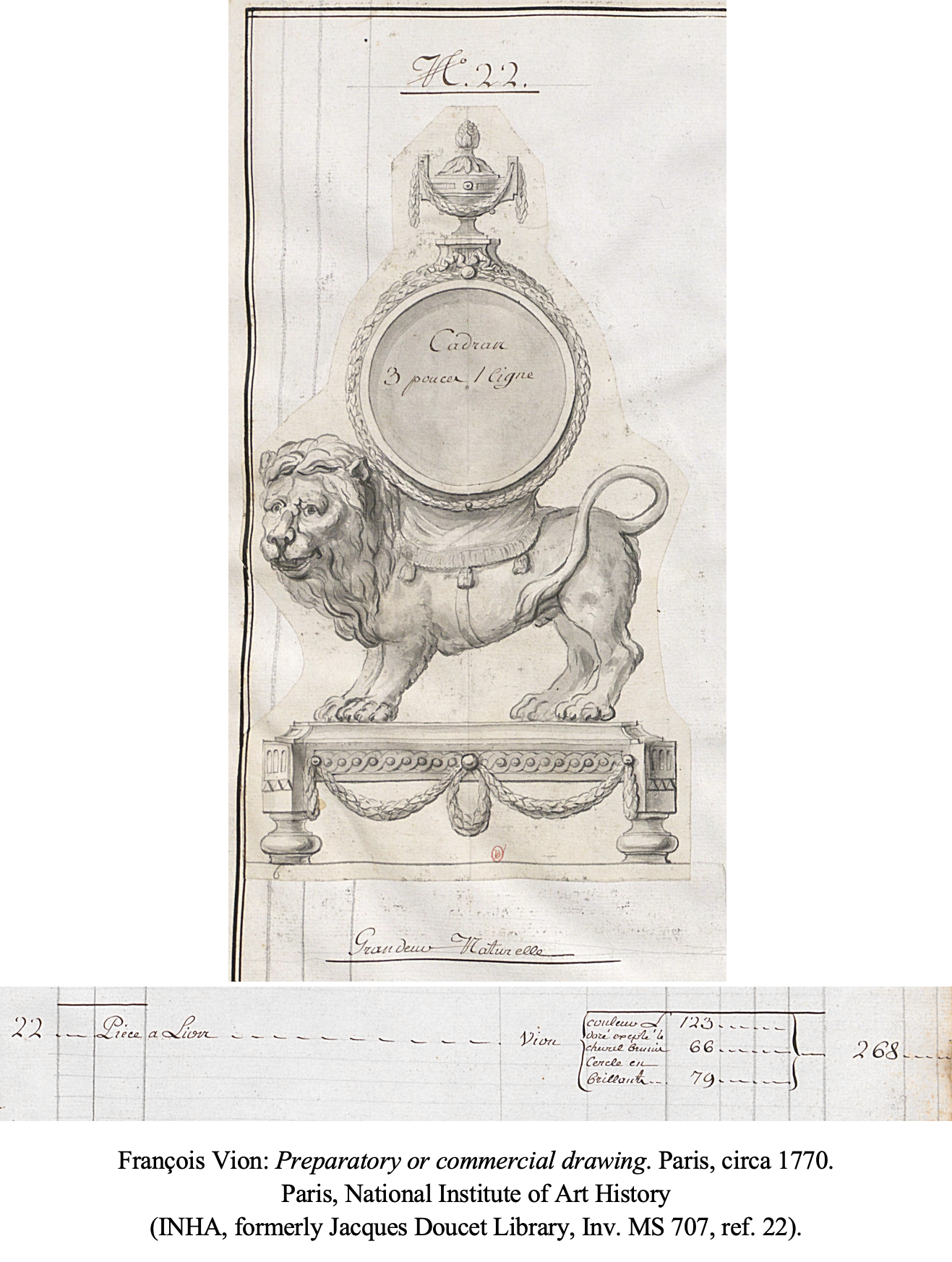
Clocks featuring movements supported by the figures of animals first appeared during the reign of Louis XV and became extremely popular during the second half of the 18th century. At that time the decorative arts in France – and especially in Paris – were changing completely, due to the advent of the neoclassical movement. The present clock stands out due to its unusual design and the quality of its chasing and gilding. A preparatory drawing that was done prior to its production is today in the Institut national d’Histoire de l’Art à Paris (drawing number 22 in the album of bronze caster François Vion). The existence of this drawing allows us to confidently attribute the model to Parisian bronze caster Vion (see H. Ottomeyer and P. Pröschel, Vergoldete Bronzen, Die Bronzearbeiten des Spätbarock und Klassizismus, Munich, 1986, Band I, p. 193, fig. 3.11.6).
By the 18th century, a small number of examples of this model, sometimes further adorned with marcasites, were mentioned as belonging to important Parisian collectors of the time. One such example is as follows: “…a clock with enamel dial that strikes and marks the hours and minutes, in its colored gilt copper case adorned with marcasites, mounted on the back of a lion on a base or gilt and silvered copper…” that was described in the late 18th century as belonging to a member of the Giambone family. Another example is a “clock made by Gille, in Paris; the case in the form of a drum, carried by a lion: the whole in finely gilt bronze; the bezel surrounding the glass garnished with stones of marcasite, with a small vase at the summit. The 8-day going movement features striking”. That clock was offered at the sale of the property of Duke Charles de Lorraine in May 1781. Lastly, in the late 19th century a “Small clock from the Louis XVI period, in gilt bronze and green patinated bronze, with a movement visible through the glass dial, bearing the name of Lepaute, in Paris. The dial, whose hands and bezel are decorated with marcasites, is set in a drum case surmounted by an urn and supported on the back of a green bronze lion that is looking toward the left. The lion is raised on a rectangular bronze base with projecting corners that are adorned with triglyphs. The base is decorated with Greek keys and laurel garlands in green patinated bronze vert. Height 31cm; width 18cm” was described as being in the collection of the Count d’Armaillé.
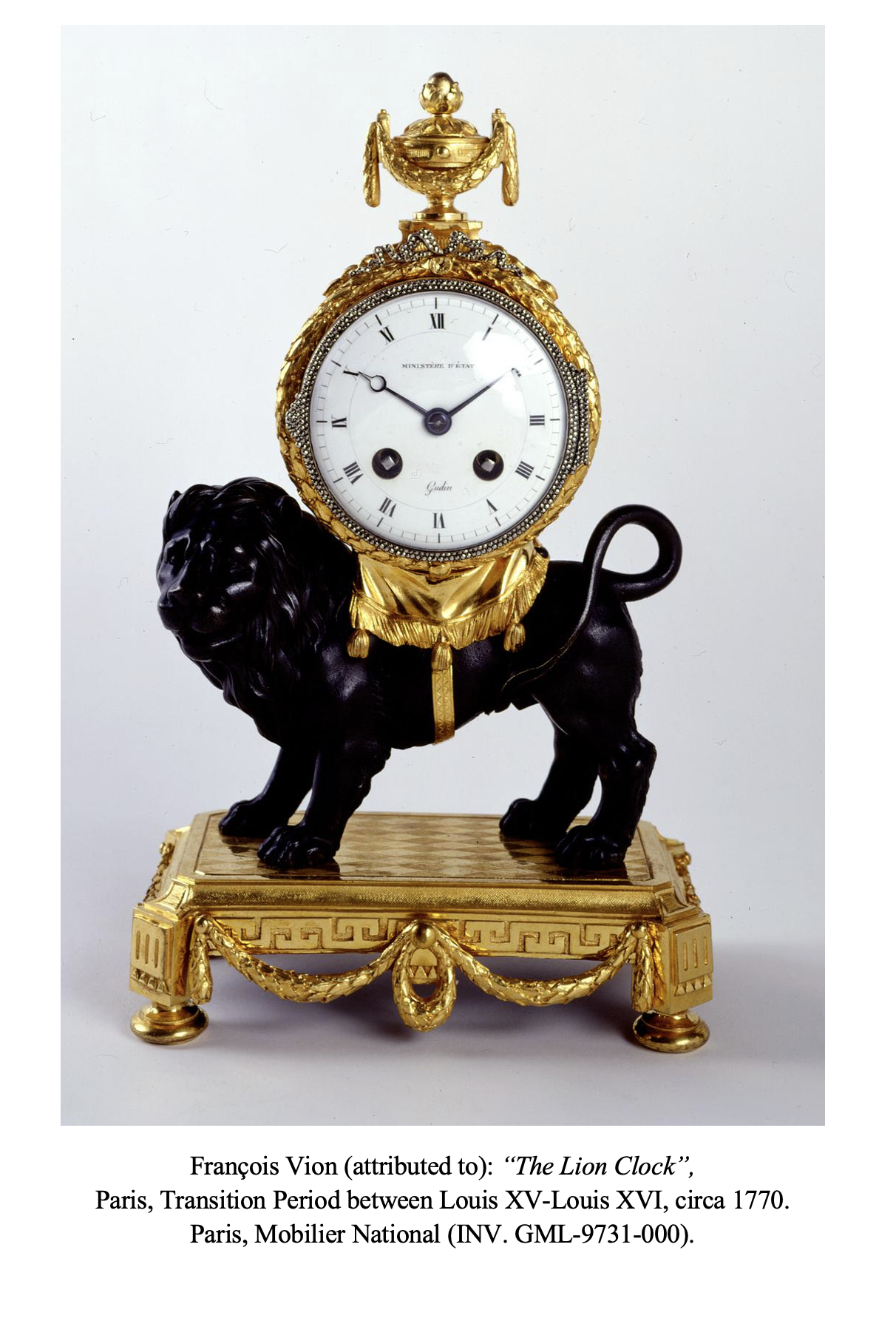
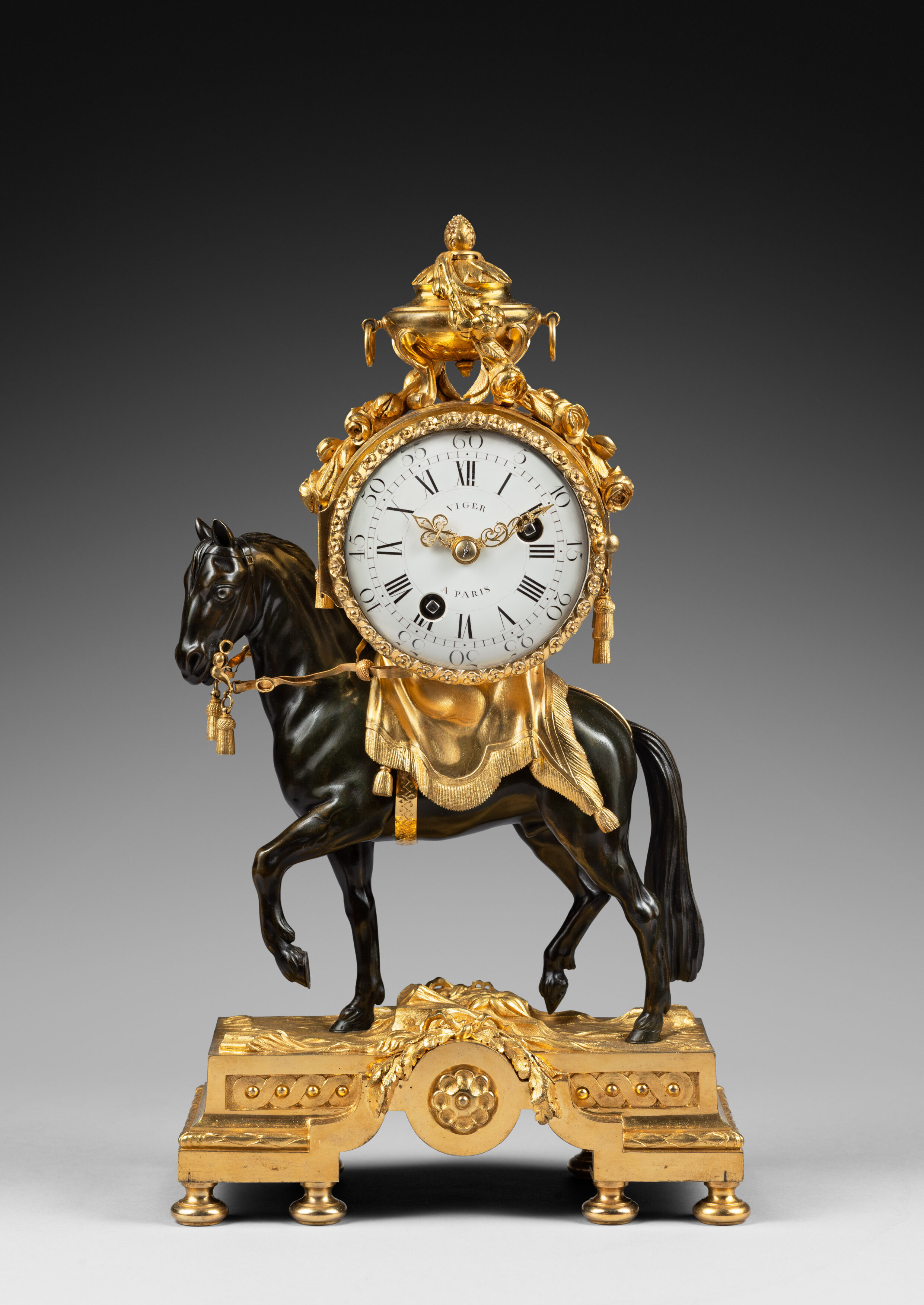
Today, only a very small number of identical clocks are known; some feature small variations in their decoration. They include three examples made of gilt bronze or gilt and patinated bronze. One, which was probably formerly in the collection of the Prince de Condé in the 18th century, is now in the Mobilier National (see Fastes du pouvoir: objets d’exception XVIIIe-XIXe siècles, RMN, Paris, 2007, p. 18-19, catalogue n° 5). A second clock is illustrated in G. and A. Wannenes, Les plus belles pendules françaises de Louis XIV à l’Empire, Florence, éditions Polistampa, 2013, p. 295. A third example is pictured in H. Ottomeyer and P. Pröschel, op.cit., p. 193, fig. 3.11.4. One further example of this model, made of gilt and silvered bronze, is in the Pavlovsk Palace near Saint Petersburg (see Palais de Pavlovsk, Catalogue complet des collections, Volume X, Métal Bronze, Tome I, Saint Petersburg, GMZ “Pavlovsk”, 2011, p. 14, catalogue n° 1).
Claude-Amé-François Dautel, whose signature was “Dautel à Paris”, was a Parisian clockmaker who died on September 26th, 1793. His wife, née Dodonney, had passed away several days before. Active as of the latter part of the reign of Louis XV, he gained a certain amount of fame among knowledgeable Parisian collectors of luxury horology. In the early 1790s, he appears to have entrusted the running of his workshop to his son Claude-André-François, who carried on in his father’s footsteps. During the 18th century, certain of his clocks were recorded as having belonged to important collectors of the time. One example was a clock mentioned in the posthumous inventory of Cardinal Charles-Antoine de la Roche-Aymon in November 1777. One of his clocks is currently in the Louvre collections (Inv. OA 5131.), a Louis XV period cartel clock stamped by cabinetmaker Jean Goyer (1731) and with a dial signed “Dautel à Paris.”
One of the most important Parisian bronze casters of the second half of the 18th century. Having become a master bronze caster in 1764, he was a rival of the Osmonds and Jean-Joseph de Saint-Germain. He specialized in creating clock cases, several of which bear his signature, particularly those known as “Venus and Love” and “Love and the Three Graces”.