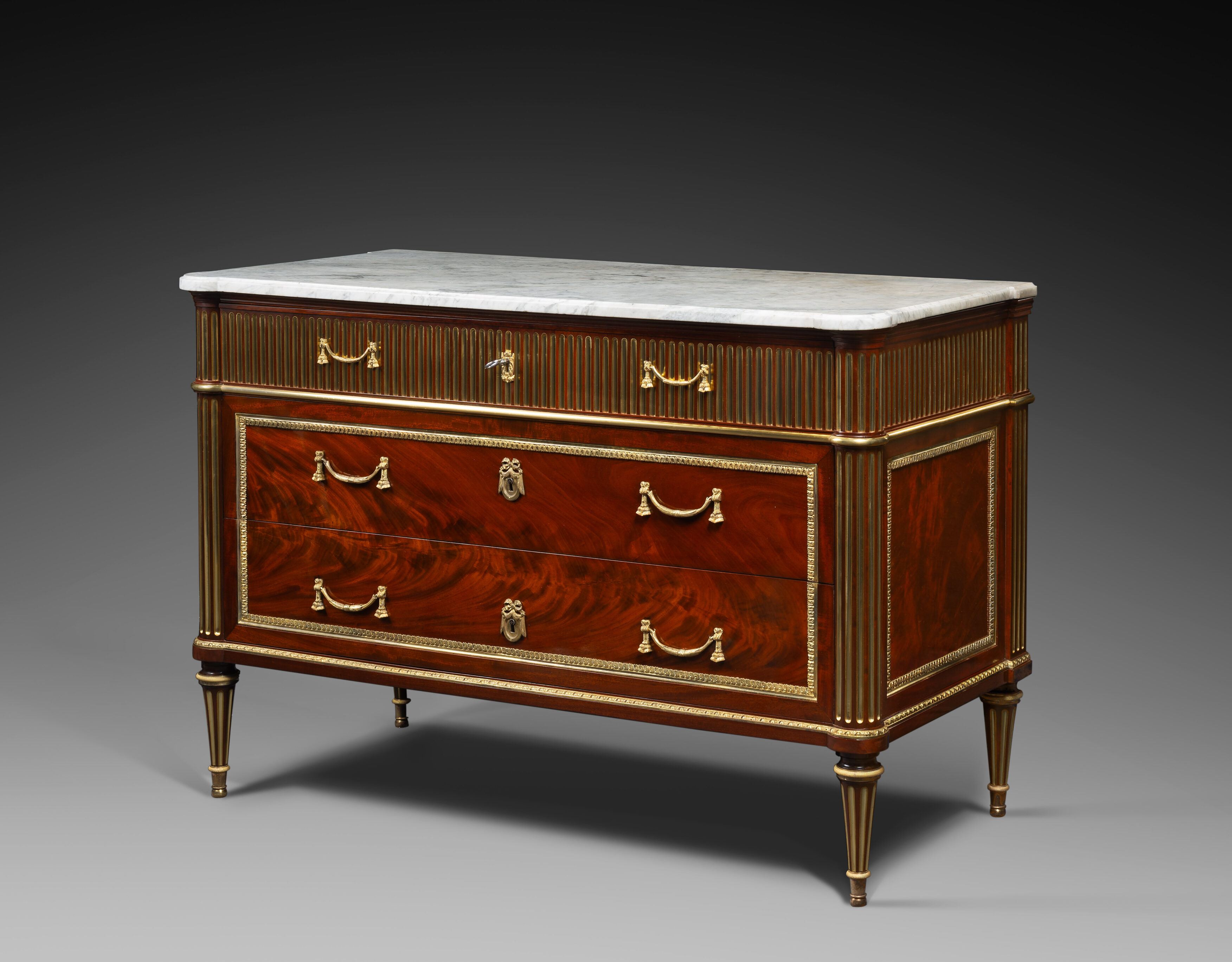
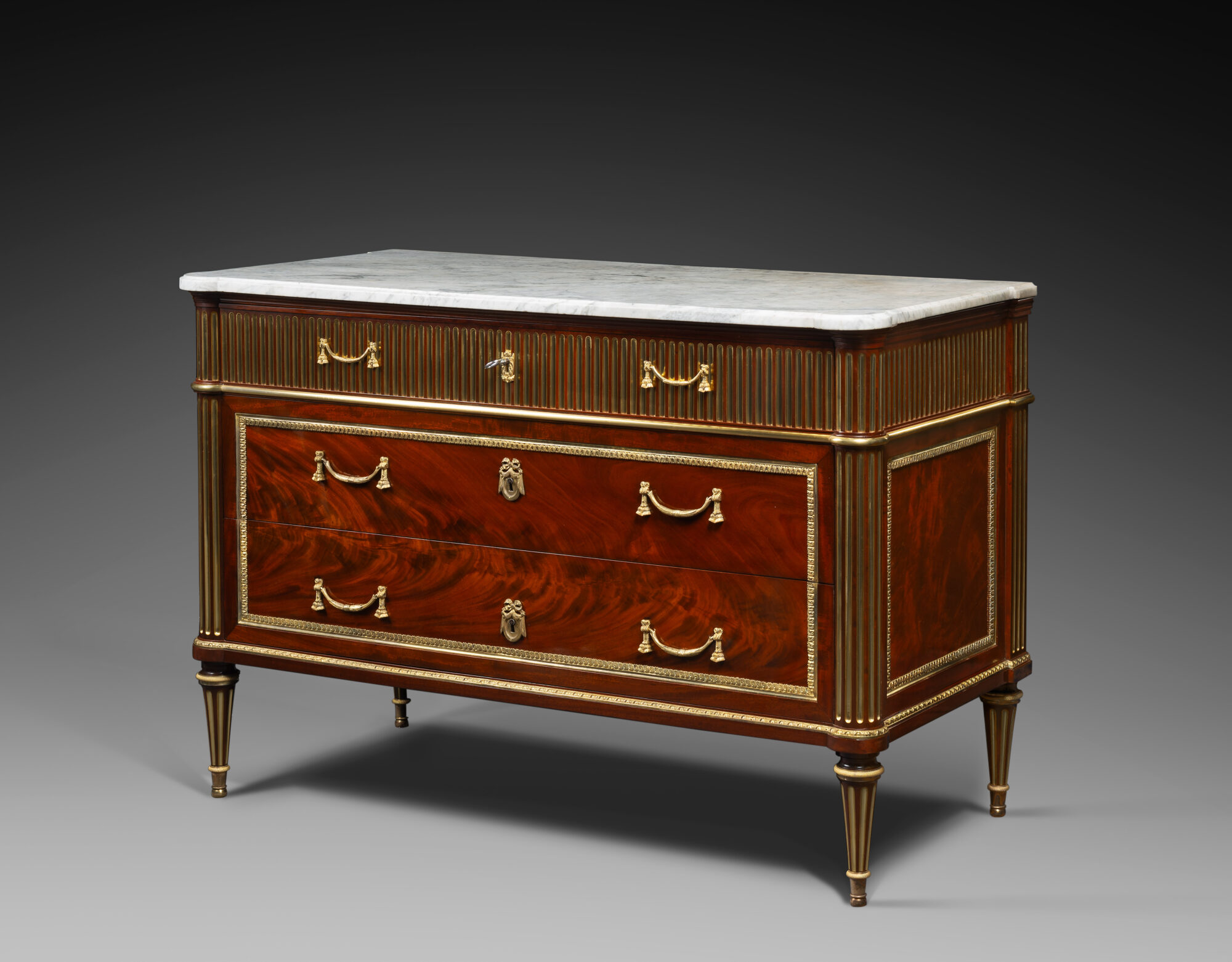
Important Mahogany and Flame-Grained Mahogany-Veneered Commode, with Finely Chased Gilt Brass and Bronze Mounts and Gray-Grained White Carrara Marble Top
SIGNATURE : Stamp “ J. Pafrat ” on the wood under the marble top
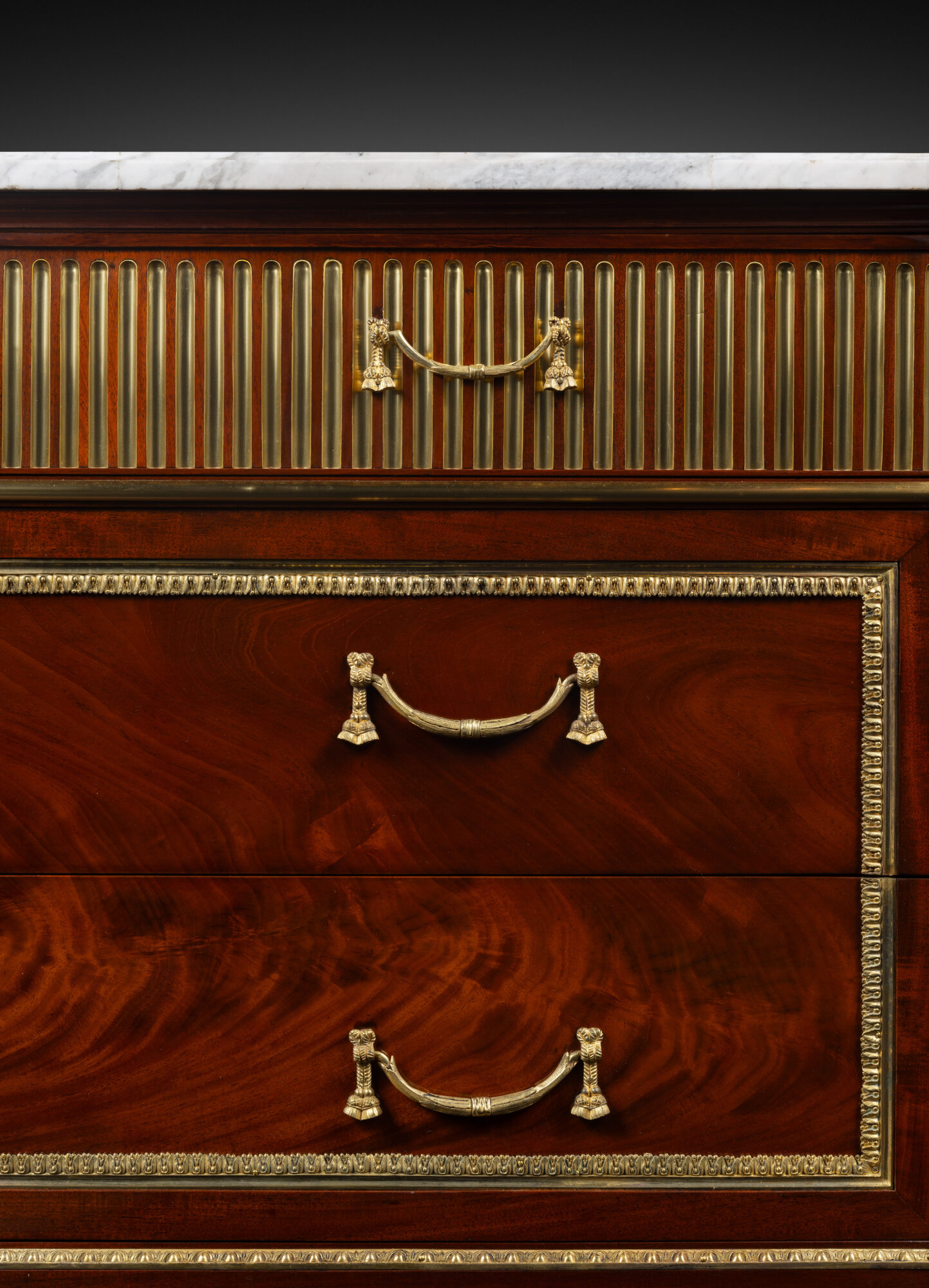
This commode, made of mahogany and flame-grained mahogany veneering, features three wide drawers, two of which have no visible crosspiece. It stands on tapering legs and is rectangular in shape, with rounded side posts, a tall upper tier and tapering legs, the whole presenting brass-inlaid fluting. It is adorned with finely chased and engine-turned gilt bronze mounts with escutcheons adorned with leaf or oval motifs, further embellished with ribbon-tied draperies, reed-adorned handles suspended between gilt bronze tassels, and framed by alternating waterleaf and stem friezes, as well as egg-and-dart friezes. The four legs are highlighted by knurled rings and molded lower feet. The molded top is of white Carrara marble with gray veins and is hiding the signature “ J. Pafrat ” stamped on the wood underneath.
The well-balanced design of this rare chest of drawers is notable for its sober use of perfectly placed bronze mounts. It is evident that the mahogany veneering, of the highest quality, was carefully chosen by Jean-Jacques Pafrat, the cabinetmaker who made this commode in the mid-1780s. That renowned cabinetmaker developed his own personal style, creating pieces of furniture characterized by clear and powerful lines and an extremely sober design. Most featured mahogany veneering.
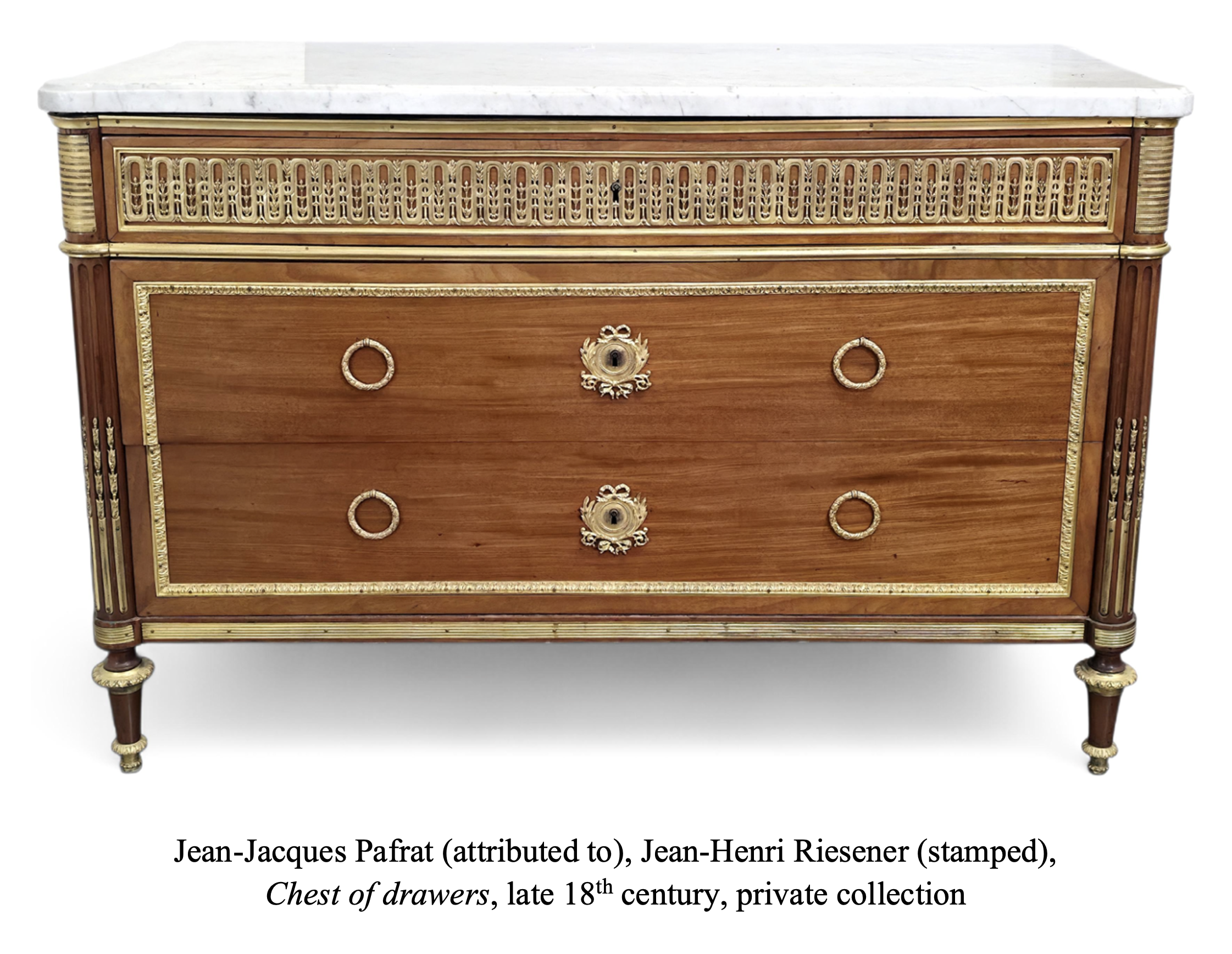
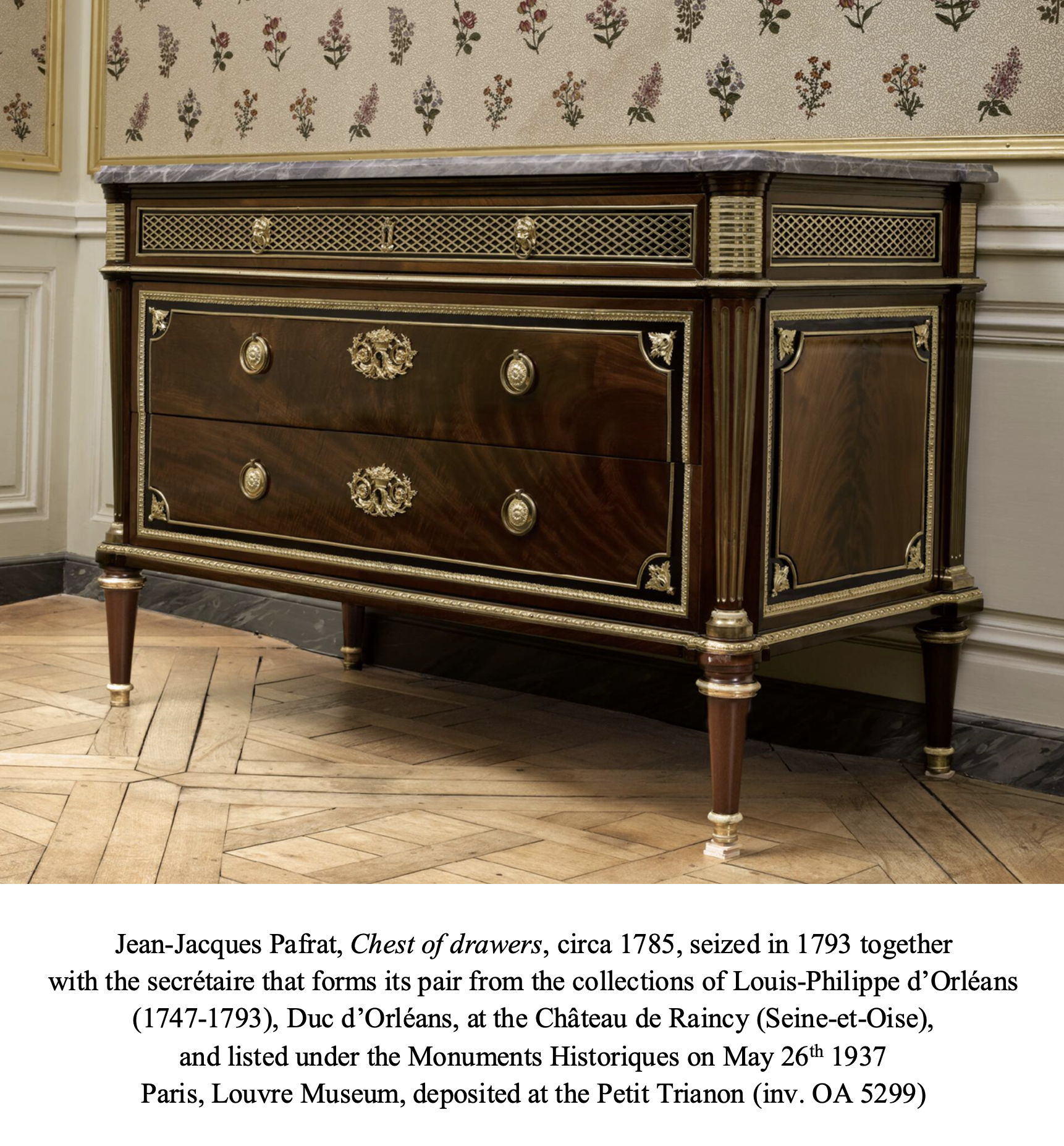
Among the comparable pieces of furniture made by Pafrat, one bureau plat with sober lines and featuring four drawers, is illustrated in Les ébénistes du XVIIIe siècle, Leurs œuvres et leurs marques by Count François de Salverte, Editions de F. de Nobele, Paris, 1985, plate LII). Also known are two commodes, one narrow and the other wider, whose upper drawers are adorned with openwork friezes (see J. Nicolay, L’art et la manière des maîtres ébénistes français au XVIIIe siècle, Editions Pygmalion, Paris, 1982, p. 351). One further set of furniture, made up of a mahogany commode and a secretary embellished with ebony bands, belonged to the Duke d’Orléans and was confiscated in 1793 in his Château du Raincy; today it is in the Musée National du Château de Versailles (illustrated in A. Pradère, French Furniture Makers, The Art of the Ebeniste from Louis XIV to the Revolution, 1989, p. 423, figs. 522-523).
Jean-Jacques Pafrat was one of the most important Parisian cabinetmakers of the latter part of the reign of Louis XVI. In September 1785, after becoming a master, he opened a workshop in the rue de Charonne. Pafrat’s career, which had a very promising beginning, was cut short by the French Revolution. This explains his limited output, despite the fact that his pieces are always of very high quality. His stamp may be found next to that of Martin Carlin on certain pieces of furniture, which has led some commentators to suggest the two cabinetmakers were in partnership. Nevertheless, the time frame does not support this hypothesis: Pafrat became a master the year that Carlin died. This makes it more likely that Pafrat may have finished certain pieces after the death of Carlin, probably after having purchased a portion of his stock.